

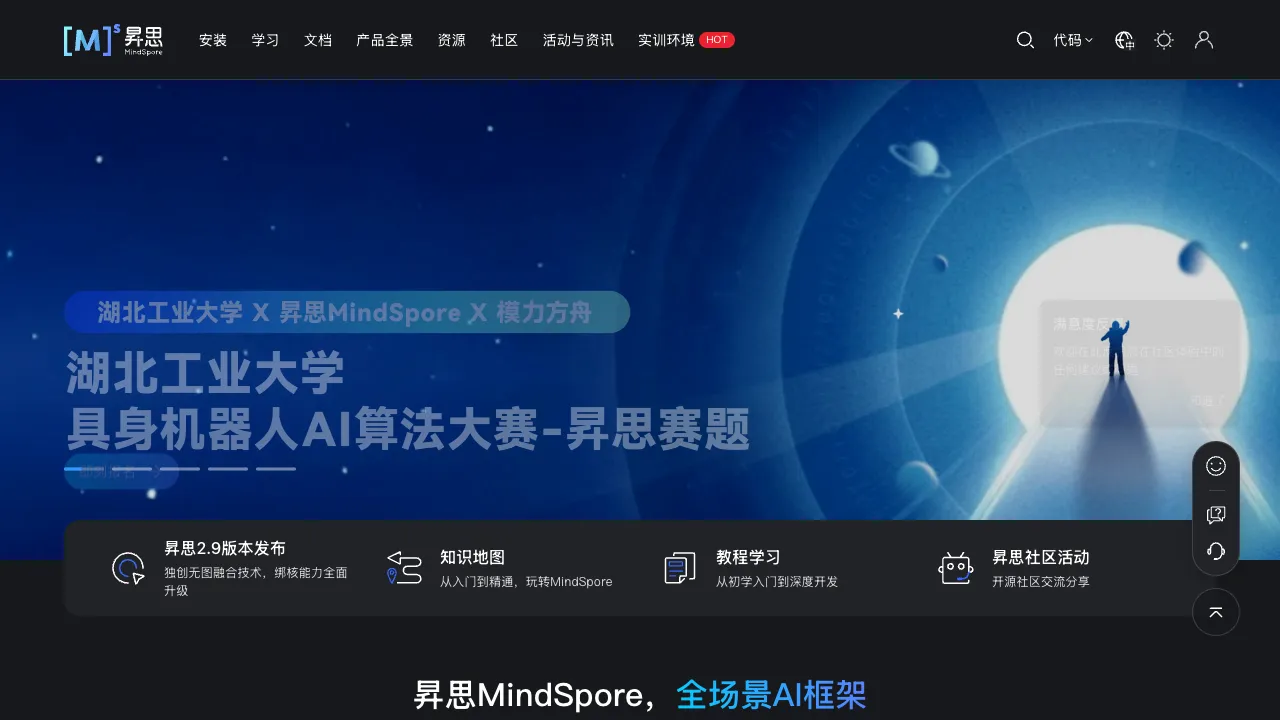
In the deep learning framework landscape, TensorFlow and PyTorch have nearly dominated the international ecosystem. However, as Sino-US tech competition intensifies and Huawei was placed on export control lists, developing an AI framework that does not rely on US technology stacks has become a strategic necessity. MindSpore is the deep learning framework launched by Huawei in this context, aiming to provide an end-to-end domestic AI technology stack spanning chips, frameworks, and applications.
What is MindSpore?
MindSpore (mindspore.cn) is a deep learning framework developed and open-sourced by Huawei, officially released in 2020. It serves as the core layer of Huawei’s AI technology stack—providing comprehensive support for model definition, training, inference, optimization, and deployment between the hardware layer (Ascend NPU) and the application layer.
MindSpore’s design goal is "full-scenario" coverage—not just running on servers, but operating efficiently on edge devices, mobile phones, and IoT equipment, aligning with Huawei’s overall strategic layout of "device-edge-cloud."
Core Features
Deep Learning Model Training
MindSpore supports the definition and training of various neural network models:
Dynamic and Static Graphs: MindSpore supports PyNative mode (dynamic graph, similar to PyTorch, facilitating debugging) and Graph mode (static graph, similar to TensorFlow, offering higher inference efficiency), as well as hybrid usage of both. This flexibility allows it to cater to both research and production needs.
Automatic Differentiation: Like mainstream frameworks, it provides automatic differentiation (Autograd) functionality. Developers do not need to manually derive gradients; they simply write forward propagation code, and the framework automatically calculates the gradients.
Distributed Training: It supports large-scale distributed training methods such as data parallelism, model parallelism, and hybrid parallelism, making it suitable for training large models and processing massive datasets.
Deep Optimization for Ascend NPU
This is MindSpore’s most core differentiator: deep optimization for Huawei’s self-developed Ascend neural processors. On Ascend hardware, MindSpore’s performance significantly outperforms directly ported TensorFlow/PyTorch because it leverages the unique instruction sets and memory architecture of Ascend NPUs.
Huawei Internal and Partners: For enterprises and institutions that have procured Ascend servers or cloud services, MindSpore + Ascend is the officially recommended technology stack combination.
Model Evaluation and Tuning
MindSpore Profiler: A performance analysis tool that helps developers identify bottlenecks in model training and inference to optimize computational efficiency.
Automatic Mixed Precision: Automatically converts FP32 training to FP16/BF16 mixed precision, accelerating training and reducing VRAM usage while maintaining accuracy.
Hyperparameter Tuning: Built-in hyperparameter search tools can automatically find optimal combinations of hyperparameters such as learning rate and batch size.
Model Lightweighting and Deployment
MindSpore Lite: A lightweight inference engine for device-side and edge devices, supporting model compression, quantization, and pruning. This allows models to run efficiently on resource-constrained devices (such as mobile phones and embedded devices), which is critical for Huawei’s consumer electronics business.
MindIR Format: MindSpore’s intermediate representation format, supporting cross-platform model conversion and deployment.
MindSpore Hub Model Repository
Similar to the Hugging Face Model Hub, MindSpore has its own repository of pre-trained models, providing pre-trained models for common CV and NLP tasks that can be directly downloaded or used for transfer learning fine-tuning.
Scientific Computing (MindScience)
MindSpore has also made inroads into scientific computing, launching specialized toolkits for fields such as physics, chemistry, and biology. It supports scientific simulation scenarios like physical simulation and molecular dynamics, representing an exploration of deep learning applications in scientific research.
Comparison with Other Frameworks
vs PyTorch: PyTorch is currently the most mainstream framework in AI research, boasting the richest ecosystem, most active community, and most complete third-party library support; its NVIDIA GPU optimization is extremely mature. MindSpore still has a significant gap in ecosystem richness but holds a clear advantage on Ascend hardware.
vs TensorFlow: TensorFlow is a mature choice for enterprise-level deployment, with a complete TF Serving and TFLite ecosystem. MindSpore’s full-scenario support competes somewhat with TFLite, but its overall ecosystem maturity does not yet match TensorFlow.
vs PaddlePaddle (Baidu): As another domestic deep learning framework, PaddlePaddle has stronger Chinese tutorials and industrial implementation cases in the CV field, while MindSpore emphasizes integration with Ascend hardware. Both are promoting domestic substitution in the Chinese market.
vs JAX (Google): JAX has unique advantages in academic research and functional programming styles; MindSpore is more oriented toward industrial applications and the domestic hardware ecosystem.
Who Should Use MindSpore?
Enterprises Using Huawei Ascend Servers or Cloud Services: If your computing resources are based on Ascend NPUs, MindSpore is the optimal choice for performance, representing its core use case.
Government Agencies and Enterprises Requiring Domestic Substitution: Certain government projects or state-owned enterprises have requirements to use domestic AI frameworks; MindSpore is a mainstream option for meeting such compliance requirements.
Developers Needing Edge Deployment: If application scenarios require running AI models on Huawei devices (mobile phones, IoT terminals), MindSpore Lite offers deep optimization for Huawei hardware.
Students and Researchers (Domestic): For students conducting AI research at domestic universities, understanding MindSpore helps in participating in relevant domestic projects and cooperation opportunities; Huawei has partnership programs targeting higher education institutions.
Limitations
The ecosystem richness still lags significantly behind PyTorch and TensorFlow—third-party library support, the number of pre-trained models, and community activity are not on the same scale, resulting in high migration costs.
If your hardware is NVIDIA GPU, MindSpore’s optimization is not as mature as PyTorch + CUDA, offering no compelling reason to switch.
International community participation is low, with most resources available only in Chinese, which poses limitations for international cooperation and English-speaking learners.
Pricing
The MindSpore framework itself is completely open-source and free (under the Apache 2.0 license), with source code available on GitHub. Ascend computing services on Huawei Cloud are billed based on resource usage; please refer to the official Huawei Cloud website for specific pricing details.
MindSpore represents China’s efforts in independent research and development of AI foundational software. For users deeply integrated into Huawei’s hardware ecosystem, it is a core choice within their tech stack. However, for general researchers and developers without specific requirements for domestic alternatives or Ascend hardware, the PyTorch ecosystem remains the more efficient option.