

In the chaotic battle of large language models, a survival rule has been verified time and again: in the general-purpose track, it’s a contest of computing power and capital; in vertical tracks, it’s about scenarios and data—the latter being the only battlefield where mid-sized players can win. NetEase Youdao is a textbook executor of this rule. It didn’t compete with ERNIE Bot or Tongyi for the position of an "all-purpose chat assistant." Instead, it bet on two areas it has cultivated for twenty years: language and education.
This bet is backed by solid confidence: Youdao Dictionary is a collective memory for generations of Chinese students. The words searched, sentences translated, and essays graded by hundreds of millions of users haveprecipitate (precipitated) into one of the thickest language-learning data assets in the Chinese-speaking world. Youdao AI is the product of pouring this asset into a large model.
What Is Youdao AI?
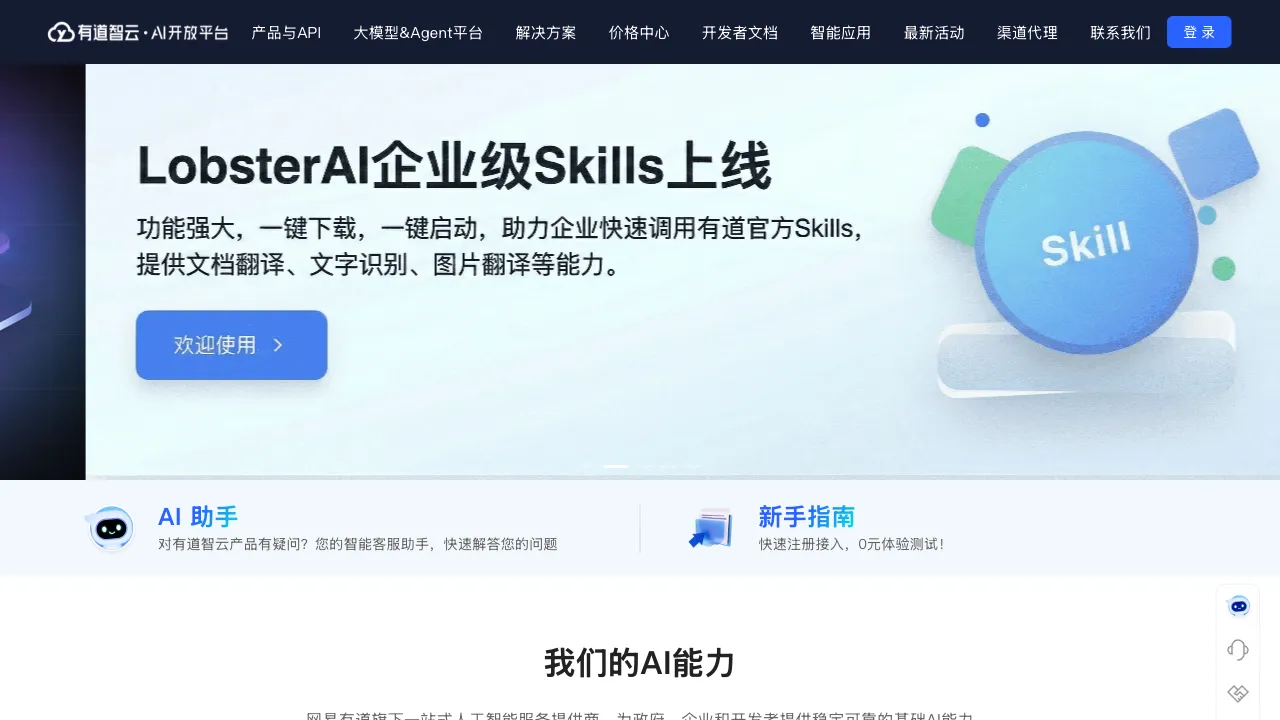
Youdao AI (ai.youdao.com) is the central entry point for NetEase Youdao’s AI products, powered by its self-developed "Ziyu" large model—one of the first vertical large models in China specifically trained for educational scenarios. Named after Confucius’s disciple Ziyu from The Analects, its positioning is clear: not an omniscient generalist, but a teacher who understands language and learning better.
The product matrix covers: AI translation (the large-model upgrade of Youdao Translate), document summarization, language-learning assistance (essay grading, speaking practice), AI dialogue and creation, and the Youdao Zhiyun API for developers.
Core Features
AI Translation
This is the evolution of Youdao’s signature skill combined with large models. Compared to traditional neural machine translation, the improvements in the large-model version focus on: context consistency in long texts (consistent terminology, coherent references), accuracy in professional domain vocabulary (backed by dictionary-grade lexical assets), and adjustable translation style (switching between academic tone and colloquialism as needed).
Chinese-English bidirectional translation is at the first-tier level domestically, with solid capabilities in Chinese-Japanese and Chinese-Korean translations. For high-frequency translation scenarios for Chinese users—papers, emails, reference materials—it forms a unique combo punch with its dictionary ecosystem (word lookup, example sentences, synonym/antonym analysis) that competitors lack: while other tools give you the result, Youdao also tells you why.
Youdao Speed Read
An AI document reading assistant: feed it PDFs, webpages, or long articles to generate summaries, extract key points, and answer questions based on the original text. The "language tax" of reading English literature and industry reports is significantly reduced—first skim the summary to decide if deep reading is worth it, then ask follow-up questions about key paragraphs. This workflow delivers tangible efficiency gains for students and researchers.
Language Learning Assistance: A True Home Field
This is where Youdao AI distinguishes itself from general-purpose assistants:
AI Essay Grading: Provides scoring and sentence-by-sentence revision suggestions for essays in the Chinese English-exam system (Gaokao, CET-4/6, postgraduate entrance exams, IELTS, TOEFL)—including error type annotation, expression enhancement suggestions, and scoring based on exam standards. General large models can also grade essays, but calibration to "CET-4/6 grading standards" is a capability honed by vertical data.
Speaking Practice: AI dialogue for speaking practice, with pronunciation assessment and expression correction, reducing the cost of practicing without a foreign tutor to zero.
Vocabulary and Grammar: Intelligent generation of example sentences for words, grammar explanations, and error analysis—features from the dictionary era fully powered by AI.
These capabilities are also deeply integrated into the Youdao Dictionary app and hardware like the Youdao Dictionary Pen. Many users use them daily without realizing "Ziyu" is behind the scenes.
AI Creation and Dialogue
General-purpose features like writing assistance, copy generation, and knowledge Q&A serve as platform complements—they work, but they are not its core strength.
Youdao Zhiyun (B2B API)
APIs for translation, OCR, speech recognition and synthesis, essay grading, etc., are open to developers. Educational apps and hardware manufacturers are the primary customers—Youdao’s invisible presence in the edtech supply chain runs deeper than its C-end brand exposure.
Comparison with Other Tools
vs ERNIE Bot / Tongyi Qianwen / Kimi: General capabilities (reasoning, coding, long-form writing) are clearly stronger in these major tech companies’ models; Youdao shouldn’t be chosen as a daily general assistant. However, for translation quality and exam-oriented learning support, Youdao’s vertical optimization makes it more accurate. Each plays to its own strengths.
vs DeepL / Google Translate: DeepL excels in European languages, and Google covers a wide range, but both lack supporting tools for the Chinese learning context. Youdao’s "translation + dictionary + learning" trinity is a unique form for Chinese learners.
vs Liulishuo / Duolingo etc. Learning Apps: Those are complete "schools" with full curricula; Youdao AI is more like an on-call "tutor"—systematic learning relies on the former, instant tutoring on the latter. They complement rather than compete.
vs Grammarly: The benchmark for polishing English writing, aimed at native-level users; Youdao’s essay grading targets learners in the Chinese exam system. Their target audiences hardly overlap.
vs Baidu Translate: A direct competitor among domestic translation tools, with comparable quality; Youdao’s differentiator is the depth of its learning ecosystem, while Baidu’s lies in its search ecosystem integration.
Who Should Use Youdao AI?
Students (primarily English learners): For a full suite of needs including essay grading, speaking practice, and translation/word lookup, Youdao is the most targeted AI option in China—this is its core user base and where it delivers the best experience.
Exam Candidates: For writing and speaking prep for CET-4/6, postgraduate exams, IELTS, and TOEFL, AI feedback calibrated to exam standards offers more value than the generic comments of general models.
Researchers and Professionals Reading Foreign Materials: The workflow of speed reading + translation + dictionary provides a smooth comprehensive experience for handling English literature.
Existing Youdao Ecosystem Users: For long-time users of the Dictionary app and Dictionary Pen, AI capabilities are embedded in products they already know, with zero migration cost.
EdTech Developers: Products needing APIs for translation or grading can rely on Youdao Zhiyun as a mature domestic option.
Limitations
General dialogue and reasoning are not its battlefield; comparing "Ziyu" to top-tier general models on comprehensive ability is meaningless—choosing it means choosing its vertical focus. For general needs, pair it with a general-purpose assistant.
The product matrix is somewhat fragmented: speed reading, translation, dictionary, and grading are distributed across different entry points, so the integrated experience isn’t as smooth as a single super app. New users need some time to figure out "which feature is where."
Pricing
Basic features are free (translation, basic speed reading, dictionary ecosystem); advanced features (premium grading, higher speed-read quotas, membership) are subscription-based; B-end APIs are pay-per-use. Refer to the official website for specifics.
The logic behind choosing Youdao AI is very clean: What proportion of your needs involves "language learning" and "translation"? If that proportion is high, its vertical depth will make it feel more useful than general large models; if low, it’s just a spare tool in your kit occasionally used. For the tens of millions of students currently learning English, the answer is usually the former—this is precisely the reason for Youdao’s bet on vertical specialization.