

The greatest advantage of a translation tool comes from data. The more data you have, and the more specialized it is, the more accurate the translation becomes in specific scenarios. Google Translate has massive multilingual text from the internet, and DeepL has deep training for European languages. So what does Alibaba Translate have?
It has e-commerce data at the hundred-million scale. Product descriptions, buyer-seller communications, user reviews, and logistics information—these real-world commercial language materials are Alibaba Translate’s irreplicable accumulation in e-commerce and cross-border trade scenarios. When you need to translate a product detail page into English for foreign buyers, or translate an inquiry from an Arabic-speaking buyer, Alibaba Translate’s understanding accuracy often surpasses other tools.
What is Alibaba Translate?
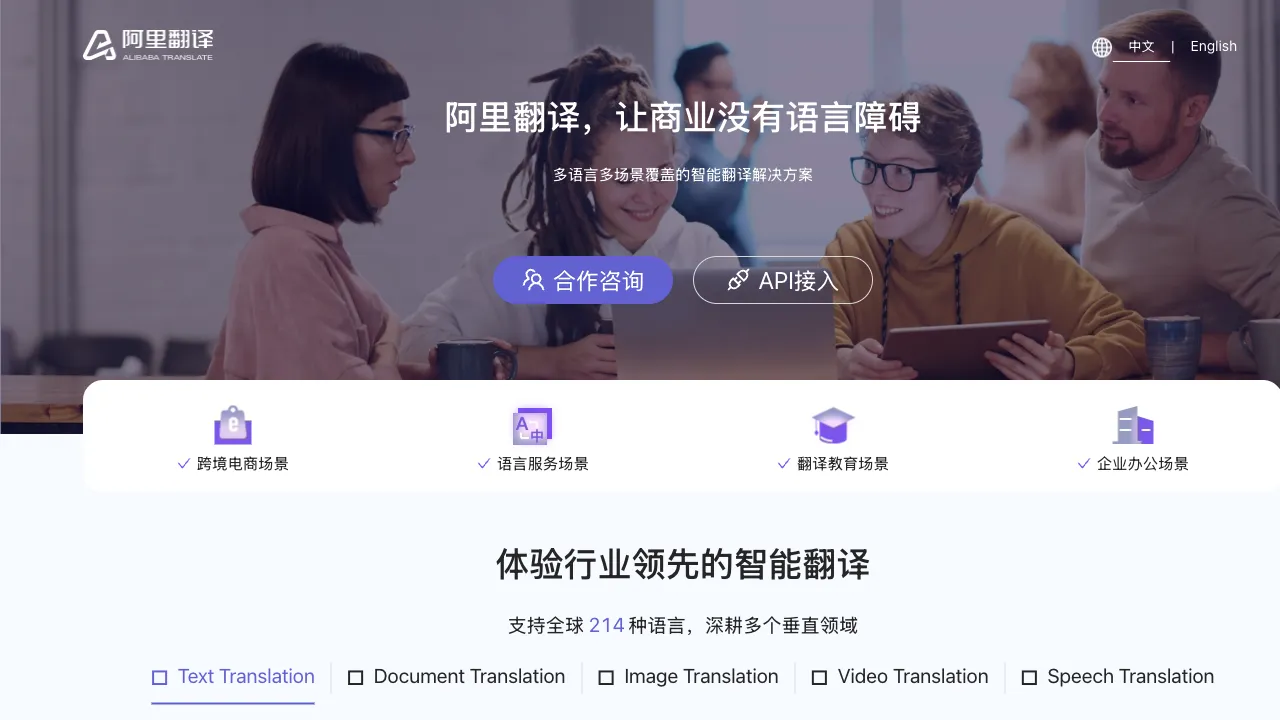
Alibaba Translate (translate.alibaba.com) is an AI translation service under Alibaba Group, powered by the Natural Language Processing team of DAMO Academy. It is not just an independent translation website but is deeply embedded in Alibaba’s entire cross-border e-commerce ecosystem—the translation features on platforms like Alibaba.com, AliExpress, and Taobao Global are all supported by Alibaba Translate’s technology. This large-scale practical commercial application is the best driver for continuous technical iteration and optimization.
Core Features
Multilingual Text Translation
Supports mutual translation between Chinese and multiple languages, covering the main market languages for cross-border e-commerce:
Mainstream Languages: English (the most core), Japanese, Korean, French, German, Spanish, Portuguese, Russian, Italian, and other major trade languages in Europe and America.
Emerging Market Languages: Arabic, Indonesian, Thai, Vietnamese, Malay, and other Southeast Asian and Middle Eastern market languages—these are the fastest-growing markets for cross-border e-commerce, and Alibaba Translate’s specialized optimization for these languages is deeper than that of general translation tools.
The translation interface is clean and simple; paste the original text to get results immediately, with no settings required.
Specialized Translation for E-commerce Product Descriptions
This is Alibaba Translate’s most valuable unique capability, but also the one least noticed by ordinary users.
E-commerce product descriptions are not ordinary article translations. They have specific language patterns:
- Selling points are highlighted with emphatic language ("ultra-thin design", "premium quality")
- Specifications and parameters require precision (no unit errors or numerical deviations)
- Purchase guidance language must be attractive (aligning with the expression habits of consumers in the target market)
- Detailed descriptions should be accurate but not overly formal (translations that are too academicon the contrary make buyers distrustful)
General machine translation of such content is often literal, resulting in a textbook-like feel without any sales appeal. Alibaba Translate has targeted optimizations here; the translated product descriptions better align with the reading habits of consumers in the target language, having a tangible impact on conversion rates.
Document Translation
Supports overall translation of document formats such as PDF, Word, Excel, and PPT, preserving the original document’s layout formatting so that the translated documents can be used directly.
For trade practitioners who frequently handle foreign trade contracts, customs declaration documents, overseas market reports, and supplier agreements, the value of document translation lies in: no need to manually copy and paste text, and preserved formatting reduces time spent on re-layout. In scenarios involving large volumes of documents, this represents a significant efficiency boost.
Webpage Translation
Directly input a webpage URL to translate the entire webpage content, suitable for quickly reading foreign product pages, competitor websites, industry news, etc.
AI Dialogue-Assisted Translation
For more complex translation needs, it supports dialogue-style translation assistance, allowing you to supplement contextual information to help the AI understand specific contexts and provide more accurate translation results.
API Interface (for Enterprises and Developers)
Through Alibaba Cloud’s API, cross-border e-commerce merchants can integrate translation capabilities into their own systems for automation:
- Automatically generate multilingual versions when publishing products
- Real-time translation conversion of buyer messages
- Automatic multilingual generation of order and logistics information
- Automatic aggregation and translation of user reviews
The API is billed by call volume, with a free tier available; commercial use beyond the quota requires payment.
Comparison with Major Competitors
Comparison with Google Translate: Google Translate has the widest language coverage (100+ languages) and very stable quality in general scenarios, making it the most comprehensive tool for most users. In pure text translation quality, there is little difference between the two in mainstream languages; Alibaba Translate’s specialized optimization in vertical e-commerce scenarios is its differentiated advantage, while Google Translate covers minor languages and non-commercial languages better. Accessing Google Translate from within China has stability issues, whereas Alibaba Translate connects directly without barriers domestically.
Comparison with DeepL: DeepL has a recognized quality advantage in European language translation (English, German, French, Italian, Spanish, etc.), with literary feel and linguistic naturalness acknowledged by many professional users. However, DeepL’s support and optimization for Chinese are not as good as those of native Chinese tools; Alibaba Translate has the upper hand in directions like Chinese-English and Chinese-Japanese. Additionally, DeepL’s Chinese interface and domestic access experience are not as smooth as Alibaba Translate’s.
Comparison with Baidu Translate: Both are domestic translation tools centered on Chinese, with very similar positioning. Baidu Translate’s OCR image translation features are richer, and its experience in life scenarios (menu translation, street sign translation) is better; Alibaba Translate’s specialized optimization in e-commerce and commercial scenarios is its differentiated advantage. The general scenario translation quality of both is close, so using both for comparison is recommended.
Comparison with Youdao Translate: Youdao’s dictionary and English learning features are stronger, making it the first choice for many students and English learners; in business and cross-border e-commerce scenarios, Alibaba Translate’s specialized optimization is more targeted.
Comparison with Tencent Fanyi Jun: Tencent’s translation tools also have good quality and similar language coverage; Alibaba Translate’s accumulation in e-commerce scenarios is its unique advantage, giving it more practical value in cross-border trade scenarios.
Who Is It Best For?
Cross-border E-commerce Sellers: This is Alibaba Translate’s core target user group. Sellers on Amazon, independent sites, and Alibaba.com need to translate product descriptions, titles, and selling points into English, Japanese, Spanish, etc.; Alibaba Translate’s e-commerce optimization provides the most direct value.
Foreign Trade Practitioners: Merchants and sales personnel handling import/export business frequently need to translate contracts, quotations, order confirmations, and procurement agreements—where high accuracy in business language is required. Alibaba Translate performs stably on such formal commercial texts.
Merchants on Alibaba Platforms: Those connecting with overseas buyers on Alibaba.com (1688.com) or selling to overseas consumers on AliExpress will find Alibaba Translate integrates most smoothly with these platforms’ systems.
Operations Teams Needing Multilingual Content: For those operating overseas social media accounts and creating multilingual marketing materials, Alibaba Translate’s API integration enables automation of multilingual content generation.
Developers: Those integrating translation functions into their own cross-border e-commerce systems will find Alibaba Translate’s API documentation complete, billing transparent, and backed by Alibaba Cloud’s stability guarantees.
Usage Scenario Examples
Product Title Optimization Translation: Translating "Pure Cotton High-Density Breathable Men's Short-Sleeve T-Shirt Summer Casual Style" into English; general tools might provide a literal translation, while Alibaba Translate understands the selling-point logic of e-commerce titles, producing results that look more like actual Amazon listings.
Buyer Inquiry Response: When overseas buyers from Arabic or Thai-speaking regions send price inquiries, Alibaba Translate’s understanding is accurate, and the replies are natural, facilitating smoother buyer-seller communication.
Overseas Competitor Analysis: Translating English product descriptions of competitors on Amazon to analyze their selling-point strategies; Alibaba Translate’s e-commerce language understanding ensures the translation results are closer to the original sales intent.
Limitations
In general translation scenarios—such as news reading, daily communication, and academic content—Alibaba Translate does not hold a distinct advantage over DeepL or Google Translate, so user preference among these tools tends to be minimal.
Its coverage of low-resource languages is less comprehensive than Google Translate’s, meaning that specific language needs in non-commercial contexts may require switching to other tools.
In scenarios demanding high literary quality, such as literary and poetry translation, there is a noticeable gap compared to human translators specializing in these fields; AI translation tools remain limited in such highly creative linguistic contexts.
Pricing
The web version of Alibaba Translate offers its basic features completely free of charge, with no registration required. This is sufficient for users with occasional translation needs.
The API service includes a monthly free tier (exact quotas are subject to the Alibaba Cloud official website). Usage beyond the free tier is charged per character, and commercial plans offer volume discounts. Compared to other translation API services, Alibaba Translate’s pricing is quite competitive for its quality level.
For cross-border e-commerce practitioners and foreign trade professionals, the specialized optimization for e-commerce scenarios provided by Alibaba Translate is a core reason to choose it. It may not be the best general-purpose translation tool, but it is the one that best fits specific professional needs.