
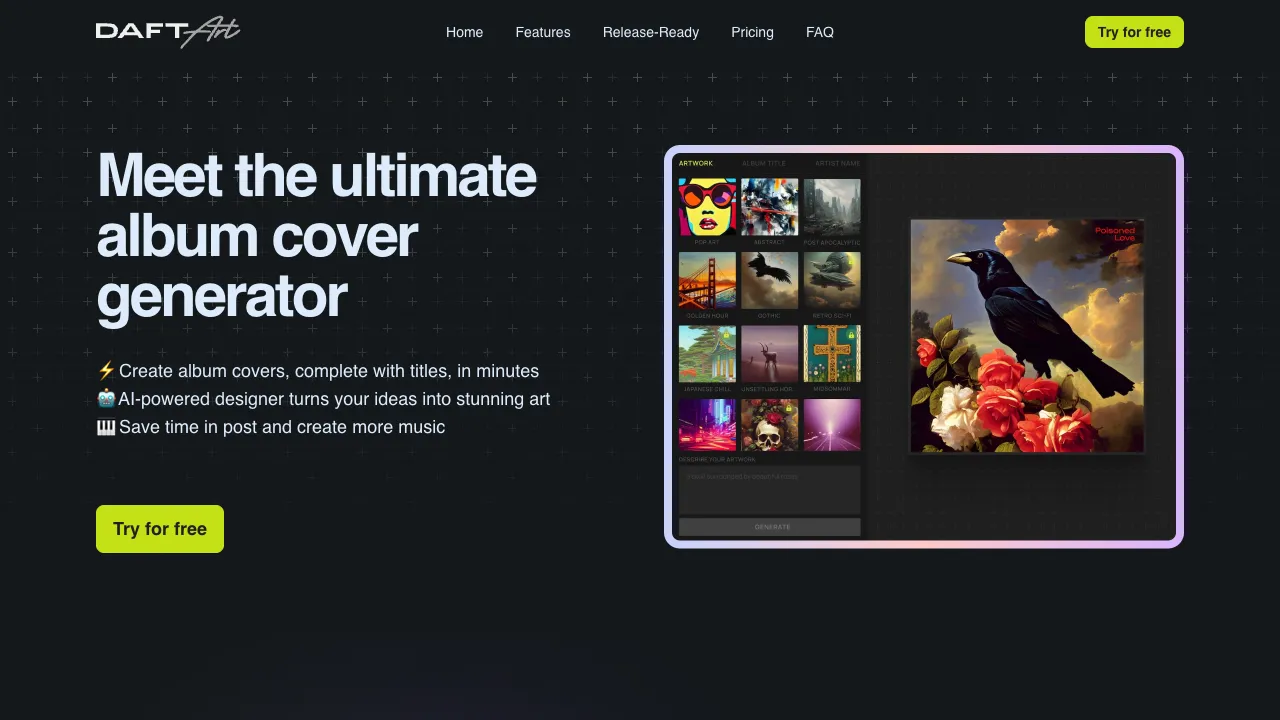
Releasing a song or an album requires a cover image. Previous options were either hiring a designer (which costs money and requires communication) or using generic AI image tools to generate one yourself (which requires prompt-writing skills and doesn’t always yield results suitable for music covers). Daft Art is an AI album cover generator built specifically for musicians, with specialized optimizations for the visual needs of music covers.
What Is Daft Art?
Daft Art is an AI music cover generation tool launched in 2022, primarily targeting independent musicians, podcast creators, DJs, and bands. It offers a variety of music-style-oriented visual styles, allowing users to generate cover images that match the tone of their music by selecting a style, adjusting parameters, and entering descriptions.
The "Daft" in the name is an English slang term (meaning somewhat silly or goofy), reflecting a relaxed brand style aimed at independent musicians, a relatively young and avant-garde user base.
Core Features
Style-Oriented Cover Generation
Daft Art’s interaction model is closer to the creative logic of music cover design than generic AI image tools. Instead of writing a prompt directly, you first select a style:
- Abstract Art: Expressing emotions through color and form
- Electronic/Digital: Cyberpunk, pixel art, glitch art
- Nature/Landscape: Using natural scenes as the main visual
- Portrait Art: People or silhouettes
- Vintage Photos: Film texture, retro tones
- Minimalism: Clean typography, ample white space
- Surrealism: Dreamlike, unrealistic visual effects
After choosing a broad direction, you describe specific colors, scenes, and moods using keywords. The AI then generates cover images in the selected style.
Output Aspect Ratios Optimized for Music Covers
Generated images are default 1:1 squares, which is the standard cover size for streaming platforms (Spotify, Apple Music, NetEase Cloud Music). There’s no need to specify "1:1 ar" as you would with Midjourney; the output is ready-to-use immediately.
Resolution supports high-definition export, meeting the upload requirements of major streaming platforms (typically 3000×3000 pixels).
Rapid Iteration and Variant Generation
Quickly generate multiple variants in the same direction for easy comparison and selection. Typically, four different versions are generated at once. You can choose the one closest to your vision and further refine the description to regenerate.
For independent musicians with limited budgets, this "rapid generation, multi-version selection" approach is far more efficient than communicating revisions with a designer.
Typography Guidance
Although Daft Art primarily generates the image portion, many of its style templates account for the need to add artist names and album titles on the cover. The generated images leave appropriate space for text layout. For musicians who don’t know design, this detail reduces the hassle of figuring out "where to place text for the best look" during post-processing.
Comparison with Other Tools
vs Midjourney: Midjourney undoubtedly produces higher image quality, but generating music covers with it requires writing prompts. Users unfamiliar with prompt engineering have a steep learning curve, and the square aspect ratio must be explicitly specified. Daft Art is optimized specifically for covers, is easier to use, and its image quality is sufficient for general purposes.
vs Adobe Firefly / Stable Diffusion: Similar comparison; while general AI image tools are more powerful, they require more usage experience. Daft Art’s style presets lower the barrier to entry.
vs Canva: Canva starts from album-cover templates; Daft Art starts from generated images. Choose according to whether you need an established layout or prefer generating and selecting a visual.
vs Hiring a Designer: For independent musicians, hiring a professional designer for a music cover typically costs $100–$500, plus the time cost of communication. Daft Art is significantly cheaper and faster, making it suitable for independent musicians with limited budgets and tight deadlines.
Who Is Daft Art For?
Independent Musicians: Releasing singles or albums on various platforms requires professional-standard cover images without wanting to spend a large budget on designers.
Podcast Creators: Podcasts need cover images (also 1:1 squares), and Daft Art can generate covers suitable for podcast styles.
Amateur Music Producers: Uploading work to platforms like SoundCloud or Bandcamp requires a cover to make the release look professional.
Bands in the Demo Stage: Producing demos or small-batch releases requires a cover but doesn’t justify a large visual budget at this stage.
Music NFT Creators: Needing visual content for music NFTs, Daft Art’s diverse styles include several directions well-suited to NFT aesthetics.
Pricing
The site has a dedicated pricing page and offers a free trial entry point.
Tiers and amounts are whatever the pricing page at daftart.com shows — figures circulating on third-party sites could not be verified and are not repeated here.
Note that the domain changed: the former www.daftart.ai now redirects to daftart.com, and the link on this page has been updated to match.
Limitations
Limited Support for Chinese Keywords: Primarily aimed at English users; understanding of Chinese keywords is less accurate than English. It is recommended to use English descriptions.
No Coverage for Design Needs Beyond Covers: Daft Art focuses on cover image generation. If you also need MV covers, posters, or event materials, other tools are required.
Limited High-Precision Detail Control: Compared to Midjourney, fewer parameters can be controlled. Achieving very precise visual effects still requires professional tools.
No Text Layout Included: It generates the base image; artist names and album titles must be added separately in tools like Canva or Photoshop.
For independent musicians, Daft Art fills the gap of "not wanting to spend a lot on designers but still wanting a professional look." Its fast generation speed, diverse styles, and optimization for music cover dimensions make it a highly efficient option for creating music covers.