

There was a famous "upset by the underdog" moment in the history of machine translation: In 2017, a Cologne-based German company that started as a dictionary website called Linguee released its own translator. The blind test results stunned the industry—professional translators, unaware of the source, generally rated its output as superior to that of giants like Google and Microsoft. Since then, "made by DeepL" has gradually become synonymous with translation quality: the text lacks the telltale "translationese," reading as if written by a native speaker. This seemingly simple standard was exactly the hurdle machine translation had failed to clear for decades, which this German company managed to overcome first.
Today, DeepL is a European AI star enterprise valued at billions of dollars, yet its persona remains consistent: not the largest, but the most accurate.
What is DeepL?
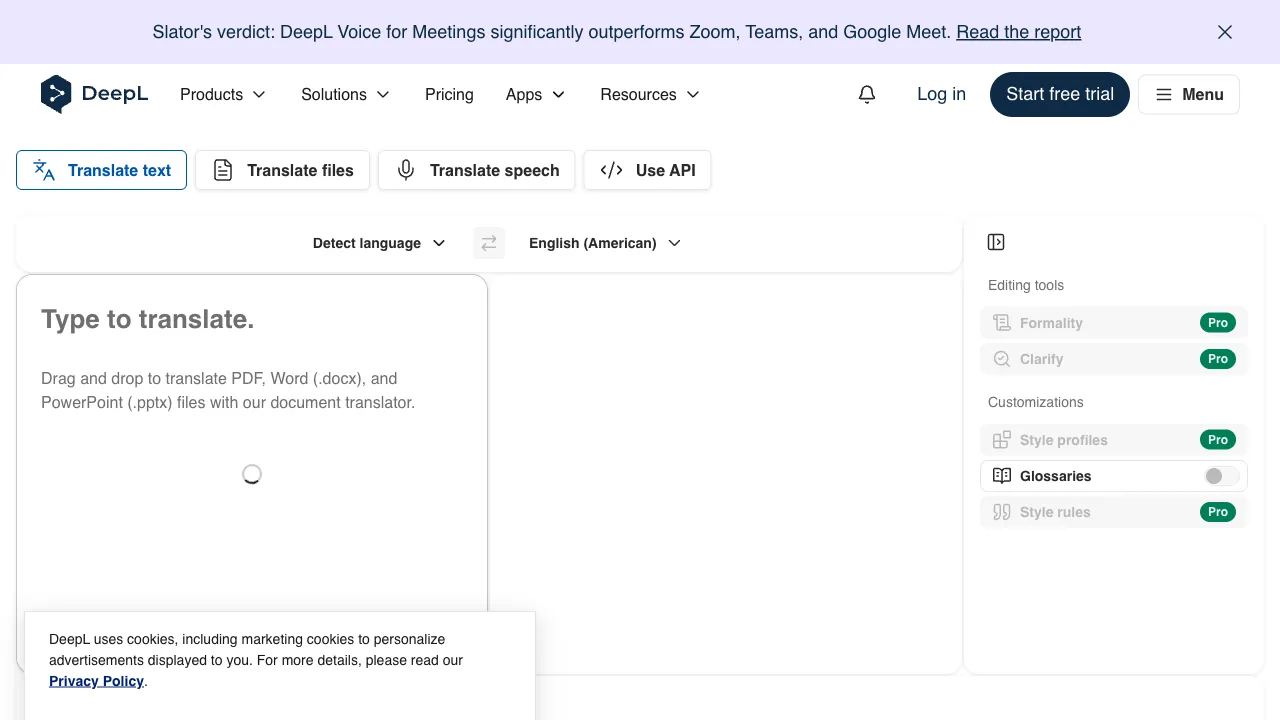
DeepL (deepl.com) is a neural machine translation service from the German company DeepL, supporting mutual translation among more than 30 languages. Its core strength lies in European languages (English, German, French, Spanish, Italian, Dutch, Polish, etc.). Its training foundation comes from the massive amount of high-quality bilingual corpus accumulated by Linguee; this "heritage" is precisely the source of its natural-sounding translations. The product ecosystem is comprehensive: web translation, document translation, desktop client, mobile app, browser extension, API, and an extended writing assistance product called DeepL Write.
Its status among professional users (translators, scholars, multinational professionals) is similar to certain specialized tools in the design world: not everyone uses it, but those who take their work seriously recognize its value.
Core Features
Text Translation: The Quality Flagship
Beyond the basic experience of instant translation upon input, DeepL features two insider-friendly designs:
Interactive adjustment of translations: Clicking any word in the translated text brings up alternative options. Selecting one automatically restructures and adapts the entire sentence. This human-machine collaborative refinement turns the binary choice of "accept all or discard all" into progressive optimization—a feature beloved by translators.
Holistic sense of language: Its translations excel because "sentences read as if written by the same person"—consistent terminology, natural transitions, and word order that aligns with target-language conventions. The gap between tools is small for short texts, but DeepL pulls ahead in the fluency of long documents and entire paragraphs. This is why reading its output requires the least amount of proofreading effort.
Document Translation
Upload entire Word, PowerPoint, or PDF files to receive translated documents with formatting preserved. The free version offers a monthly limit, while the Pro version has no limits. For users handling foreign contracts, reports, and papers, the value of "preserved formatting" is as significant as the translation itself.
DeepL Write
A writing refinement tool extended from translation: it offers grammar correction, phrasing upgrades, and tone adjustment (formal/casual) for English and German texts. For non-native speakers writing English emails and reports, it serves as a strong second opinion alongside Grammarly—applying the same "native feel" gene to editing rather than just translation.
Multi-platform Support and Shortcuts
The global shortcut in the desktop client (pressing Ctrl+C twice with text selected to pop up the translation) is a model of efficiency details, embedding translation seamlessly into any workflow. Extensions, apps, and APIs are all available. The Pro version promises a no-text-retention data policy, which is a tangible selling point for corporate compliance.
Comparison with Similar Tools
vs Google Translate: Google wins decisively in language coverage (100+ vs 30+) and ecosystem breadth; however, blind test reputation for translation quality and naturalness in major European languages has long favored DeepL. The classic division of labor: use Google for breadth, DeepL for precision. Add one more practical reality for China: the web version of Google Translate is inaccessible, making DeepL's accessibility actually better (though it occasionally fluctuates).
vs Domestic Tools (Youdao/Baidu/Huoshan): Chinese is DeepL's away game. While it can compete in Chinese-English mutual translation, it does not hold an advantage; its delicate handling of Chinese nuance lags behind domestic engines specialized in Chinese. Its home turf remains European languages. For daily Chinese-English tasks, use domestic tools; for English-German-French-Spanish mutual translation, use DeepL. Assigning tasks by language pair is the most pragmatic approach.
vs Large Model Translation (ChatGPT/Claude): Large models allow style customization, explanation, and stronger context understanding; their upper limit in professional translation scenarios now matches or even surpasses DeepL's. DeepL wins on the speed and stability of a dedicated tool (no prompts needed, batch document processing, mature API). This is DeepL's most realistic competitive pressure today—it is also integrating large model capabilities into its products to respond.
vs Caiyun Translation: Caiyun's specialized Japanese features and bilingual reading aremisalignment (misaligned) advantages; DeepL's Japanese capability is "usable" but not a strength.
Who Should Use DeepL?
Users of European languages: Those studying in Europe, trading with European markets, or learning French, German, or Spanish—DeepL is the unquestionable first choice for English-German-French-Spanish-Italian mutual translation, where the quality gap is visible to the naked eye.
Professional translators and academic researchers: For professionals who are picky about translation quality and sensitive to proofreading time, the workflow of "DeepL draft + human refinement" is one of the industry standard configurations. The saved proofreading hours translate directly into money.
Multinational professionals: For translating and refining English emails and reports (paired with DeepL Write), ensuring a high level of professionalism in the output.
Developers needing translation APIs: For products requiring embedded high-quality translation, the DeepL API is a standard candidate for quality-first scenarios.
Limitations
Chinese and Asian languages are not its strengths. Chinese users should set realistic expectations: choose DeepL for its European language capabilities, not for Chinese—pure Chinese-English needs are equally well served by domestic tools.
Language coverage is limited to over 30 languages, with obvious gaps in minor languages. Free version restrictions (character limits, monthly document counts) are tight for heavy users; serious usage inevitably leads to a Pro subscription.
Pricing
Four translation tiers, with prices varying slightly by region and billing cycle. Annual rates:
- Free $0: 50,000 characters of text translation a month, 1 file translation (up to 5MB), 1 glossary with 5 entries per language pair; resets monthly, no rollover
- Individual, about $8.74/mo: 300,000 characters
- Team, about $28.74/user/mo: 1,000,000 characters
- Business, about $57.49/user/mo: unlimited under fair use
- Enterprise: custom
Undiscounted monthly rates run about $10.4 for Individual, $34.2 for Team and $68.5 for Business, with annual billing saving roughly 16%.
Add-ons and API: DeepL Write Pro is a $7.49/user/month add-on on Individual and Team, and is included at no extra charge on Business and Enterprise; Translation Flow appears only on Enterprise, quote-based. The API is its own system: API Free covers 500,000 characters a month, while API Pro is $5.49/month plus $25 per million characters with no volume cap. Developer tiers are API Free, API Pro and Growth.
The thing people miss: "unlimited" on Business and Enterprise comes with a fair-use policy, not a blank cheque.
DeepL Agent pricing is not public — it is sold through Sales or Customer Success.
Check the official pricing page for exact current figures.