

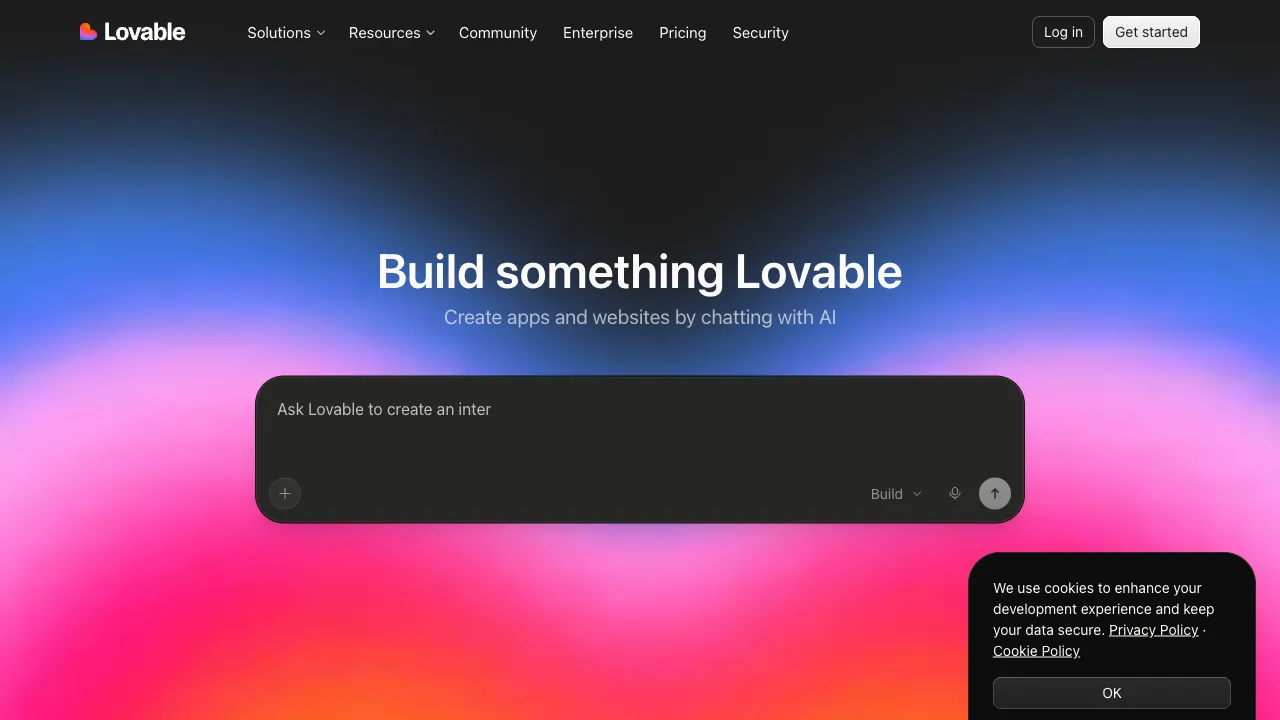
“Describe the app you want in natural language, and AI generates runnable code for you.” This concept has been around for years, but usable products didn’t truly emerge until 2024. Lovable (formerly GPT Engineer) is one of the most mature products in this space today. If you have an idea for a web app but don’t want to write code from scratch, or if you’re a designer/product manager looking to quickly validate an interactive prototype, Lovable is definitely worth a look.
What is Lovable?
Lovable is an AI App Builder focused on generating complete web applications directly from natural language descriptions. You tell it what you want to build, and it writes the frontend code (React + Tailwind CSS) and backend logic, producing an app that runs directly in your browser.
The code is hosted in the cloud, and each app gets a shareable URL, so there’s no need to configure your own server. If you’re satisfied with the result, you can export the code or connect it to your own GitHub repository.
The underlying technology relies on Claude (Anthropic’s model) for code generation and context understanding.
Core Features
Chat-Based App Generation
This is the most basic feature. Open Lovable and describe the app you want in the input box:
“Help me build a task management app that supports adding tasks, marking them as complete, sorting by priority, and has a clean interface.”
Within minutes, it generates a web app with full functionality—including UI, interaction logic, and data state management. You can interact with it directly to see if the features meet your expectations.
Iterative Refinement
If you’re not satisfied with the generated app, you can continue refining it via chat:
- “Change the color scheme to a dark theme.”
- “Add a search bar at the top.”
- “Convert the task list into a card-based layout.”
Lovable modifies the existing code rather than regenerating everything from scratch. This iterative workflow is central to the Lovable experience—you don’t need to know how to program; through conversation, you gradually polish the product into exactly what you want.
Supabase Integration
Lovable integrates deeply with Supabase (an open-source Firebase alternative). Once connected, it can automatically generate database schemas, API endpoints, and user authentication. This means you can build apps with real backend capabilities: data persists, users can register and log in—it’s not just a frontend demo.
GitHub Sync
App code can be synced to GitHub. You can then open it locally in VS Code or Cursor for manual edits, push changes back to Lovable, and keep both environments in sync. This bridges the gap between “AI-generated” and “traditional development,” ensuring you aren’t locked into the Lovable platform.
One-Click Deployment
After generation, Lovable automatically assigns a subdomain under lovable.app that you can share with others immediately. If needed, you can bind a custom domain to your app.
What It Can Do, and What It Can’t
Strengths:
- CRUD apps (Create, Read, Update, Delete): Task management, note-taking apps, contact managers
- Dashboards: Data visualization, report displays
- Simple SaaS app prototypes: Subscription management, user administration interfaces
- Landing pages: Product introductions, marketing pages
- Utility apps: Calculators, forms, conversion tools
Limitations:
- Complex business logic: If your app requires complex workflows, multi-step approval processes, or fine-grained permission controls, AI-generated code may have omissions or errors that require manual correction.
- Highly customized designs: If you have very specific visual requirements for the UI (pixel-perfect fidelity), adjusting via chat is inefficient compared to writing code directly.
- Performance-intensive features: Scenarios requiring complex calculations or large-scale data processing may result in suboptimal AI-generated code.
- Native mobile apps: Lovable only builds web apps; it does not generate iOS or Android native code.
Comparison with Bolt.new and v0
Other major competitors in this space include StackBlitz’s Bolt.new and Vercel’s v0.
vs. Bolt.new: Bolt leans more toward full-stack development and supports a wider range of tech stacks (not just React). Lovable has a cleaner design and deeper Supabase integration. Overall capabilities are similar; the choice largely comes down to personal preference.
vs. v0 (Vercel): v0 focuses on generating UI components, outputting clean React + shadcn/ui component code suitable for copying into your own projects. Lovable generates complete, runnable applications, positioning itself at a higher level of abstraction.
Who Should Use Lovable?
Entrepreneurs and Product Managers: People looking to validate product ideas. Build a usable MVP to test with early users and gather feedback, rather than spending two or three months building a full product only to discover the market isn’t interested. Lovable compresses this cycle into one or two days.
Designers: Creating product prototypes. Interactive prototypes made in Figma are “fake”; what Lovable produces is a real, clickable app, making it far more persuasive for user testing.
Non-Technical Business Professionals: Those with clear tool needs but no development resources. For example, “I need an internal customer follow-up tracking tool”—previously requiring tech team scheduling, now you can build it yourself to meet 80% of your needs.
Indie Developers (for Rapid Prototyping): Developers who already know how to code but want to skip the boilerplate phase. Use Lovable to generate the framework, then refine it manually—much faster than building from scratch.
Pricing
Lovable charges for credits, not seats — which is why every plan allows unlimited workspace members, and why credits are what actually set your cost:
- Free: 5 build credits a day, capped at 30 a month, resetting at 00:00 UTC with no rollover, plus 20 monthly Cloud credits
- Pro $25/mo: 100 monthly credits, about $21/mo billed annually
- Business $50/mo: the same credit count as entry Pro — the premium buys SSO and governance; about $42/mo billed annually
- Enterprise: custom
The structural change worth knowing is that the credit pools merged. Building your app, hosting it and running its AI features used to each have their own allowance; now all three draw from one balance, so every AI call your live app makes spends the credits you use to keep building. Paid plans can top up or upgrade when the balance runs out.
Two more things shape the real cost. Complex multi-file generations now cost 2–3 credits rather than 1. And daily credits on paid plans are uncapped, so an active builder can pull in well over a hundred extra credits a month at no additional cost.
There is also a 50% student discount. Confirm current numbers at lovable.dev/pricing.
Practical Experience Tips
Be specific in your descriptions. "Help me build an app" is too vague. A description like "Help me create an internal error feedback tool for our team that allows submitting bug screenshots and descriptions, tracks status (pending/in progress/resolved), and lets admins assign owners" will yield an application with a much higher chance of being directly usable.
Iterate in small steps; don’t ask for too much at once. Demanding "Build me a complete e-commerce system" all at once often results in a mess. Start with the core functionality, get it working, and then add more features.
Connect Supabase for real data. Apps built by Lovable that aren’t connected to a database store data only in browser memory, which is lost on refresh. To create a product that others can genuinely use, connecting to Supabase is essential.
Lovable represents a new path for product development: building truly usable applications without writing code. Its boundaries are clear—fast, simple, and iterative; beyond those boundaries, you must accept limitations or revert to traditional development. Within those boundaries, it opens a door that didn’t previously exist for creators without technical backgrounds.