

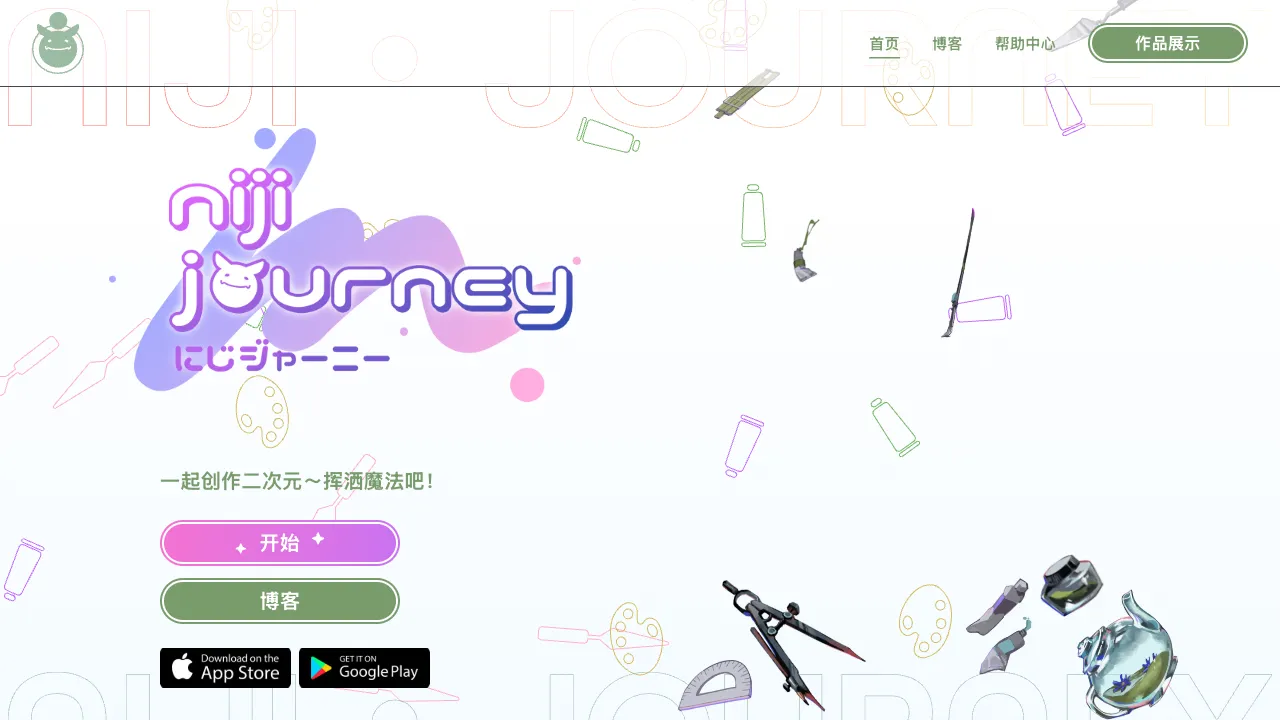
If you’ve used Midjourney to create anime-style images, you may have encountered this issue: the results lack that authentic "Japanese flavor." The proportions of characters’ eyes, the texture of their hair, and the lines of their clothing always carry a hint of Western illustration. Niji Journey was created specifically to solve this problem. It is an anime-exclusive version developed through a collaboration between Midjourney and Spellbrush, with deep optimizations for Japanese 2D anime styles in both the model architecture and training data.
What Is Niji Journey?
Niji Journey (nijijourney.com) is an AI image generation tool designed specifically for anime, 2D anime, and Japanese illustration styles. Technically, it is a derivative of the Midjourney model, developed in partnership with Spellbrush (a company focused on anime AI art) and trained on specialized datasets of Japanese anime artwork.
The name comes from the Japanese word "にじ" (niji, meaning rainbow), combined with "Journey" from Midjourney, forming Niji Journey.
Its basic usage is identical to Midjourney: you send text prompts via a Discord Bot (/imagine), and the AI generates corresponding images. You can also use it directly through the Niji Journey website. Midjourney subscribers can switch to the niji model directly within the Midjourney Bot using the --niji parameter, without needing a separate subscription.
As of August 2026, the current major version is Niji 7. Released in January 2026, it continues to focus on anime characters, Japanese illustration and East Asian visual aesthetics. Older instructions using --niji 6 should be updated to --niji 7.
Core Features
Japanese Anime Style
This is Niji Journey’s core differentiator: its generated images naturally exhibit characteristics of Japanese anime aesthetics—
Character Features: Eye proportions, refined hairstyles and hair textures, and standardized facial feature layouts that align with Japanese aesthetic standards; it avoids the Western comic book feel often present in Midjourney’s default style.
Lines and Colors: Clean contour lines, high-saturation color palettes, and clearly layered color blocks; it approaches the production style of commercial anime rather than emphasizing brushstroke textures like Western illustrations.
Clothing and Props: High fidelity in detailing Japanese-themed attire such as school uniforms, kimonos, and battle suits; props and scene items (swords, magic circles, etc.) also adhere more closely to the aesthetic norms of Japanese fantasy styles.
Multiple Style Modes
Niji Journey supports several different style parameters:
Expressive: More vibrant lines and colors, suitable for original illustration styles that feel less "template-like."
Cute: Chibi style (small head-to-body ratio), moe-style characters, ideal for memes, merchandise design, and lighthearted themes.
Scenic: Optimized generation quality for scenes and backgrounds, suitable for illustrations requiring detailed environments, such as game background art or storyboards.
Original: Closer to the style of earlier Niji models; users with specific preferences can select this option.
These modes allow Niji to cover a wide range of needs, from light novel illustrations to game art, without being limited to a single "anime style."
Character Consistency
One of the biggest pain points in AI image generation is character consistency—the difficulty of maintaining uniform appearance traits for the same character across different scenes. Niji Journey has been optimized in this area; by combining character description prompts with reference images, it can relatively stably maintain a character’s key features (hair color, eye color, clothing style). This capability is crucial for users managing character IPs or engaged in continuous creation.
Multi-Character Scenes
In Japanese anime, scenes often require multiple characters interacting in the same frame, which is a challenging task for AI image generation, frequently resulting in merged figures or deformed hands. Niji Journey has undergone specialized optimization for multi-character scene generation, making it significantly more stable than the general Midjourney model.
Comparison with Other Tools
vs. Midjourney (General Version): Midjourney offers industry-top artistic quality and handles various styles well; however, its default style leans toward Western art sensibilities. Generating Japanese anime requires extensive prompt adjustments, and the results are not as pure as those from Niji. If your primary focus is anime-style content, Niji saves time and effort compared to Midjourney.
vs. Stable Diffusion + Anime Models (NovelAI, Anything V3, etc.): The SD ecosystem boasts a vast number of anime models, allowing for high personalization through LoRA stacking; however, it requires local deployment or third-party cloud platforms, presenting a technical barrier. Niji Journey is easier to operate, requiring no knowledge of SD parameters, and delivers more stable results, though it lacks the flexibility of the SD ecosystem.
vs. NovelAI: NovelAI is also an AI image generation tool trained for anime styles and offers full support for NSFW content; Niji Journey delivers higher quality in SFW scenarios, with commercial-grade illustration quality closer to professional standards, catering to a slightly different user base.
vs. Tongyi Wanxiang, Wenxin Yige (Domestic Platforms): Domestic platforms tend toward "Chinese anime" styles; Niji Journey’s "pure Japanese feel" is difficult for these platforms to replicate. Niji requires Discord and payment, while domestic platforms are cheaper and easier to use.
vs. Adobe Firefly: Firefly’s anime style capabilities are weaker and better suited for commercial design and realistic styles, with stronger copyright safety guarantees. Niji Journey far surpasses Firefly in anime quality, though copyright issues remain a widespread controversy in the AI image generation field.
Who Is Niji Journey For?
Anime/Manga Creators: Those needing character designs, scene concept art, or storyboards can use Niji as a concept draft generation tool, significantly reducing time costs in the early stages of creation.
Game Artists and Indie Game Developers: For character portraits, NPC designs, and UI illustrations, Niji can rapidly produce anime-style assets in bulk, lowering art costs for small teams.
Light Novel and 2D Content Creators: The commercial feel and completion level of Niji’s generated results are well-suited for supporting illustrations, cover designs, and social media graphics.
2D Merchandise Designers: For prototype designs of merchandise such as memes, stickers, and acrylic stands, the Cute style mode is specifically tailored to these needs.
Midjourney Users: If you already have a Midjourney subscription, you can switch to the --niji parameter to use it without additional fees, making it an immediate upgrade path for anime generation.
Limitations
Prompts must be in English. While Chinese prompts can be attempted, the results are noticeably inferior to those using English prompts, imposing a learning curve for users unfamiliar with English.
Copyright issues remain a gray area across the entire AI image generation field. Since Niji’s training data is derived from numerous Japanese anime artworks, users bear the copyright risks associated with commercial use.
The price is not low because access requires a paid Midjourney subscription, which may not be cost-effective for occasional users.
The barrier to entry via Discord can be challenging for non-technical users. Although the official website interface is more user-friendly, it lacks the full feature set of the Discord Bot.
Pricing
Niji Journey is available through a paid Midjourney subscription. Plan prices and Fast GPU allowances can change, so check Midjourney's official pricing page before subscribing.
If you already subscribe to Midjourney, you can switch to the Niji model directly in the Midjourney Bot using the --niji 6 parameter without any additional cost.
For users focused on anime and 2D content, Niji Journey is the most direct Japanese-style option in the Midjourney ecosystem. Existing Midjourney subscribers can switch to Niji 7 without buying a second subscription.