

When evaluating Chinese large language models, there is a perspective often overlooked by domestic users: what overseas developers are using. If you check the model download rankings on Hugging Face, the answer has long been prominent—the Qwen series consistently dominates the charts. Global developers use it for fine-tuning, product development, and research; tens of thousands of derivative models have emerged, and if you look closely at the foundation of many overseas startups’ so-called “in-house models,” they are often built on Qwen. This is the most successful business card Chinese large models have in the global open-source ecosystem, and behind it lies Alibaba’s Tongyi Qianwen system.
Therefore, understanding Tongyi Qianwen requires looking at two layers: the C-end conversational app is merely the storefront; the Qwen open-source model ecosystem is Alibaba’s true heavy bet on the AI table—a strategy diametrically opposed to OpenAI’s closed-source route and directly confronting Meta’s Llama in the open-source arena.
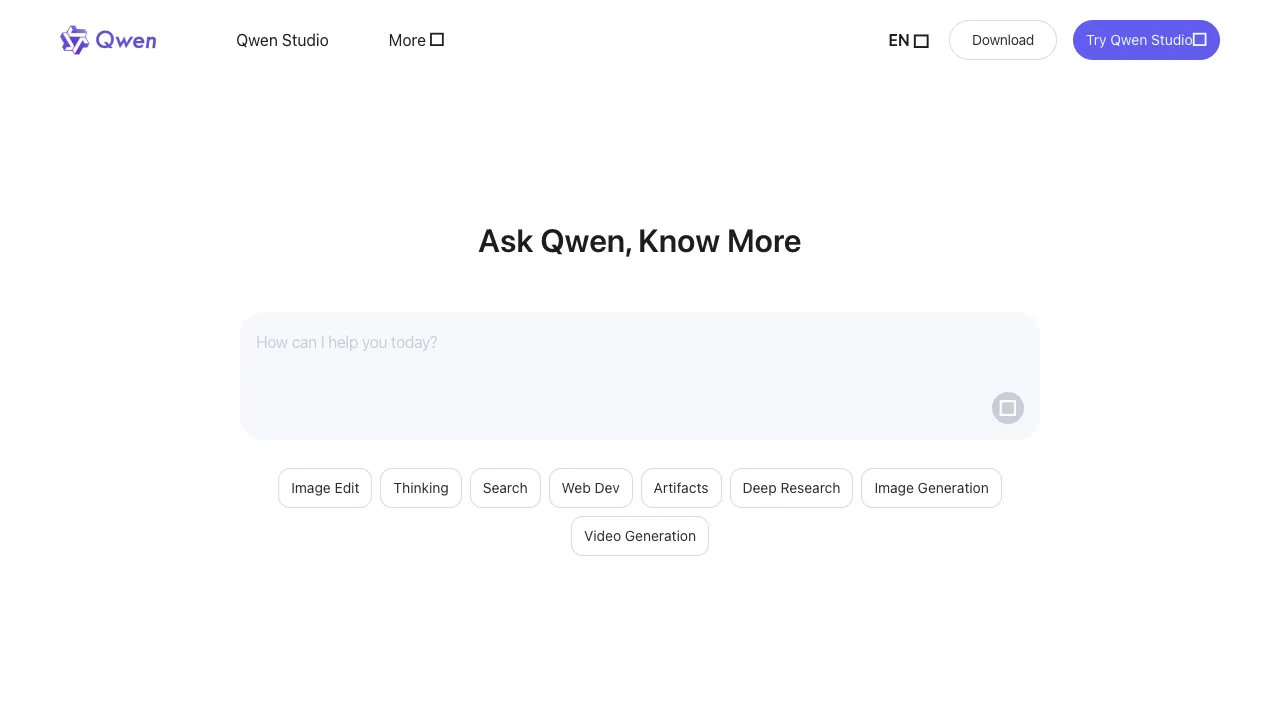
Entry point changed (checked 2026-09-06): www.tongyi.com now issues a permanent 301 redirect to www.qianwen.com, where both the web app and the desktop client live (client version 2.3.1 for Windows and macOS, plus a browser extension). "Tongyi" remains the umbrella name for the models and services behind it, while "Qianwen" is the user-facing entry brand. The headline capabilities are AI search, page summarization, image generation, AI slide decks, meeting transcription, and inline word lookup and translation.
What Is Tongyi Qianwen?
Tongyi Qianwen is Alibaba’s large model brand, structured in three layers:
C-end applications (tongyi.aliyun.com and the App): A free AI assistant for the general public, covering dialogue, writing, coding, document processing, and image understanding with comprehensive capabilities.
Qwen open-source model family: A full-size open-source lineage ranging from edge-side small models to flagship large models, covering specialized areas such as language, vision (Qwen-VL), code (Qwen-Coder), and mathematics. Licensed under Apache, it is commercially usable—the top tier of the global open-source community.
B-end services: APIs and enterprise solutions on Alibaba Cloud’s Bailian platform, along with deep integration into Alibaba ecosystem products like DingTalk and Quark.
Core Features
Dialogue and Chinese Understanding
Beyond standard capabilities like multi-turn dialogue, knowledge Q&A, and analytical reasoning, Chinese is its home turf: idioms, cultural contexts, policy expressions, memes, and linguistic nuances of the Chinese internet. In daily use by native Chinese speakers, this nuanced “understanding of Chinese” is difficult for English-centric models to replicate.
Content Creation and Coding
The quality of Chinese writing (copywriting, articles, official documents) ranks in the top tier domestically. Coding capabilities are bolstered by specialized models (Qwen-Coder performs exceptionally well in open-source code model evaluations), providing solid and reliable daily assistance in generation, explanation, and debugging.
Multimodal and Long Documents
Image understanding (object recognition, chart reading, document photo parsing), uploading long documents like PDFs for Q&A and summarization, and web search for up-to-date information—these complete the suite of capabilities for a modern AI assistant. Its context capacity for processing long documents is competitive among domestic products.
Practical Toolset
Scenario-based features integrated into the C-end app: meeting minutes, PPT assistance, spoken language practice, etc. Integration with the DingTalk ecosystem (meeting transcription and summarization) offers convenient enhancements for office workers.
Qwen Open-Source Ecosystem: The True Moat
This aspect deserves separate elaboration because it is Tongyi Qianwen’s strategic choice that distinguishes it from all domestic competitors:
Alibaba has open-sourced the entire Qwen model family to Hugging Face and ModelScope, free for commercial use. The result is a snowballing ecosystem: global developers use it as a foundation → derivative models and toolchains flourish → more people default to choosing Qwen → Alibaba Cloud’s computing power and services monetize accordingly. Academia uses it as a research baseline, startups use it as a product foundation, and individual developers run its smaller versions on consumer-grade GPUs—the status of “the number one Chinese model in the open-source world” shows no challengers in the short term.
For ordinary users, the significance of this ecosystem is indirect but real: a considerable proportion of the capabilities you experience in various domestic AI applications are driven by Qwen at thebase layer (backend).
Comparison with Similar Products
vs ChatGPT: Top-tier closed-source models still lead in comprehensive capabilities (especially complex reasoning and Agent ecosystems), but access barriers exist. Tongyi offers direct, free access within China, surpassing in local understanding of Chinese scenarios. For daily Chinese needs, Tongyi is sufficient and more seamless.
vs ERNIE Bot (Baidu): The two giants of domestic tech have similar capabilities but different ecosystems—ERNIE ties into the search ecosystem, while Tongyi ties into e-commerce and office (DingTalk) ecosystems. The biggest divergence lies in strategy: Baidu leans toward closed-source commercialization, while Alibaba bets on open source. The latter’s victory in developer mindshare is already evident.
vs Kimi/Doubao: New-generation products offer sharper single-point experiences (Kimi for long documents, Doubao for productization). Tongyi wins through the completeness of its full suite and the depth of its open-source ecosystem; this is not competition on the same dimension.
vs DeepSeek: The strongest domestic competitor in the open-source track, shaking up the global market with extreme cost-performance and reasoning capabilities. Qwen’s cards are the comprehensiveness of its model lineage (size, modality, specialization) and the backing of the Alibaba Cloud ecosystem. Together, they uphold the international prestige of “Chinese open-source models.”
vs Llama (Meta): The direct global competitor in open-source models. Qwen dominates in Chinese capabilities and trades wins with Llama in comprehensive evaluations—this confrontation itself measures China’s presence in the open-source AI world.
Who Should Use Tongyi Qianwen?
Daily Chinese users: Free, directly accessible, with full capabilities—it qualifies as either the primary or backup domestic AI assistant. Choosing among other domestic assistants often comes down to personal preference and ecosystem affiliation.
Alibaba ecosystem users: Professionals in DingTalk office work, Alibaba Cloud development, or Taobao/Tmall e-commerce will find Tongyi’s integration in these scenarios smoother than what competitors offer.
Developers: The group that should pay most attention: When choosing a foundation model for AI applications, Qwen’s open-source lineage (from edge to flagship, from language to multimodal) is the most complete shelf domestically. Local deployment, fine-tuning customization, and commercial implementation are supported by an end-to-end ecosystem.
Enterprise technology decision-makers: For selecting private large model deployments, open-source Qwen + Alibaba Cloud solutions are among the most mainstream candidate paths in China.
Limitations
The gap in complex reasoning and creativity compared to the world’s top closed-source models (GPT/Claude flagships) remains, though it is continuously narrowing. The richness and polish of C-end product features feel slightly more like “big-tech tools” compared to new-generation products focused on the C-end (like Doubao).
The product matrix is vast (Tongyi App, Bailian, ModelScope, various scenario-specific sub-products), requiring some patience for new users to find their entry points.
Pricing
Individuals use the web and app editions free, with direct access inside mainland China, a Chinese-native interface, and a phone number for signup.
Developers are a separate track: per-token calls through Alibaba Cloud's Model Studio, priced by model tier. The open-weight models can be downloaded and self-hosted, in which case you only pay for your own compute. There is also a Qwen Coding Plan aimed at developers and businesses.
Model tiers and rates change often — check Alibaba Cloud for current numbers.