

GitHub AI Weekly · Issue 06

GitHub AI Weekly · Issue 06 (Sep 19, 2026) · AI Beyond

2026 week 38

This issue covers the ISO week 38 GitHub Trending chart as of September 19, 2026, 11:24 Beijing time: ten AI projects ranked by weekly star growth across coding, agents and RAG, with recent changes, use cases and limitations, plus deeper looks at Open Code Review, Orca and WeKnora.

Top 10 projects

  1. This week+14,144
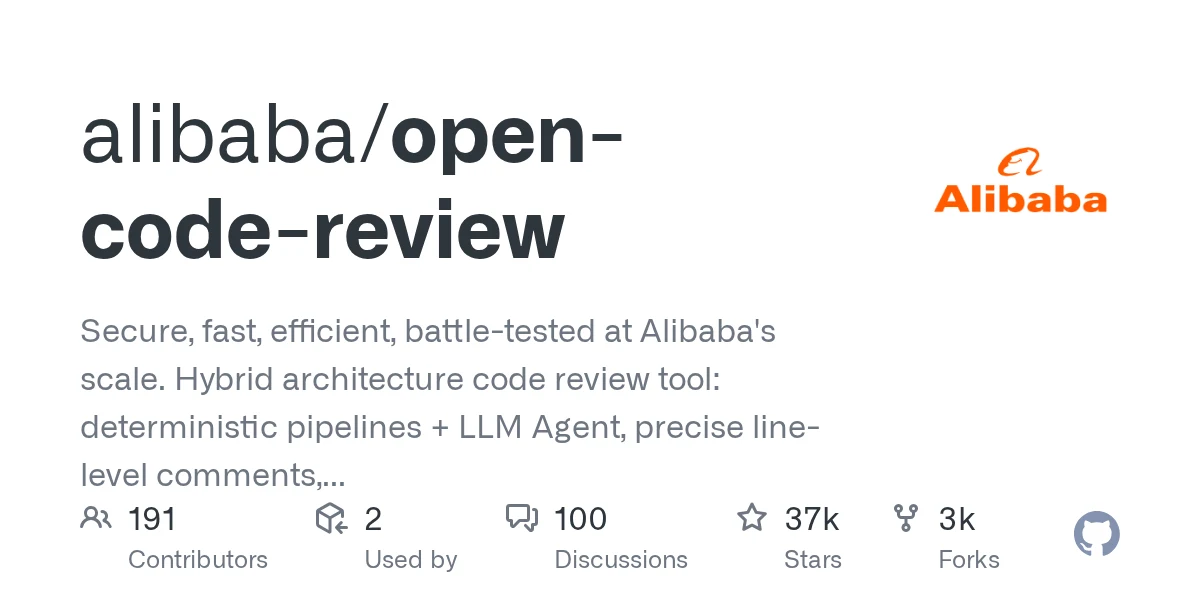
    alibaba/open-code-review repository preview

    Secure, fast, efficient, battle-tested at Alibaba's scale. Hybrid architecture code review tool: deterministic pipelines + LLM Agent, precise line-level comments, built-in multi-language ruleset (NPE, thread-safety, XSS, SQL injection), OpenAI & Anthropic compatible.

    Stars
    36,776
    Forks
    2,620
    Open issues
    218
    Last commit
    2026-09-19

    It now leads by weekly star growth. Beyond budget enforcement, duplicate-comment fixes and IDE integration in v1.12.5 and v1.12.6, the September 19 main branch added self-contained HTML exports of review sessions so findings can be archived as CI artifacts.

    Teams reviewing cross-file changes and drowning in vague suggestions can compare it against PRs already reviewed by humans, checking both false positives and missed defects.

    The repository acknowledges that prioritizing precision sacrifices recall, and vendor benchmarks do not establish performance on your codebase; check model setup, code leaving the environment and usage costs separately, and do not assume today's HTML export is already in v1.12.6.

    Deep dives

    With a general instruction to review a change, an agent often decides which files to read, how much context to gather and when to stop. Open Code Review moves deterministic steps into software: selecting changes, bundling related files and matching rules, then letting each review unit inspect more code. That makes a missed defect traceable to a stage instead of leaving only a convincing paragraph of feedback.

    Its AACR-Bench uses real PRs. The README reports higher precision with fewer tokens under the same model, while acknowledging lower recall. That is a useful trade-off, not evidence that human review can be replaced. For permissions, billing or concurrency changes, a few fewer noisy comments and one missed defect have very different costs; acceptance samples should be stratified by risk.

    Today's main branch adds self-contained HTML export, making a review a durable artifact: CI can preserve it and reviewers can revisit findings after the task ends. A complete archive does not make the conclusions correct. Run it alongside human review first, tracking placement, context coverage, false positives and misses separately, and verify whether the installed release includes this new capability.

  2. bilawalsidhu/gods-eye-view

    AI agentsJavaScript
    This week+11,683
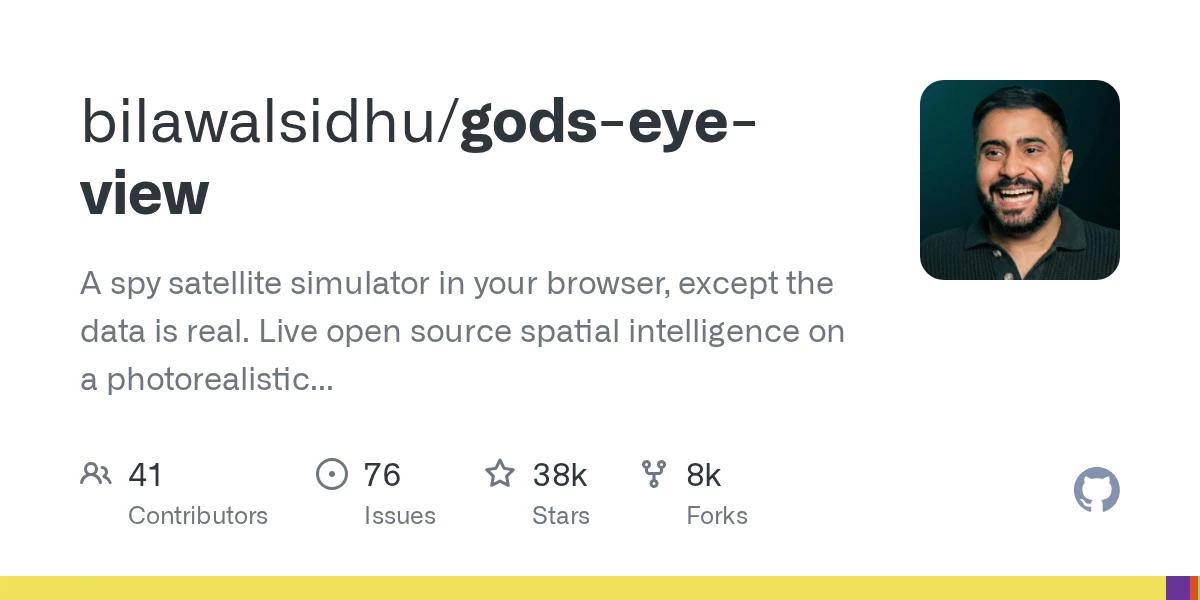
    bilawalsidhu/gods-eye-view repository preview

    A spy satellite simulator in your browser, except the data is real. Live open source spatial intelligence on a photorealistic 3D globe.

    Stars
    37,908
    Forks
    7,645
    Open issues
    209
    Last commit
    2026-09-17

    This is its third consecutive appearance. This week added Director scene authoring, import previews and shareable bundles, and distinguished partial vessel snapshots from stale feeds; the emphasis is shifting from adding layers to making spatial stories replayable.

    Builders of public-transit, geography-teaching or spatial-interaction prototypes can combine public feeds and let a voice agent adjust views, layers and annotations.

    The README now explicitly states MIT, resolving the license uncertainty recorded last issue; third-party maps and datasets retain separate terms, vehicle positions include simulations, and the project rules out navigation and other safety-critical use.

  3. ayghri/i-have-adhd

    AI codingPython
    This week+7,869
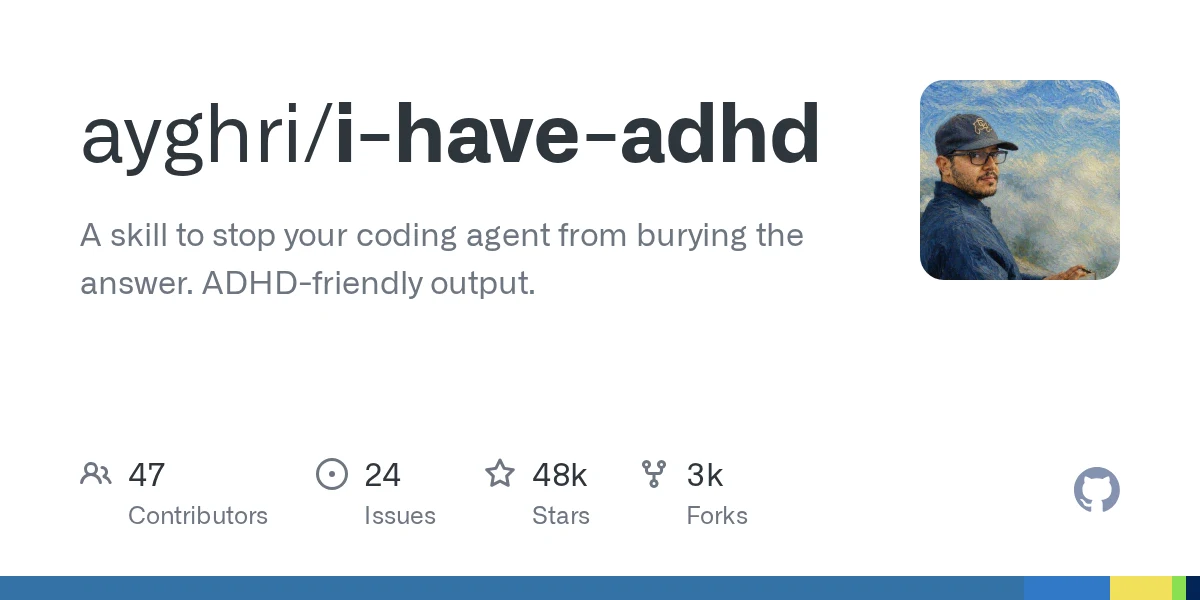
    ayghri/i-have-adhd repository preview

    A skill to stop your coding agent from burying the answer. ADHD-friendly output.

    Stars
    48,135
    Forks
    2,800
    Open issues
    73
    Last commit
    2026-09-16

    On its second consecutive appearance, the project added evidence for whether shorter answers actually save money: September 15 brought session-scenario evaluation and reports of token and cost differences, including input overhead.

    People who repeatedly hunt for the next command inside long answers can start with routine tasks and check that shorter responses retain necessary context.

    It changes output habits and is not a medical intervention; a five-item list cap and state restatements can conflict with complex analysis, and fewer output tokens do not guarantee a lower total cost.

  4. affaan-m/ECC

    AI codingJavaScript
    This week+5,877
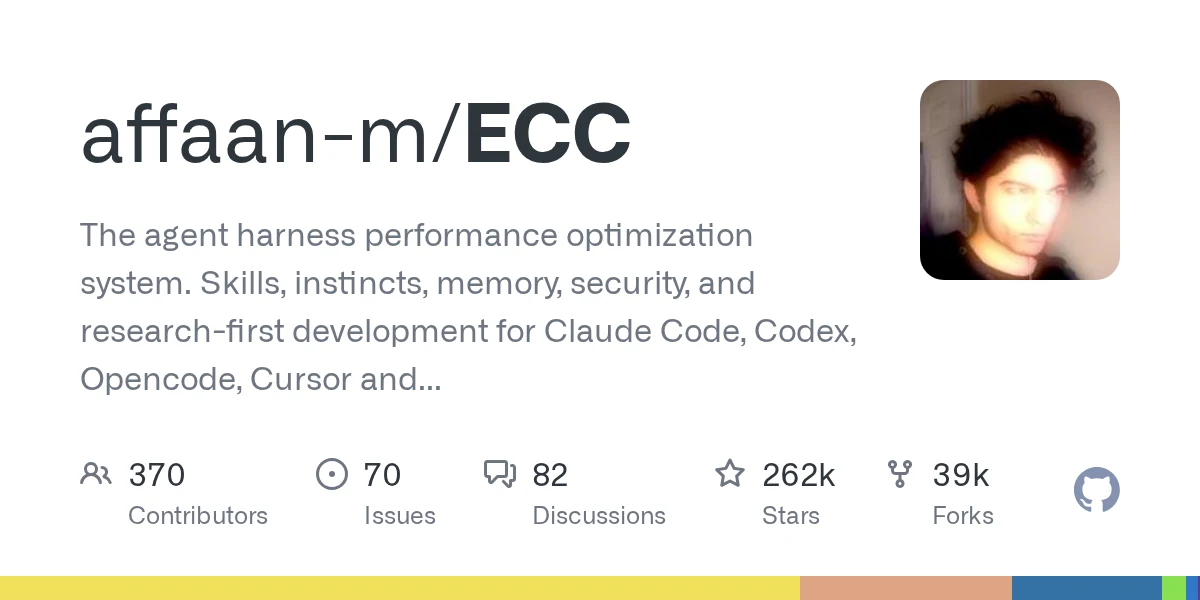
    affaan-m/ECC repository preview

    The agent harness performance optimization system. Skills, instincts, memory, security, and research-first development for Claude Code, Codex, Opencode, Cursor and beyond.

    Stars
    262,143
    Forks
    39,223
    Open issues
    210
    Last commit
    2026-09-19

    On its second consecutive appearance, September 19 brought concrete fixes: forwarding generation limits to Ollama, correcting plugin-agent locations and ecc: namespaces, and reducing GateGuard false positives on heredoc prose. This week's changes now extend beyond sponsor documentation.

    Teams maintaining several coding-assistant configurations can begin with one review or memory module they actually need and inspect the host-support matrix.

    The formal release remains v2.2.1, so fixes merged into main today are not necessarily in the installed package; host adapters also differ, and hooks, MCP tools and memory scripts should be reviewed module by module.

  5. stablyai/orca

    AI codingTypeScript
    This week+5,272
    stablyai/orca repository preview

    Orca is the ADE for working with a fleet of parallel agents. Run any coding agent with your own subscription. Available on desktop, mobile and remote runtime.

    Stars
    72,040
    Forks
    4,709
    Open issues
    6,334
    Last commit
    2026-09-19

    It brings terminal agents, worktrees, an editor and mobile monitoring together. This week's v1.4.205 hardened failure cleanup; today's main branch also fixed loss of the only remote-pane scrollback copy when parking a terminal and shortened the database-row hold during relay control admission.

    Developers shipping several independent tasks across different models can first test notifications, recovery and merging with two loosely coupled tasks.

    Model usage comes from your own agent subscription or configuration; mobile access depends on a desktop and relay, and release notes warn of a merge-to-release delay, so today's terminal and relay fixes require checking the installed version.

    Deep dives

    After opening several agents, developers often lack task state: which branch is running, which needs input and which has changed code without tests. Orca brings sessions, worktrees and the editor together while retaining CLI control. It reduces time spent piecing together terminals, directories and transcripts; it does not improve the model's coding ability by itself.

    The most revealing release details concern failure cleanup: stop deletion when an archive script fails, and preserve an unknown child-process state instead of guessing it finished. Such behavior determines whether several tasks can be left running. A phone notification is only an entry point; returning to the correct worktree, restoring context and inspecting the diff complete the handoff.

    Start with two tasks whose file boundaries are clear rather than dispatching ten requests. Measure review, rework and merge time as part of total elapsed time. Database migrations, shared interfaces and changes to one state machine still need an agreed dependency order. Worktrees separate files, not semantic conflicts.

  6. This week+4,703
    Tencent/WeKnora repository preview

    Open-source LLM knowledge platform: turn raw documents into a queryable RAG, an autonomous reasoning agent, and a self-maintaining Wiki.

    Stars
    27,047
    Forks
    3,639
    Open issues
    680
    Last commit
    2026-09-18

    WeKnora combines document Q&A, a ReAct agent and a maintainable wiki. This week's main-branch work added persistent compaction checkpoints, window-aware history sizing and fixes for cross-workspace access in shared spaces, showing that knowledge platforms must handle permissions and long-running state.

    Teams with evolving internal documents can test citations, revisions and rollback on a realistic sample before adopting both source retrieval and maintained knowledge pages.

    The formal release is still September 3's v0.8.0, so deployments must verify whether this week's main-branch fixes are included; models, retrieval, storage and sandboxes need configuration, and automatically organized knowledge still needs an accountable reviewer.

    Deep dives

    Basic document Q&A chunks material, retrieves passages and asks a model to answer; when sources change, readers still reconstruct topics themselves. WeKnora's Wiki mode goes further by having an agent produce linked pages with manual editing, revision history and rollback. It resembles a maintained internal knowledge site, so evaluation should include how outdated conclusions get corrected.

    This week's shared-space access fixes deserve attention before feature breadth. An accurately cited answer still fails if it uses material from a workspace the reader cannot access. Test isolation across roles and knowledge bases and verify that the pinned image includes required fixes; a fix on main does not establish that the deployed version contains it.

    An automatically generated wiki creates maintenance responsibilities: who approves pages, what happens after source deletion and whether regeneration overwrites human edits. Start with a bounded product-documentation set, compare citation completeness against direct retrieval, and check whether non-developers understand revision and rollback. Without that process, more pages merely make stale information easier to find.

  7. This week+3,766
    Panniantong/Agent-Reach repository preview

    Give your AI agent eyes to see the entire internet. Read & search Twitter, Reddit, YouTube, GitHub, Bilibili, XiaoHongShu — one CLI, zero API fees.

    Stars
    83,156
    Forks
    7,286
    Open issues
    150
    Last commit
    2026-09-15

    This week added a Boss Zhipin channel for job search and full job descriptions, with a read-only diagnostic for installation, browser port and page state; platform differences continue to sit behind replaceable backend choices instead of being rediscovered by every agent.

    People organizing public technical discussions, video transcripts or user-supplied job leads can enable only the channels they need and verify each channel's output.

    Some platforms still require user-controlled login sessions, cookies or additional tools; the description's zero-API-fee claim does not eliminate model and operating costs or guarantee reliability after platform changes.

  8. obra/superpowers

    AI codingShell
    This week+3,573
    obra/superpowers repository preview

    An agentic skills framework & software development methodology that works.

    Stars
    288,568
    Forks
    25,809
    Open issues
    366
    Last commit
    2026-09-19

    Today's v6.4.1 changes the earlier assessment: it adds session-failure diagnosis, rebuilds plan execution as Native mode, and supports OpenCode 2.0, Muse and Qwen Code. Version 6.4.0 was never shipped; v6.4.1 is the relevant release.

    Teams choosing between delegated agents and one-session execution, or investigating repeated work and ignored plans, can compare cost and rework on an existing plan.

    Native mode now executes the whole plan before a final review instead of checking in every few tasks; diagnosis reads local transcripts, so inspect stopping boundaries and transcript scope before upgrading rather than assuming the old cadence.

  9. blader/humanizer

    AI codingPython
    This week+3,118
    blader/humanizer repository preview

    Agent skill that removes signs of AI-generated writing from text

    Stars
    49,977
    Forks
    4,034
    Open issues
    22
    Last commit
    2026-09-06

    Attention continues after September 6's v3.0.0 reorganized writing guidance into 25 patterns in five groups and removed the ai-detection keyword. No new commits were found this week, so continued star growth should not be presented as a new release.

    Editors of technical blogs, product copy and team announcements can have it flag empty sentences, contrived contrasts and repetitive endings before the author decides how to revise.

    Style is not proof of authorship, and this is not a reliable AI detector; rewriting can erase necessary qualifications or personal voice, so facts and quotations still require separate checks.

  10. addyosmani/agent-skills

    AI codingJavaScript
    This week+3,051
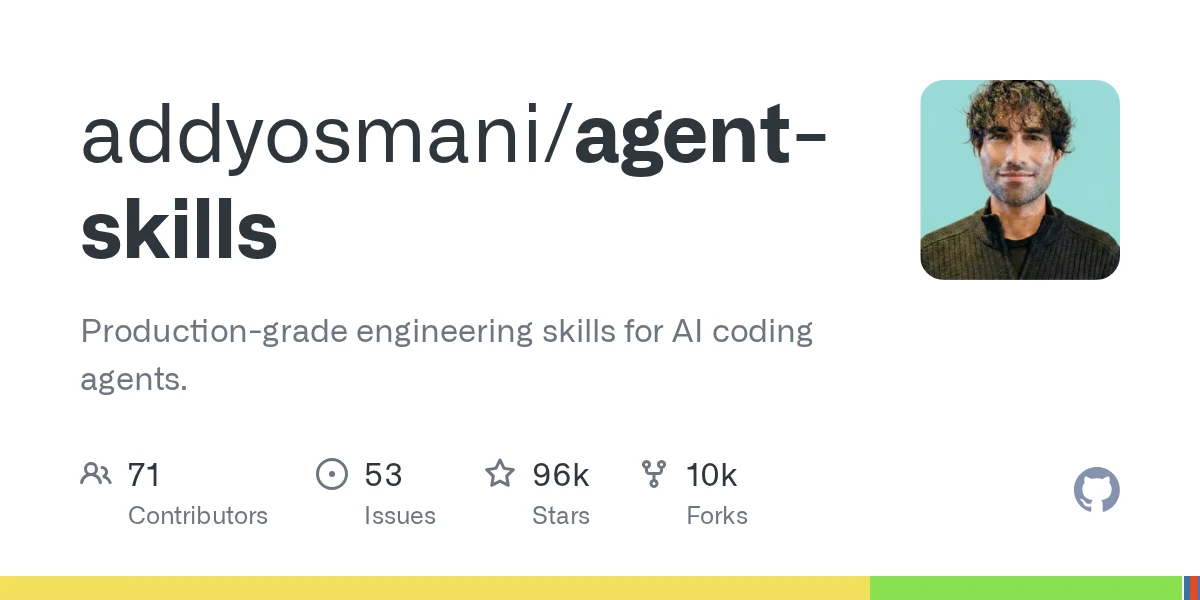
    addyosmani/agent-skills repository preview

    Production-grade engineering skills for AI coding agents.

    Stars
    96,459
    Forks
    10,199
    Open issues
    111
    Last commit
    2026-09-18

    It returns to the top ten after Issue 01. September 18's 0.6.10 stops automatic SessionStart injection of the meta-skill to avoid duplicating native discovery, and fixes a simplify-ignore hook that could overwrite externally made edits at session end.

    Teams with an existing engineering process can add one skill for requirements, performance auditing, review or delivery checks; the repository currently offers 25 skills and nine workflow commands.

    Installing a single skill does not bring the repository-root shared checklists, a gap documented with workarounds in the README; configurations relying on the old startup injection also need adjustment, and file access by rules and hooks should be inspected before installation.

This week's trend signals

Open Code Review now leads in weekly star growth, and Addy Osmani's agent-skills returns to the top ten, concentrating the chart further on coding workflows and acceptance. Dedicated review tools, skills and parallel workspaces address different problems: finding defects, guiding execution and tracking task state. Installing all three does not complete a process; first identify where the team repeatedly reworks its output.

Today's releases also change how the attention should be interpreted. Superpowers v6.4.1 introduces Native execution of an entire plan followed by one final review; agent-skills removes startup injection that duplicates native discovery and fixes a hook that overwrote edits. One reduces handoffs during execution, while the other reduces side effects from the rules themselves. Both reconsider the cost of process.

Three projects return from last issue: God's Eye View for a third consecutive week, and i-have-adhd and ECC for a second. The first still requires distinguishing observations, delayed feeds and simulations; the latter two are measuring communication costs and fixing model adapters and rule invocation. Continued star growth can reflect circulation or substantive maintenance, and commits and releases help distinguish them.

WeKnora keeps RAG in the top ten, while inference, multimodal and infrastructure categories are absent this time. We would first try capabilities that retain evidence and recover state: archivable reviews, reversible knowledge revisions and remote-task output that survives session changes. Repository descriptions preserve source wording; promotional claims should be read alongside the commentary and limitations.

Ranking figures as of Sep 19, 2026, 3:24 AM UTC

via: GitHub Trending weekly, each project's GitHub repository, README, commits and releases