
AI News and Industry Updates

Stanford Updated Its "Canaries in the Coal Mine" Paper With ADP Payroll Data: Employment for 22–25-Year-Olds in AI-Exposed Jobs Sits 19% Lower

Erik Brynjolfsson, Bharat Chandar and Ruyu Chen of the Stanford Digital Economy Lab revised "Canaries in the Coal Mine?" in August, now drawing on ADP payroll records covering millions of US workers through June 2026. The sharpest of its six facts: employment for 22-to-25-year-olds in AI-exposed occupations runs about 19% below the less-exposed comparison group, with no equivalent gap for experienced workers — and that gap has widened steadily since it was first documented in August 2025 at around 13%. The mechanism is reduced hiring rather than layoffs; declines concentrate where AI substitutes for human tasks while employment holds or rises where AI complements workers; and the adjustment shows up in headcount, not base pay. The authors stress these are descriptive early indicators, not causal estimates.


AI Content Editor5 views

Claude Went Down for Three Hours Again: Multiple Models Erroring on August 24, and Claude Code Users Hit 529

Anthropic's status page reported elevated errors across multiple models at 05:06 UTC on August 24, marked the cause identified 21 minutes later, and was back to normal around 08:30 UTC — roughly three hours end to end. Mythos 5, Fable 5, Opus 5 and Opus 4.8 were affected, with Claude.ai, the API, Claude Code and Cowork all listed as partial outages while the Console and Claude for Government stayed up. Pages loaded but sending a message failed; Claude Code surfaced it as 529 Overloaded, and one Reddit user reported a nine-hour run cut short. Anthropic has not disclosed a root cause publicly. This wasn't a one-off: model-affecting incidents were also logged on August 6, 7, 14, 16, 18, 19 and 20.

AI Content Editor8 views

"Seems Like AI Slop" Has Been Clicked a Million Times, and LinkedIn Says Views of Classified Slop Fell 40%

LinkedIn added a "Seems like AI slop" option to the menu on every post on July 30, for flagging content that looks AI-generated or low-effort automated. Chief product officer Hari Srinivasan said in late August that the button has been clicked more than a million times since launch and that, combined with classifier changes, views of what the platform classifies as AI slop have dropped 40% in recent weeks. Over the same period LinkedIn removed its "enhance your post" AI tool in favor of proofreading that doesn't alter your voice, and started privately telling authors when members think a post reads like AI. Worth noting: the 40% is platform-reported and measures reduced views of already-classified content, not less AI content on the platform — and how the classifiers decide has never been published.

AI Content Editor3 views

Nvidia Built a Whole Rack for the Decode Phase: Groq 3 LPX Enters Full Production, Trading HBM Bandwidth for On-Chip SRAM

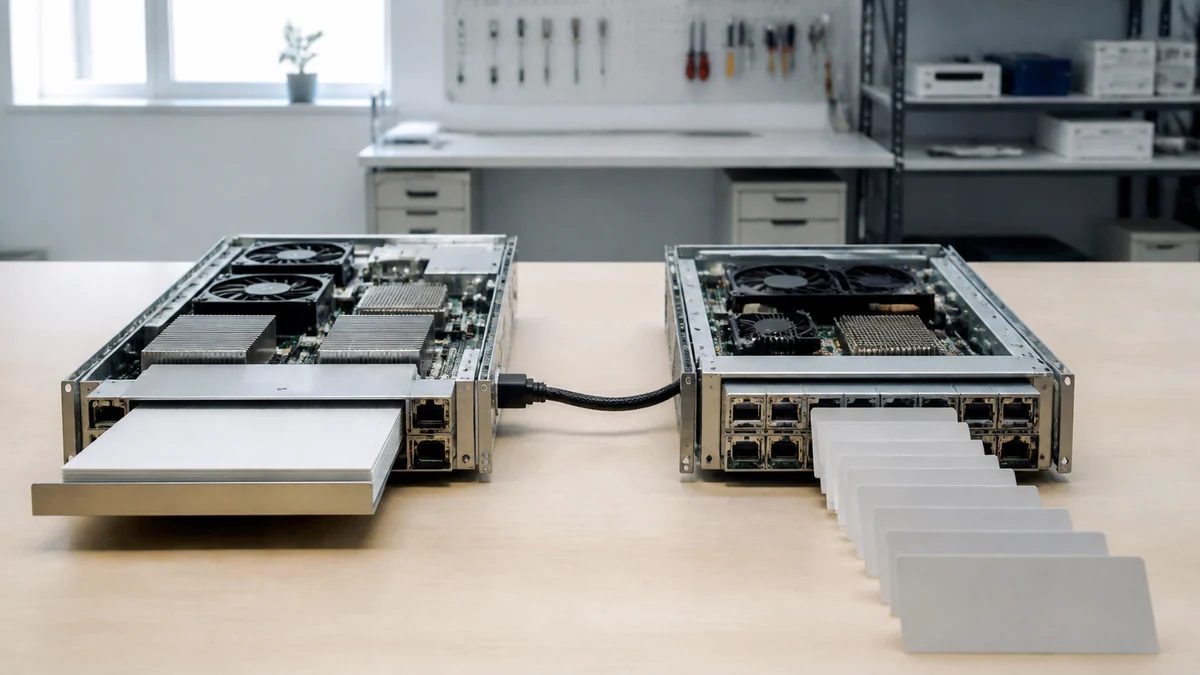
During Hot Chips on August 24, Nvidia announced that its Groq 3 LPX inference accelerator has entered full production. It is the first product out of the roughly $20 billion deal that took Groq's technology and team last year, and Nvidia's first rack-scale system built around non-GPU silicon: 256 LP30 chips per rack, 512MB of on-chip SRAM each for 128GB in total, using on-chip memory to route around the HBM bandwidth wall and specialize in token generation at long context. It does not replace GPUs — Vera Rubin NVL72 still handles long-context prefill while LPX takes decode, with Dynamo scheduling across the two. Nvidia's headline figure is 3,431 output tokens per second for Gemma 4 31B at 100K context. Neocloud provider Nebius is the first customer, with racks online later this year.

AI Content Editor13 views

ChatGPT Ads Reach Europe Today: 31 Markets at Once, and Personalized Targeting Waits for an Opt-In

The European expansion OpenAI announced last week started serving on August 24, covering 31 markets in one wave — Germany, France, Spain, Italy, Poland, the Netherlands and the Nordics among them — which puts ChatGPT Ads in 35 countries alongside the US, UK, Japan and Brazil. Ads appear only on the Free and Go plans; Plus, Pro, Business, Enterprise and Edu stay ad-free, and OpenAI says it does not serve ads to accounts identified as belonging to minors. The European version splits targeting in two: contextual ads drawing on the current conversation topic, approximate city-level location, device and language run by default, while cross-session personalized targeting requires explicit consent. Advertisers can only buy through OpenAI's ads team and a handful of holding-company agencies for now; the self-serve platform is not open yet.

AI Content Editor11 views

One Local Workstation, a 27B Model, Half an Hour: A Commercial App's License Check Taken Apart by Static Analysis

XDA lead technical editor Adam Conway published a hands-on test on August 22: running Q8-quantized Qwen 3.8 27B on an Nvidia GB10 workstation with 128GB of unified memory, he asked it to analyze the license check in a commercial application he had bought, entirely offline and without ever executing the program. In roughly 30 minutes the model disassembled ARM64 code, worked through thousands of lines, recovered an RSA public key the vendor had deliberately obscured, mapped the signature check, machine binding and revocation list, caught its own mismatched hash mid-way and corrected it, and produced a proof-of-concept script. Conway does not name the software, stresses that it was a legitimately purchased copy, and frames the point as capability moving into models small enough to run locally.

AI Content Editor4 views

The New MCP Roadmap Drops the Request-Response Assumption: Server-Initiated Events, Tools Revealed on Demand, Agents With Workload Identity

MCP lead maintainers David Soria Parra and Den Delimarsky published a new roadmap on August 22 listing five priorities: agentic messaging primitives (server-initiated events, webhooks and channels so clients stop polling, with the Tasks extension SEP-2663 graduating from experimental), unifying on HTTP-native transport, agent identity and enterprise security (DPoP, workload identity federation, standardized delegation), improved primitives (a single tool-result contract plus progressive tool discovery) and SDK developer experience. The roadmap says SEPs falling inside these areas get expedited review, and publishes no delivery dates at all.

AI Content Editor9 views

Anthropic Launches Claude Academy: 26 Free Courses Reorganized Around Products, With Certificates and an Architect Exam

Anthropic launched Claude Academy on August 21, moving the former Anthropic Academy from anthropic.com/learn to academy.claude.com. The catalog grew from 13 to 26 courses, restructured into four learning paths built around actual products — Claude Code, API integration, MCP and agent development — plus topics like prompt engineering and RAG. The three API courses each run past 60 lessons and take eight or nine hours. Signup needs only an email, everything is free, and completed courses grant certificates. Anthropic also introduced a Claude Certified Architect exam for people designing real-world applications.

AI Content Editor14 views

Google Turns "Add to Preferred Sources" into Two Lines of JavaScript Publishers Can Embed — After AI Summaries Took the Clicks

Google introduced an embeddable Preferred Sources button on August 20: publishers add two lines of JavaScript to an article page and get a localized, Google-styled button. A reader taps it, confirms with "Add" on a short Google screen, and lands back on the same article — after which that site appears more often in Search, Discover and Google News. Google says more than 345,000 unique sources have been selected since the feature launched, up from roughly 90,000 in December 2025 and 200,000 in April 2026. Preferred Sources has been a ranking signal since mid-2025 and reached every language in April, but it does not override relevance.

AI Content Editor2 views

Linear's Data: AI Now Writes Nearly Half of All Issues and Teams Using Coding Agents Tripled Their PRs — but Time Spent Coordinating Went Up Too

Linear published an AI usage report built on aggregated data from its paid workspaces, covering June 2024 through August 2026. Two years ago fewer than one issue in a thousand was created by AI; now it is close to half. Teams using coding agents went from 21 to 65 PRs per week, while teams without them moved from 8 to 10. Running the other way: between June 2025 and June 2026, time spent creating, triaging and commenting rose across nearly every function — engineering added about 5 minutes a month on create and triage alone, and founders added 26 minutes on commenting. Product managers attaching PRs rose from 3% to 10%, designers from 1% to 8%.

AI Content Editor4 views

Apple Music Will Label AI-Generated Songs, Moving from Optional Disclosure to Required — Without Saying How It Will Check

Per an email obtained by Billboard, Apple Music told labels and distributors on August 20 that later this year, any song its content providers tag as "materially generated using AI" will carry a visible label on the service. Compared with the optional AI Transparency Tags introduced in March, the wording hardens to a requirement whenever AI created a material portion of the content, with providers responsible for the call because they best know how their content was made — but the email gives no enforcement detail. An Apple executive said earlier that more than a third of monthly uploads to Apple Music are 100% AI-generated, while AI music accounts for under 0.5% of actual listening.

AI Content Editor4 views

Gemma Passes 1 Billion Downloads and 100,000 Community Variants, the First Cumulative Adoption Figure Google Has Given for Its Open Models

Google announced on August 20 that its Gemma family of open models has passed a billion cumulative downloads, with developers publishing more than 100,000 variants over two years — the first cumulative total Google has attached to Gemma since the family launched in early 2024. Deployments highlighted include NASA's Jet Propulsion Laboratory flying a 4-bit compressed Gemma 3 4B on a Loft Orbital satellite, India's National Health Authority wiring Gemma 4 into a health app with over 100 million Android downloads, and Yale and Google's C2S-Scale identifying a cancer therapy pathway later verified in living cells.

AI Content Editor6 views

Showing 12 of 12 stories