
GitHub AI Weekly · Issue 04

GitHub AI Weekly · Issue 04 (Sep 5, 2026) · AI Beyond

2026 week 361 views

This issue covers the GitHub Trending weekly board for week 36 of 2026, taking the first 10 AI projects allowed by our editorial rules in descending order of stars gained this week. They span AI coding, agents, multimodal tools and model inference; every entry covers what changed, where it fits and what to check before adopting it, with three deeper reads. Figures are current to Sep 5.

Top 10 projects

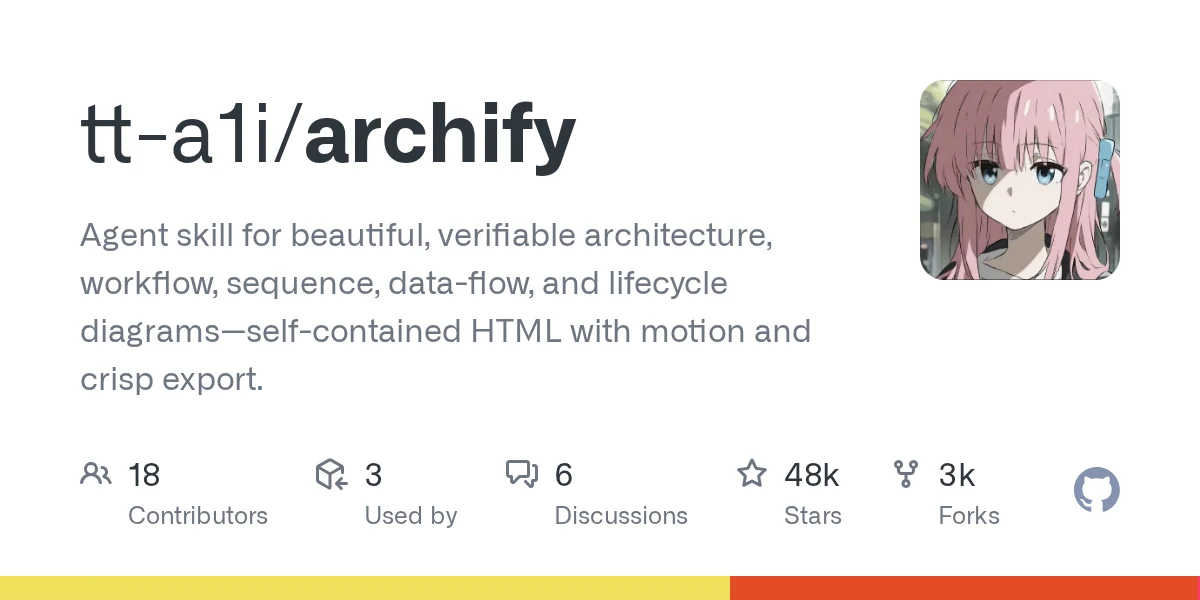
  1. tt-a1i/archify

    AI codingJavaScript
    This week+24,227
    tt-a1i/archify repository preview

    An agent skill that compiles typed intermediate data into verifiable architecture, workflow, sequence, data-flow and lifecycle diagrams, delivered as self-contained HTML.

    Stars
    48,036
    Forks
    3,100
    Open issues
    112
    Last commit
    2026-09-04

    It is charting for a second consecutive week, and this one is not momentum alone: v2.16.0 shipped on Aug 30 with a constraint-driven compiler, reproducible archives, a localized viewer and a RAG architecture example, followed by fixes for license provenance, preview-watcher fallback and CLI argument validation.

    Developers already asking Codex, Claude Code or OpenCode to read repositories can try it on one real system when they need the structure turned into a reviewable artifact.

    The diagram captures an agent's interpretation of code and documentation, not ground truth; using it in review still requires source checks, and 112 open issues show that a fast-growing project has plenty of edges left.

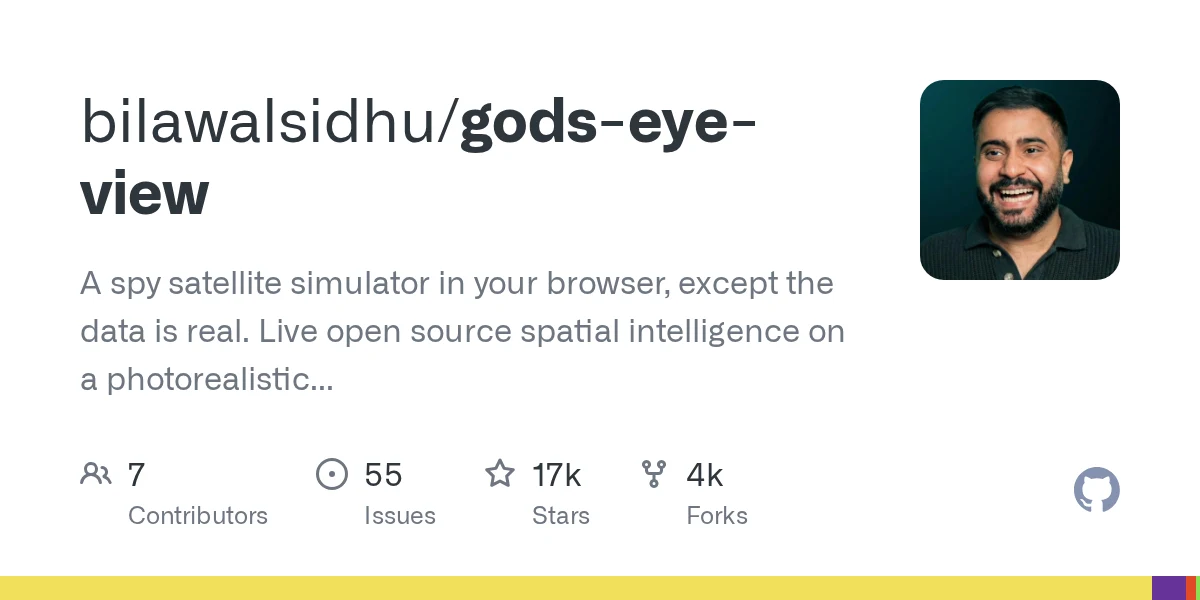
  2. bilawalsidhu/gods-eye-view

    AI agentsJavaScript
    This week+10,485
    bilawalsidhu/gods-eye-view repository preview

    A browser-based 3D spatial-intelligence interface that layers public aircraft, vessel, satellite, earthquake, traffic and camera feeds onto a globe, with control through a realtime voice agent.

    Stars
    17,493
    Forks
    3,528
    Open issues
    124
    Last commit
    2026-09-04

    The project opened its source and released v0.1.0 and v0.1.1 this week, turning the showcase videos into something people could launch keyless through Pinokio; the patch then repaired macOS startup, dropped fire batches and response-size handling for live feeds.

    People building maps, public-data tools, OSINT visualizations or spatial-interaction prototypes can pull apart its data layer, Cesium scene and voice tool calls.

    Do not mistake the cinematic surface for uniform data precision: keyless traffic is simulated, camera poses and rocket trajectories are coarse estimates, and voice requires a metered OpenAI API; GitHub currently identifies no standard license, so reuse also needs a rights check.

    Deep dives

    The visual makes this easy to misread as a movie-control-room demo. The more useful part to study is the orchestration underneath it. Aircraft, vessels, satellites, earthquakes, public cameras and bike stations come from different open feeds with different refresh rates, coordinate quality and authentication. God's Eye View pulls those signals into one spatial interface, then lets a user move from an object on the globe to its current state.

    AI is only one layer, but it has a concrete job. The voice agent is wired to 28 action tools for switching layers, finding places, selecting nearby contacts and framing the camera; at street level it can also inspect the current view for visible signs. Without an OpenAI key the globe still works, while voice and the AI HUD summary switch off. That graceful degradation is healthier than binding the entire application to one model endpoint.

    The more the screen resembles an intelligence system, the more its source notes matter. The repository says plainly that some traffic is simulated along real roads, camera orientation and rocket trajectories are estimates, and free and paid feeds carry different quotas. It is a compelling interactive laboratory for public data. Using a screenshot as an operational claim goes beyond what the project can guarantee.

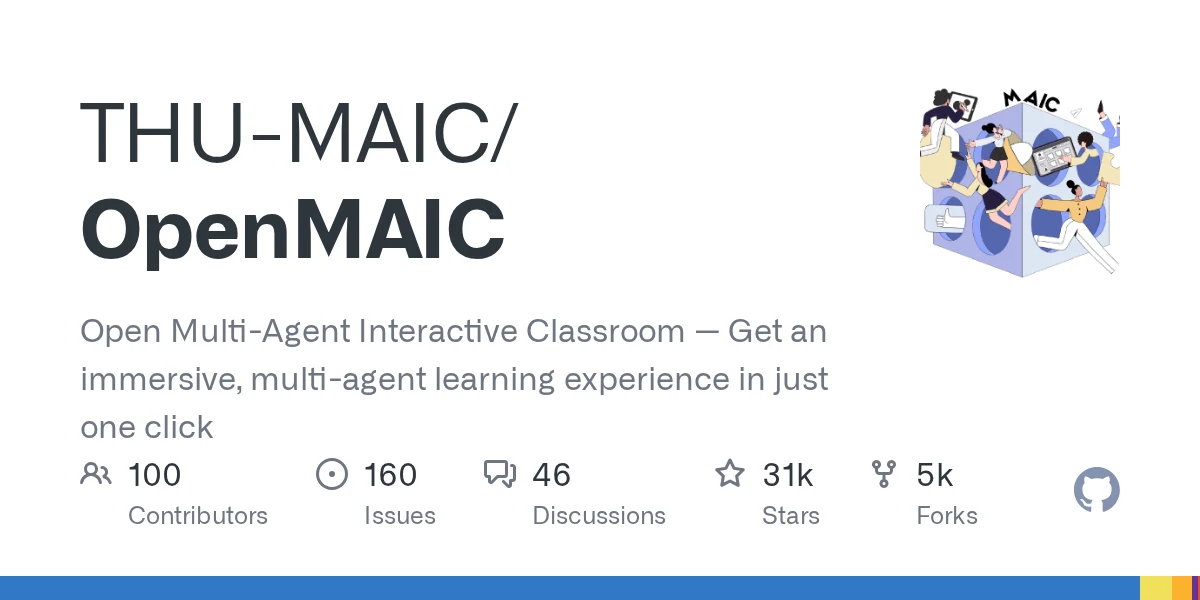
  3. THU-MAIC/OpenMAIC

    AI agentsTypeScript
    This week+10,023
    THU-MAIC/OpenMAIC repository preview

    An open multi-agent classroom builder that starts from a prompt or uploaded documents, audio, video and web material, then generates and revises lessons, quizzes, interactives, images and narration.

    Stars
    31,497
    Forks
    5,183
    Open issues
    217
    Last commit
    2026-09-04

    The Aug 27 v1.0.0 release replaced one-shot generation with a conversational course workbench whose runs can be paused and resumed, and that launch carried into this week's board; recent commits then added concise session titles, Exa search and double-click canvas text while bounding media requests, skill retries and archive expansion.

    Teachers, training teams and education-product builders who need existing material turned into a playable course prototype can validate the structure in the hosted demo before deciding whether to self-host.

    Facts, answer keys and media rights still need a page-by-page human review; self-hosting requires at least one model provider or a local Lemonade setup, while durable storage, media extraction and video export add Postgres, FFmpeg and container work, and the example persistence authentication is explicitly not production-ready.

    Deep dives

    OpenMAIC used to look like “enter a topic and wait for a classroom.” Version 1.0 turns it into a production desk you can negotiate with. The agent plans the curriculum and builds page by page; you can upload documents, audio and video as source material, cancel or resume a run, and ask it to rebuild one part. That is not the flashiest change, but it determines whether the tool can leave demo territory and enter real lesson preparation.

    The difficult part of a long course is not producing one attractive page. It is keeping page fifteen attached to the same learning objective and recovering without restarting the whole job. This week's commits expose exactly those engineering problems: media requests need unique IDs, scene-generation retries need a ceiling, bottom table rows cannot disappear in playback, and failure causes must survive. Those are closer to production needs than another animation preset.

    It is ready to try, not ready to turn “course generated” into “course complete.” Material extraction can miss context, a model can make a smooth explanation wrong, and every quiz deserves its own check. A shared deployment also has to replace the sample authentication intended only for localhost or a trusted network. The safest role today is first-draft structure and an interactive prototype, with a teacher retaining publication control.

  4. This week+7,370
    K-Dense-AI/scientific-agent-skills repository preview

    A skills collection for research agents spanning bioinformatics, chemistry, medicine, drug discovery and scientific visualization, with access to more than 100 databases; the repository description says 165 skills while the README currently lists 163.

    Stars
    42,632
    Forks
    3,899
    Open issues
    31
    Last commit
    2026-09-02

    This week's concrete additions are paper arXiv:2609.00065 and v2.66.0, alongside a shift from Claude-specific wording to the open Agent Skills standard; the release itself is mostly documentation, citation and scanner-report work rather than a sudden batch of new research capabilities.

    Researchers already doing analysis, literature retrieval or computational biology in Codex, Claude Code, Cursor or Gemini CLI are better served installing a small topical subset than importing the entire collection.

    The repository itself warns against installing everything at once: a skill can execute code, install packages, use the network and modify files, while community submissions cannot be exhaustively reviewed; individual skills also bring their own databases, credentials and Python dependencies, and their output does not replace research validation or clinical judgment.

  5. debpalash/VoiceStudio

    MultimodalPython
    This week+3,902
    debpalash/VoiceStudio repository preview

    A local-first voice workbench for dubbing, voice cloning and design, transcription, dictation and audiobook workflows; the repository lists 16 TTS engines, 11 ASR engines and a 646-language catalog.

    Stars
    17,928
    Forks
    2,354
    Open issues
    24
    Last commit
    2026-09-04

    Momentum from v0.5.1 was still running when this week's main branch added watch-folder ingestion, realtime dubbing preview and a simpler voice-design panel, then fixed non-English Windows install paths, stale backend processes and several localized interfaces.

    Podcast, audiobook and video teams that want recordings and models to stay on their own machines can choose an engine around their language and hardware rather than a single cloud plan.

    The 646-language figure is the union of the catalog, not equal quality in every engine; the default local workflow asks for at least 8 GB of RAM and 10 GB of disk, accelerated work starts around 4 GB of VRAM with 8 GB preferred, the application is AGPL-3.0, and downloaded models keep their own terms.

  6. jingyaogong/minimind

    InferencePython
    This week+3,122
    jingyaogong/minimind repository preview

    An educational, from-scratch small-language-model repository covering data cleaning, pretraining, SFT, LoRA, DPO, PPO, GRPO, tool use, agentic RL, distillation and serving, with a roughly 64M-parameter dense model on the main path.

    Stars
    58,527
    Forks
    7,605
    Open issues
    60
    Last commit
    2026-09-04

    The repository kept exposing the experiment surface this week: random seeds and MoE expert configuration reached the CLI, benchmark tables gained resolution notes, and a confusing expert-argument path was then removed. The attraction is not a new frontier model but a training stack people can follow end to end.

    Students and engineers who want to run the entire language-model training, alignment and serving path themselves can learn more cheaply on 64M parameters than by starting inside a multi-billion-parameter codebase.

    The README's two-hour claim refers specifically to one SFT epoch on a single RTX 3090, not complete pretraining plus alignment in two hours; a 64M model is useful for teaching and testing code paths, not as a proxy for production-model quality.

  7. every-app/open-seo

    AI agentsTypeScript
    This week+2,941
    every-app/open-seo repository preview

    A self-hostable SEO workbench for keyword research, rankings, competitors, backlinks, audits and AI visibility, exposing its data to Claude Code, OpenClaw and other agents through MCP and Agent Skills.

    Stars
    17,017
    Forks
    2,117
    Open issues
    150
    Last commit
    2026-09-03

    Version 0.1.7 on Sep 2 added deeper SERP loading on demand and repaired Search Console Discover and Google News reports in MCP, crashes during tool-heavy answers, and blank screens in older browsers; the two commits after the release are blog content only.

    Small teams already willing to pay for underlying SEO data, and wanting an agent to query it and run fixed research workflows, can self-host it through Docker or Cloudflare.

    Open source does not make the data free: self-hosting still requires a DataForSEO key and usage charges, while the hosted service adds a margin; 150 open issues and several external data dependencies make this an adaptable young product, not a zero-cost replica of Semrush's coverage.

  8. abi/screenshot-to-code

    MultimodalPython
    This week+2,412
    abi/screenshot-to-code repository preview

    A tool that converts screenshots, designs and screen recordings into HTML, Tailwind, React, Vue, Bootstrap or Ionic prototypes, with an optional browser preview for visual checking.

    Stars
    77,685
    Forks
    9,454
    Open issues
    141
    Last commit
    2026-08-14

    The repository has had no new commit since Aug 14, so this week's 2,412 stars are renewed circulation around an established project, not evidence of a feature release.

    People who need a runnable front-end skeleton from a competitor screenshot or static design get the clearest time saving by treating the output as a first pass and then taking over components and interactions.

    Local use needs at least one OpenAI, Anthropic or Gemini key, with Gemini and Replicate separately recommended for asset extraction and image work; a screenshot cannot reveal business logic, responsive rules or accessibility semantics, every output needs review, and the maintainers do not recommend local Ollama models for final quality.

  9. This week+2,324
    google-research/timesfm repository preview

    A pretrained time-series foundation model from Google Research for zero-shot forecasting; version 3.0 natively handles univariate and multivariate series plus past-only and past-and-future dynamic covariates.

    Stars
    31,041
    Forks
    2,956
    Open issues
    236
    Last commit
    2026-09-04

    TimesFM 3.0 entered this week's board after its Aug 28 release; commits this week did not add another headline feature, but fixed KV-cache indexing in batched decoding, covariate-window alignment after context truncation, and rejection of unsupported SwiGLU configuration.

    Data teams with sales, traffic, capacity or sensor series can use it as a zero-shot baseline before comparing it against statistical models and task-specific training.

    The code is Apache-2.0, but the TimesFM 3.0 pretrained weights currently use a separate non-commercial license that explicitly forbids commercial and production use; the repository also says this open version is not an officially supported Google product, and the first-week inference fixes make version pinning and regression tests essential.

    Deep dives

    Last issue had no model repository in the top ten. TimesFM and MiniMind bring that slot back from opposite directions. TimesFM 3.0 is more than a checkpoint refresh: it makes multivariate series and dynamic covariates native inputs, so one model can consider several related signals and future-known information such as holidays or campaign schedules. For sales and capacity forecasting, that is much more useful than extending one historical column.

    The first week after release also shows that 3.0 is still settling. Incorrect KV-cache indexing during batched decoding and misaligned covariate windows after context truncation are the kind of bugs that can produce a plausible but wrong result without crashing. Existing 2.x users should not judge an upgrade by sample plots alone; they need to replay their own backtests case by case.

    The license, not the chart position, decides whether this can ship. Repository code is Apache-2.0 and weights through 2.5 remain Apache-2.0, but the 3.0 weights are currently restricted to non-commercial, non-production use. Research baselines can start immediately. A company either stays on an older permitted checkpoint or confirms terms through Google's supported product routes; open source code does not make the newest model commercially open.

  10. This week+1,846
    handsomestWei/patent-disclosure-skill repository preview

    An agent skill for Chinese patent work, assisting with invention mining, disclosure drafts for invention, utility-model and design patents, plain-language reading of published patents, and office-action response drafts.

    Stars
    7,368
    Forks
    814
    Open issues
    7
    Last commit
    2026-09-04

    This week it split different jobs into separately installable skill packages, restored CNIPA classification fixtures, preserved source formulas, and moved Word generation for office-action responses behind explicit user confirmation — all changes that tighten the document-delivery path.

    Chinese R&D teams that need to structure project material into a first disclosure draft, read published patents in batches or prepare office-action material can use it as a workflow assistant.

    It does not replace a patent attorney or legal advice, and prior-art scope, claims and response strategy all require professional review; the workflow also depends on Python, Playwright, public CNIPA pages and local document conversion, so upstream page changes can require maintenance.

Signals this week

The clearest shift is that the projects at the front now produce something you can point at. Archify delivers architecture diagrams, God's Eye View lays public signals over a 3D globe, OpenMAIC builds a playable classroom and VoiceStudio outputs speech and dubbing. Together they hold four of the top five slots. Last issue was about attaching skills, plugins and free allowances to coding agents. This one is about what an agent actually hands back and whether that result remains editable.

Vertical skills are also moving from broad collections into real jobs. Scientific Agent Skills wraps research databases and analysis packages, OpenSEO puts SEO data behind MCP, and the tenth project handles Chinese patent disclosures and examination material. Their limiting factor is not model intelligence. It is permissions, external data, professional judgment and supply-chain safety. Installing a skill is easier than copying a prompt, but it also delegates the ability to execute code, call the network and change files.

Models returned to the board by taking opposite routes. MiniMind shrinks the full training path into a 64M-parameter system one person can reproduce. TimesFM 3.0 moves multivariate and covariate forecasting into a more practical interface. One is for learning the machinery and the other for establishing a business baseline, but neither should be chosen from a README headline: MiniMind's two-hour figure has a specific hardware and training-stage boundary, while TimesFM 3.0 weights currently cannot be used commercially or in production.

Archify is charting for a second week, with weekly stars rising from 11,099 to 24,227. That proves the demand for agents that draw systems. It does not prove a particular diagram is correct. The same warning applies to screenshot-to-code, automatic courses and spatial intelligence: this week's board rewards visible results, while adoption still depends on verifiable results.

Ranking figures as of Sep 4, 2026, 11:49 PM UTC

via: GitHub Trending weekly, each project's GitHub repository, README, commit history and releases