

GitHub AI Weekly · Issue 03

GitHub AI Weekly · Issue 03 (Aug 29, 2026) · AI Beyond

2026 week 3516 views

This issue covers the GitHub Trending weekly board for week 35 of 2026: the top 10 AI projects by stars gained this week, spanning AI coding, agents, AI infrastructure and multimodal. Each entry states what changed this week, where the project actually fits, and what to know before installing it, with deeper reporting on three of them. Data as of Aug 29.

Top 10 projects

  1. This week+12,877
    freestylefly/awesome-gpt-image-2 repository preview

    Prompt as Code — a GPT-Image-2 prompt engine and template library, with 530+ reverse-engineered cases and 20+ templates packaged as skills you can load into a coding agent.

    Stars
    24,238
    Forks
    2,396
    Open issues
    17
    Last commit
    2026-08-28

    The pace is the story: four separate commits this week added cases 521 through 544, roughly a batch every other day, and the companion gallery lets you filter by style and copy a full prompt in one click.

    If you already have a way to call GPT-Image-2 and would rather not start from an empty prompt box, editing one of these cases beats ten rounds of guessing.

    That said, this is a prompt library, not an image tool — you bring your own model access. The README gives more space to sponsors than to content, with several API relay vendors mixed in among the writeups, so read it with that in mind. Prompts are also version-bound: when the model updates, older cases may stop reproducing.

  2. tt-a1i/archify

    AI codingJavaScript
    This week+11,099
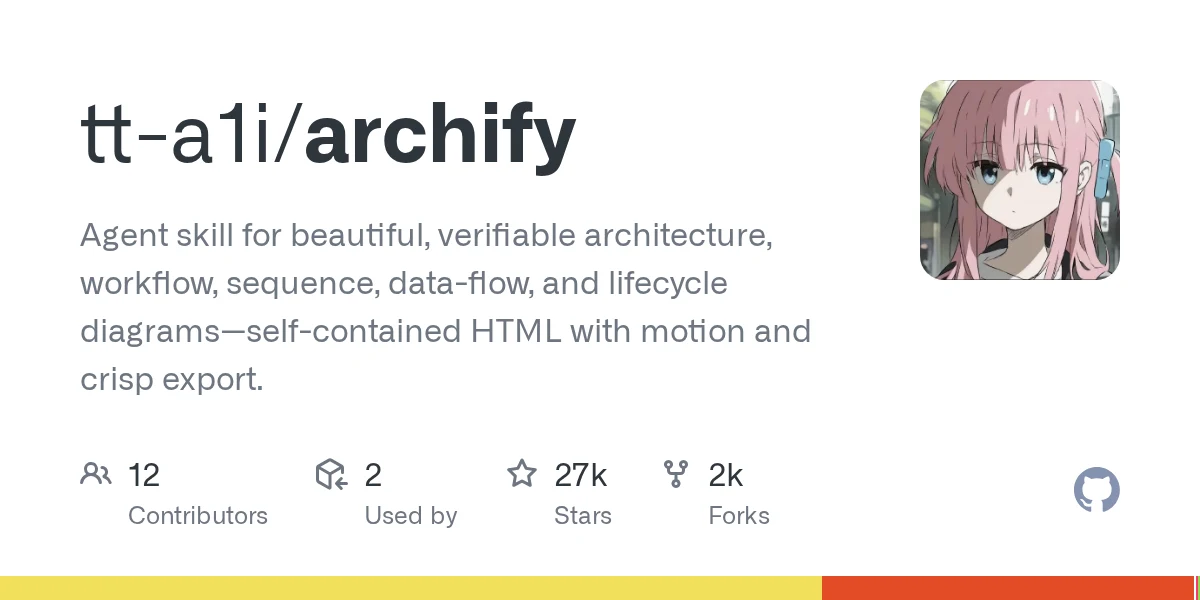
    tt-a1i/archify repository preview

    An agent skill for Cursor, Claude Code, Codex CLI and OpenCode: the agent emits typed JSON, and a local renderer compiles it deterministically into self-contained HTML/SVG architecture, workflow, sequence and data-flow diagrams.

    Stars
    27,415
    Forks
    1,739
    Open issues
    61
    Last commit
    2026-08-28

    Honestly, there is barely a feature commit in the repo this week — what changed was site language switching, a star-history chart and where the viewer's navigation dock sits, and the last tagged release, v2.15.0, is still dated Aug 14. Those eleven thousand stars are word of mouth from the previous fortnight cashing in at once.

    Anyone already writing technical docs with these coding agents who wants the architecture diagram to be checkable against the code will at least stop hand-writing Mermaid.

    The catch is that mainline currently sits at 2.16.0-dev, so features land on the dev version first; output is self-contained HTML/SVG, and real polishing still means opening another tool; and the README and product page are more finished than the documentation, so don't judge maturity from the showcase renders.

    Deep dives

    Last issue this slot belonged to cathrynlavery/diagram-design. This week that project dropped off the board entirely and archify took its place. Same job — get a coding agent to draw an architecture diagram worth looking at — two winners in two weeks. The demand is clearly firmer than any single repository serving it.

    The approach is worth a paragraph. Archify does not let the model emit SVG or Mermaid directly. The agent produces a typed JSON intermediate representation, and a local Node program validates and compiles it. That moves where errors surface: if the model invents a call that does not exist, validation can reject it, whereas a hand-drawn diagram from a model looks identical whether the edges are real or not. It also diffs two snapshots into Before / Delta / After, listing added, removed, changed and rerouted nodes one by one — that is a code-review artifact, not a slide.

    The cold water: no release shipped this week, so what grew was attention, not capability, and there is a full round of changes sitting between the tagged version and dev. Before putting it in front of a team, run it once on a mid-sized repository and see whether it recognises your layering. Drawing something pretty and drawing something correct are different problems.

  3. openai/codex

    AI codingRust
    This week+9,109
    openai/codex repository preview

    Lightweight coding agent that runs in your terminal, written in Rust, with editor and desktop builds alongside the CLI.

    Stars
    119,566
    Forks
    18,254
    Open issues
    14,287
    Last commit
    2026-08-29

    A dozen-plus 0.151.0 alphas went out this week, almost all of them subagent and MCP plumbing: cleaning up the bundled browser when a subagent stops, running executor hooks even for interrupted turns, per-tool MCP output limits, preserved context baselines across nested agent forks, cloud task credentials restricted to trusted origins.

    If you already pay for a ChatGPT plan and live in a terminal rather than an IDE, one sign-in gets you working against that plan's quota.

    But there are more than fourteen thousand open issues, and several alphas can land in a single day, so tracking mainline means accepting the occasional broken build; the recommended sign-in path is tied to a ChatGPT plan, and using an API key instead takes separate setup.

  4. Alishahryar1/free-claude-code

    AI infrastructurePython
    This week+4,769
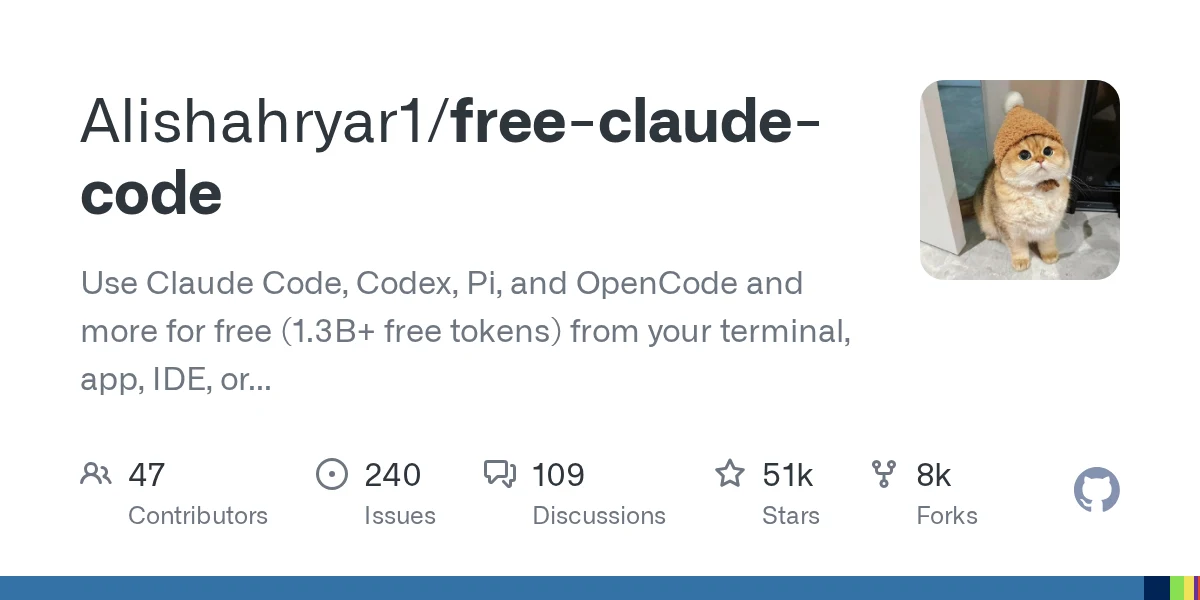
    Alishahryar1/free-claude-code repository preview

    Use Claude Code, Codex, Pi, OpenCode, Cline, Aider and five more coding agents against one catalog assembled from 50 providers' free tiers, with automatic fallback to the next model when retries run out — no restarting the turn.

    Stars
    51,201
    Forks
    8,245
    Open issues
    359
    Last commit
    2026-08-28

    This week it added Aider as the tenth harness, switched Muse Code to a native Windows install, and fixed two long-standing translation-layer bugs: images being dropped across protocols, and cache-hit accounting not adding up after a translated response.

    If you want to try several coding agents side by side without paying a separate subscription for each, one install lets you switch between them against the same catalog.

    But the word free is defined by each provider, the rules change without notice, and the project itself says it removes an integration once a provider stops allowing it; most of the 359 open issues sit in that translation layer, where debugging spans several hops; and handing several vendors' keys to one local service is a risk you should price yourself.

    Deep dives

    Two projects in this week's top ten are doing the same thing: pooling free tiers behind one endpoint so coding agents can draw on them. This one is fifth, freellmapi is tenth. That lane did not exist in the last issue; this week it holds two slots.

    It does two things a plain relay does not. The first is protocol translation: Claude Code speaks Anthropic's protocol, Codex speaks OpenAI's, and the model underneath may be neither, so something has to translate both ways — this week's fixes for images lost in translation and cache hits not reconciling live in exactly that layer. The second is token thrift: an optional RTK filter strips the bulk of useless terminal output, which the project claims cuts terminal-output tokens by up to 90%, alongside several optimisations aimed at quota probes and command prefixes. It also makes a point of following provider terms, dropping integrations that are no longer allowed, and states plainly at the top of the README that it is not affiliated with Anthropic.

    Whether it is worth installing comes down to how much you trust the convenience to last. Free tiers are not commitments; a combination that works today can be gone next month. As a low-cost sandbox for trying agents it fits well. As a cost-saving plan for production work it is a bad bet — for that, one honest paid quota is less trouble.

  5. This week+3,263
    rohitg00/ai-engineering-from-scratch repository preview

    A free, MIT-licensed AI engineering curriculum built around writing things by hand: 511 lessons across 20 phases and roughly 329 hours, in Python, TypeScript, Rust and Julia, where every lesson ships an artifact — a prompt, a skill, an agent or an MCP server.

    Stars
    50,618
    Forks
    8,780
    Open issues
    98
    Last commit
    2026-08-23

    The last substantive change was the Aug 23 batch that added an agent-skills track and a stateless MCP curriculum, and collapsed the MCP route to a single canonical path. Nothing landed in the repo this week; the stars are momentum from people still passing the course around.

    If you want to work through the ladder from linear algebra to agents and MCP in order, and will actually build the artifact each lesson asks for, the sequencing is the value here.

    Bear in mind that 511 lessons and roughly 329 hours assume you finish, and most people won't get halfway; English is canonical while the other languages are machine-translated lesson pages on a separate branch; and with no commits this week, you'll want to check the pace yourself before committing months to it.

  6. This week+2,372
    VoltAgent/awesome-agent-skills repository preview

    A curated collection of agent skills from official dev teams — Anthropic, Google Labs, Vercel, Stripe, Cloudflare, Hugging Face, Figma and more — alongside community submissions, with the compatible clients listed per entry: Claude Code, Codex, Gemini CLI, Cursor and others.

    Stars
    33,063
    Forks
    3,484
    Open issues
    18
    Last commit
    2026-08-26

    A dozen-odd community submissions merged this week — a spec writer, a Chinese de-AI-ifier, a multi-source search skill among them — and the badge count has moved from the 1000+ written in the README body to 1497+.

    If you run Claude Code, Codex or Cursor and have no appetite for writing your own skill, browsing the vendor sections for the official ones is the fastest path.

    It is still a list of links, so whether a skill installs cleanly is the upstream repo's problem; the community section is populated by pull request, and this week's merges range from serious tooling to a dark-psychology skill pack, so don't take the list on faith; and since the repo holds no code, anything that breaks goes back to the source project.

  7. This week+2,353
    tinyhumansai/openhuman repository preview

    A local-first personal AI: your data compressed into scored Markdown memory trees in SQLite, mirrored as an Obsidian vault you can open and edit, with agent orchestration and deep research running on top.

    Stars
    38,724
    Forks
    3,802
    Open issues
    325
    Last commit
    2026-08-27

    The through-line this week was consolidating memory scoring into its own event bus and pinning every module's tinymemory dependency to 1.13.2 to stop submodule and registry versions drifting apart — foundation work on the memory layer rather than new surface.

    If you want the AI's memory of your life to live on your own machine in files you can open in Obsidian, rather than in another cloud assistant, this is the one currently doing that.

    It ships labelled Early Beta by its own authors; GPL-3.0 is a hard constraint for anyone hoping to embed it in a closed-source product; figures like 100+ OAuth integrations, 5,000+ MCP servers and 90,000+ skills are the project's own claims; and with 325 open issues and desktop versions moving fast, expect rough edges.

  8. This week+2,207
    anthropics/claude-plugins-community repository preview

    The community plugin marketplace for Claude Cowork and Claude Code as a read-only mirror, synced nightly from Anthropic's review pipeline; plugins appear only after passing automated security scanning and approval.

    Stars
    2,585
    Forks
    213
    Open issues
    42
    Last commit
    2026-08-25

    It has 2,585 stars in total and 2,207 of them arrived this week — this is essentially the week it got discovered. The reason is mundane: installing community plugins requires an address to hand `claude plugin marketplace add`, and this is that address.

    If you want community plugins for Claude Code or Cowork but would rather someone ran a security scan before you install them, this is the vetted door.

    Only, it is a read-only mirror — pull requests opened here are closed automatically and submissions go through the official form; the catalog syncs nightly, so what you see is not necessarily the current state; and the repo holds no plugin code, so implementations live upstream and entries disappear when upstream does.

  9. tashfeenahmed/freellmapi

    AI infrastructureTypeScript
    This week+2,162
    tashfeenahmed/freellmapi repository preview

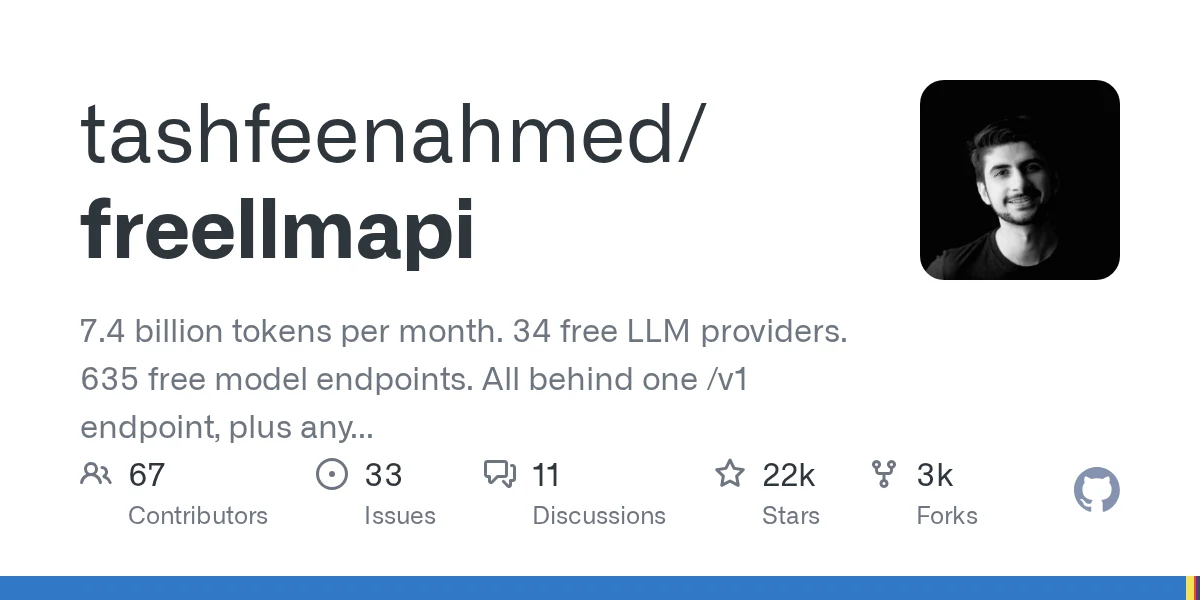
    Free tiers from 34 providers plus any custom OpenAI-compatible endpoint behind a single /v1 API: keys stored encrypted, a router that picks an available model and fails over when one is rate-limited, and per-key usage tracking to stay under every free-tier cap.

    Stars
    21,614
    Forks
    3,061
    Open issues
    66
    Last commit
    2026-08-28

    Five releases went out on Aug 28 alone, v0.8.6 through v0.9.0: the Mac desktop build is now signed and notarised (the DMG itself, not just the app inside), an estimated usage frame fills in when an upstream omits usage so quota accounting doesn't silently drift, and an opt-in Fetch Relay outbound transport landed.

    If you want a dozen providers' free allowances to behave like one /v1 endpoint and are willing to run the router yourself, that is exactly what this does.

    But the rules for those free tiers belong to the providers, and the project scopes itself to personal experimentation; the model catalog comes from a signed feed where free installs get a monthly snapshot — new models reach you 30 days late unless you pay $19 a year; and the README carries a dense layer of promotional links worth reading past.

Signals this week

The composition of the top ten is the story: not a single model repository. Three add skills or plugins to coding agents, two route allowances across providers, and the rest are a terminal agent, a job-search workflow, a course, personal memory and a prompt library. Last issue at least had the 14MB Needle 2 holding the model slot. This issue it is empty.

Saving money became its own lane for the first time. free-claude-code is fifth and freellmapi is tenth, and both pool free tiers from dozens of providers behind one OpenAI-compatible endpoint. Their emphasis differs — protocol translation across ten coding agents versus quota accounting and routing. They make sense as sandboxes. As long-term production cost plans they are fragile: free allowances, provider rules and the routing chain are not commitments.

Getting an agent to draw diagrams charted for a second consecutive week, but with a different repository: last issue it was diagram-design, which dropped off the board, and this week archify took 11,099 stars. Same demand, new winner. The practical conclusion is simple: use the board to spot demand, not to outsource technical selection. Test whether a tool draws your real repository correctly before wiring it into the team's workflow.

RAG and inference are both absent, and last issue's pile-up of agent-memory projects has narrowed to openhuman. At the same time, the top ten mixes vendor repositories such as openai/codex and anthropics/claude-plugins-community with an individually maintained prompt library at number one and a job-search pipeline at number four. A more useful filter than the author's halo is three questions: what changed this week, whether the limits are stated plainly, and whether you can validate the project in your own setting in an afternoon.

Ranking figures as of Aug 29, 2026, 12:52 AM UTC

via: GitHub Trending weekly, each project's GitHub repository, README and releases