

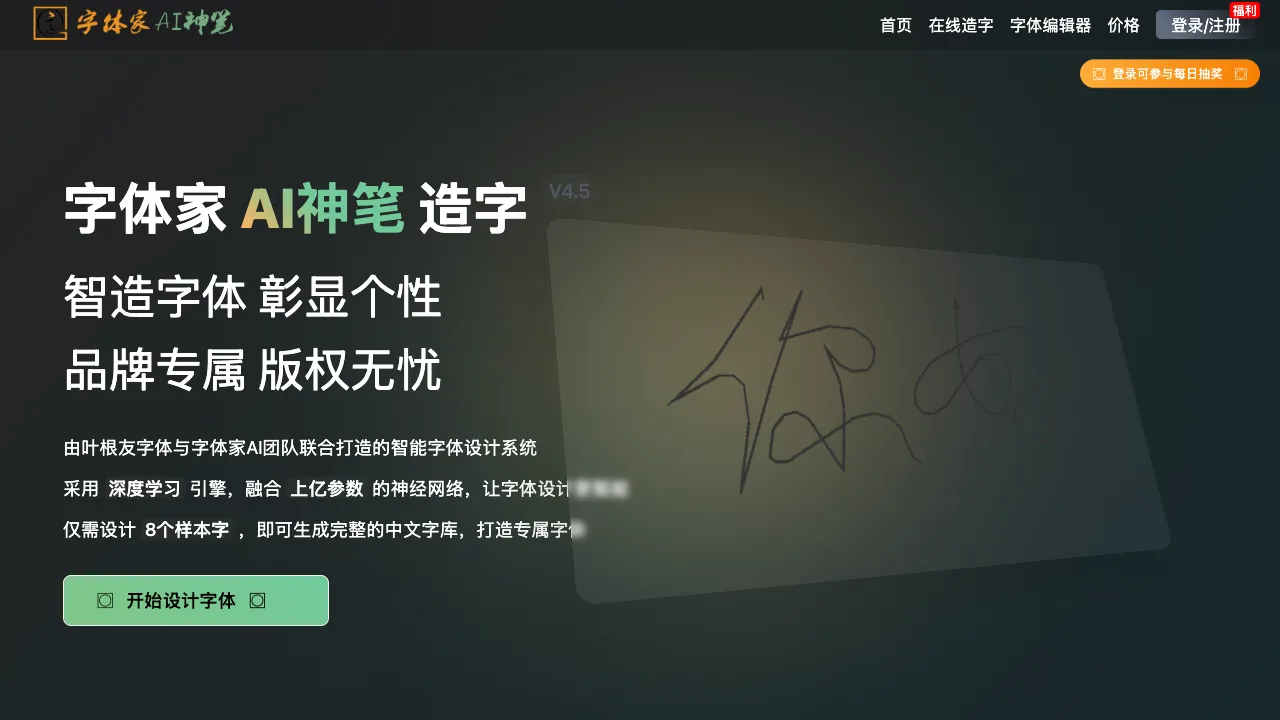
Anyone who has done font design knows how exhausting it is—a complete Chinese character set needs to cover 6,763 common characters, plus punctuation and other symbols, making the workload immense. Even for professional font designers, creating a complete original Chinese font takes at least several months, and up to several years. FontJia AI Shabi aims to solve this problem: by providing just eight handwritten Chinese characters as samples, the AI learns the stroke style and extrapolates to generate a complete font library of over 6,000 characters.
What is FontJia AI Shabi?
FontJia AI Shabi is an AI font generation tool launched by the FontJia platform, and it is currently a representative product in the field of Chinese AI font creation. Users only need to handwrite a small number of Chinese characters as samples (the platform claims as few as eight are sufficient). The AI analyzes the stroke style, structural patterns, and writing habits in these samples to automatically generate font files that cover the complete set of common characters. The generated fonts can be exported in TTF/OTF formats for direct installation and use.
FontJia itself is a well-known domestic platform for legitimate fonts, providing licensing, purchase, and download services for a vast array of commercial typefaces. AI Shabi represents an innovative direction built on this foundation—it doesn’t sell ready-made fonts but helps users create their own exclusive typefaces.
Core Features
Generating a Full Font Library from Minimal Samples
This is the most astonishing feature of AI Shabi: with just eight Chinese characters, the AI can complete the remaining 6,000+.
The underlying technical principle is glyph style learning and transfer: the AI extracts the writer’s "stroke DNA" from the few samples—the angle of horizontal strokes, variations in vertical stroke thickness, the curvature of sweeping strokes, the finishing technique of pressing strokes, and the proportional relationships between components—and "transfers" these patterns to every Chinese character in a standard glyph database, generating glyphs that match the writer’s style.
Although eight characters is the advertised minimum threshold, in practice, more samples result in more stable and accurate font styles. The platform typically offers sample packages at different tiers, with more samples corresponding to higher-quality generation results.
Custom Personal Handwritten Fonts
The most typical use case: turning your own handwriting into a font file. Your everyday handwritten characters, when digitized, offer visual effects and personal style that standard fonts cannot replicate.
Suitable scenarios include:
- Designing business cards, letterheads, or personal brands with a distinct individual style
- Creating unique greeting cards, invitations, or journal templates
- Adding a personalized signature to your illustrations or social media content
- Digitally preserving the handwriting of yourself (or family members) as a keepsake
Calligraphy Font Generation
Not limited to daily handwriting, artistic fonts such as brush calligraphy, hard-pen regular script, and running script can also be converted into digital fonts via AI Shabi. Calligraphers and hard-pen enthusiasts can solidify their artistic style into a font, expanding its application scope.
Brand Custom Fonts
Corporate brands sometimes require exclusive typefaces to strengthen their visual identity system—using the same font across websites, posters, packaging, and signatures creates a stronger sense of cohesion. Commissioning a font design company to create a custom Chinese font is expensive; AI Shabi offers a low-cost alternative.
By having representative individuals (or corporate designers) write dozens of sample characters, the AI can generate a unified brand font, significantly reducing costs.
Font Editing and Fine-Tuning
AI generation doesn’t guarantee perfection for every character, especially rare characters with complex strokes. The platform provides an online font editing tool, allowing users to manually fine-tune unsatisfactory glyphs to ensure the final font quality meets standards.
Practical Experience
Sample quality significantly impacts the generation result. When writing samples, keep the following in mind:
- Ensure handwriting is clear and not too cursive
- Maintain uniform stroke thickness and consistent style
- Use even lighting when photographing or scanning to avoid shadows
- Prefer a white background to reduce noise
The quality of common characters (high-frequency glyphs) in the generated result is usually good, while rare characters may suffer from distortion; manual proofreading of important characters’ display effects is necessary.
Comparison with Other Tools
vs. Traditional Font Design Tools (FontCreator, Glyphs): Traditional tools require drawing each character individually, posing a high technical barrier that non-professional users find difficult to master. AI Shabi has nearly zero technical barriers; writing a few characters completes the entire font library generation.
vs. Full Handwriting Method: The traditional method requires handwriting all thousands of characters before scanning, with an engineering workload hundreds of times greater than the AI approach. AI Shabi drastically reduces time costs, compressing months of work into just a few hours.
vs. International AI Font Tools (Calligrapher.ai, etc.): International tools primarily target English fonts; the challenge of 26 letters is of a completely different magnitude than that of 6,000+ Chinese characters. FontJia AI Shabi is designed specifically for Chinese and is currently a professional tool for Chinese AI font creation.
vs. Purchasing Commercial Fonts: Ready-made fonts cost hundreds to thousands of yuan per set and use someone else’s style. AI Shabi generates your own style, which is unreplicable, and can be used repeatedly after a one-time generation.
Who Should Use FontJia AI Shabi?
Those wishing to preserve family handwriting: Turning the handwritten characters of parents or elders into a font allows for permanent preservation and use, "extending" that warmth in various scenarios. This is AI Shabi’s most emotionally valuable application.
Designers seeking differentiation: Providing clients with truly unique handwritten fonts rather than using common typefaces everyone else uses enhances the uniqueness of the design.
SMEs building their brand: Obtain an exclusive brand font at low cost to strengthen visual identity, saving the high fees associated with commissioning font design companies.
Calligraphy enthusiasts and teachers: Convert your calligraphy style into a font for convenient use on electronic devices, or as teaching material.
Social media influencers and content creators: With an exclusive handwritten font, using it for titles and key content increases the personal recognizability of your work.
Copyright Considerations
Copyright issues regarding generated fonts need serious attention:
- Personal non-commercial use: Generally carries no copyright risk
- Commercial use: Requires purchasing the corresponding commercial license package; the scope of commercial use varies by package
- Others’ handwriting: Using someone else’s (including celebrities or public figures’) handwriting to generate a font may involve copyright or portrait rights issues and requires written authorization from the individual
- Existing font styles: If the samples imitate the style of an existing commercial font, there may be infringement risks
Be sure to carefully read the platform’s copyright terms before any commercial use.
Pricing
FontJia AI Shenbi is a paid service with tiered pricing based on the scale and intended use of the generated font library. Personal and commercial versions have different price points, with commercial licensing costing more. The platform typically offers a trial version that allows you to test the results for free before deciding whether to pay. For specific details, please refer to the official website.
FontJia AI Shenbi represents a significant breakthrough in the field of Chinese typography: it transforms work that was once exclusive to professional designers into something accessible to anyone. For users who want to convert their own handwriting or specific writing styles into usable fonts, this is currently the most practical tool available in China.