

Everyone who has ever written something has experienced this moment: you’re at the end of an article, wanting to quote a poem about "perseverance" to craft a beautiful conclusion. You have a vague impression in your mind that some ancient figure said something similar, but you can’t quite recall the exact line. You open a search engine and type "quotes about perseverance," only to be bombarded with content farm pages. After scrolling through three pages, you still haven’t found a single quote that fits.
The essence of this dilemma is that traditional search is "finding words by keywords." You must know the specific keywords in the sentence to find it. Your actual need, however, is "finding sentences by meaning": you know what you want to express and just need help finding a good sentence that conveys that meaning. Between these two lies a chasm of semantic understanding—a gap that NLP technology is uniquely suited to bridge.
"Quote by Meaning" (Ju Yi Cha Ju) is its own product manual: find sentences based on their meaning.
What Is Quote by Meaning?
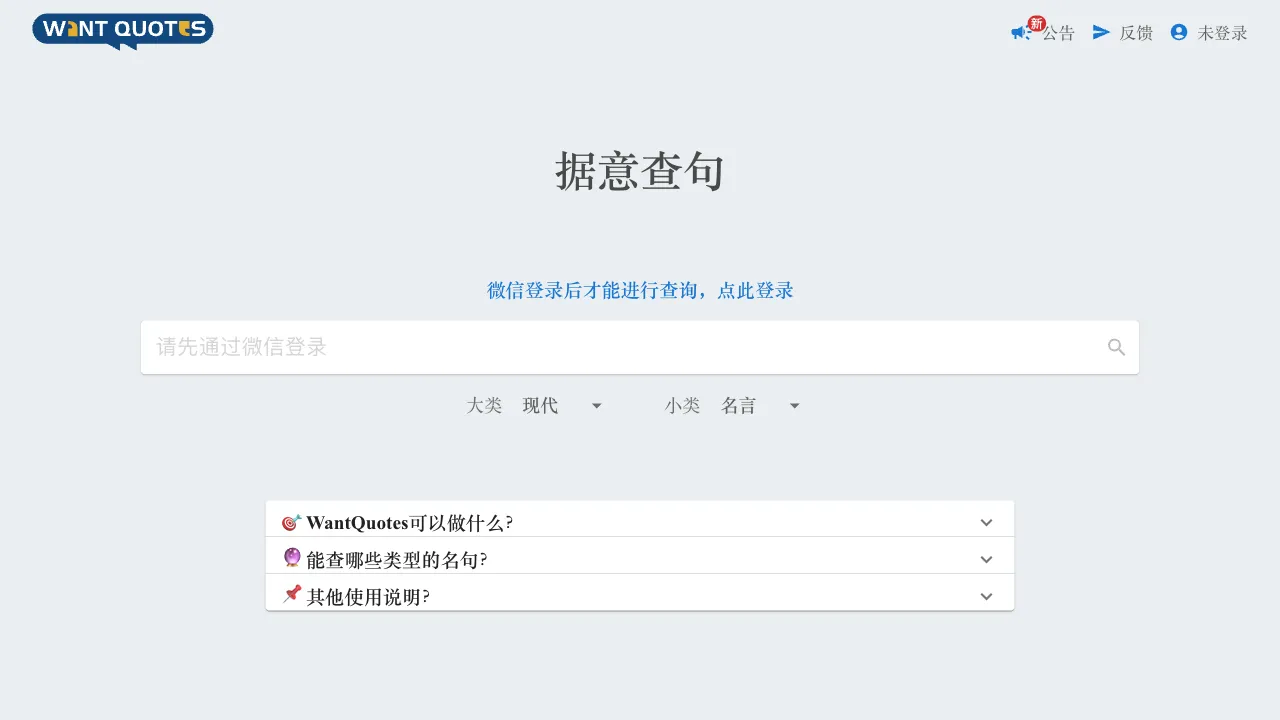
Quote by Meaning (wantquotes.net) is a free online tool launched by the Tsinghua University Natural Language Processing and Social-Humanities Computing Laboratory (THUNLP). Its usage is minimalist: input your intended meaning in plain language, and the system uses deep semantic matching technology to retrieve sentences from a large-scale corpus covering classical poetry, famous quotes, idioms, proverbs, and more that express that meaning.
It is a sister product to "Deep Meaning" (Ju Yi Cha Ci), also produced by the same lab—one helps you find words, the other helps you find sentences. The team behind it, DeepLang AI, was incubated from this Tsinghua laboratory.
It is completely free, requires no registration, and works as soon as you open the webpage—a characteristic simplicity common to tools produced by academic institutions.
Core Features
Quote by Meaning: From Meaning to Sentence
Input a daily expression, and it returns multiple semantically matched quotes, sorted by relevance. Here are a few examples of actual experience:
- Input "Time flies"—returns "The water flows away like this, never ceasing day or night," "A white pony passes a crevice" (time flies), and "Light and shadow easily cast people aside, reddening the cherries, greenening the plantains," among others. Ranges from the Analects to Song Dynasty ci poetry; choose your style.
- Input "Don’t give up when facing difficulties"—returns "Through a thousandMojīs it remains firm, letting the wind blow from east, west, south, or north," "After mountains and rivers confirm there is no path, willows darken and flowers brighten another village," along with numerous inspirational quotes from Chinese and foreign figures.
- Input "Sincerity is what matters most between friends"—returns "The value of acquaintance lies in understanding; the value of understanding lies in knowing the heart," and "A bosom friend afar brings a distant land near."
The retrieval is true semantic matching, not keyword matching. It doesn’t matter if none of the characters you input appear in the results; as long as the meaning aligns, it works. This is the essential difference between it and traditional search, and where Tsinghua’s NLP technology shines.
Multi-Type Corpus
Results can be filtered by corpus type, covering:
- Classical Poetry and Prose: Shi (poetry), Ci (lyrics), Qu (drama lyrics), and classical prose—the go-to sources for adding literary flair to writing.
- Famous Quotes: Quotes from Chinese and foreign figures, a standard requirement for speeches and argumentative essays.
- Idioms: Four-character condensed expressions.
- Proverbs and Folk Sayings: Grounded folk wisdom, suitable for relaxed contexts.
- Xiehouyu (Two-part Allegorical Sayings): Specifically for humorous scenarios.
- Movie Lines and Modern Golden Quotes: Pop culture quotes, friendly to the style of self-media writing.
The same meaning requires different "concentration" of expression in different settings—quoting Zhuge Liang for a report to your boss, or movie lines for WeChat Moments. Multi-type coverage allows you to get the full spectrum of candidates from a single search.
Associative Expansion
Results are not limited to exact matches; they also provide semantically adjacent expressions. You often encounter the pleasant surprise of "I was looking for A, but found B is better." For writers, this discovery itself is inspiration.
Typical Use Cases
Self-Media Writing: For WeChat Official Account articles, a well-chosen quote in the title, opening, or conclusion is the lowest-cost "texture enhancer." This is also the largest user group for Quote by Meaning.
Student Essays: The use of quotes as evidence in argumentative essays directly impacts scores. Using it before exams to accumulate a quote library for specific sub-themes is a highly cost-effective preparation method.
Speeches and Presentations: Opening with a poem to set the tone, closing with a famous quote to elevate the theme—cliché but effective, provided the quote is accurate. Quote by Meaning solves the problem of "accuracy."
Copywriting and Planning: When brand copy, event themes, or poster slogans need cultural depth, finding imagery in classical poetry is a common technique. Quote by Meaning fits this workflow perfectly.
Daily Expression: Blessings, WeChat Moments, signature lines—any moment you want to express yourself with more flair than just "Keep it up."
Comparison with Alternatives
vs. Deep Meaning (Ju Yi Cha Ci): Sister products from the same lab with clear division of labor. If you can’t recall a word, use Deep Meaning (input "describing quietness" to get "all sounds are silent"); if you want a full sentence quote, use Quote by Meaning. Both should be bookmarked.
vs. Large Language Models like ChatGPT: Asking LLMs to recommend quotes is entirely feasible and allows for explanation of meaning or customization on demand. However, they have a fatal flaw: they hallucinate. Models often generate "pseudo-poems" that look classical but don’t exist, or misattribute authors. Quoting incorrectly in formal settings is embarrassing. Quote by Meaning retrieves from a real corpus, so the quotes found are authentic. This is its core advantage over LLMs. A robust workflow: use Quote by Meaning to find true quotes, and use an LLM to help you understand and select them.
vs. Search Engines: Searching for "quotes about X" yields results heavily polluted by SEO content farms, and you can only get lucky with topic keywords. Quote by Meaning retrieves directly via semantics—fast and accurate.
vs. Quote Apps/Compilations: Static compilations can only be browsed by preset categories, with a coarse granularity of "meaning." Semantic retrieval can respond to any nuanced expression need.
Limitations
No matter how large the corpus, there are boundaries. Particularly obscure or specific meanings may not find fitting quotes, returning results that are only tangentially related.
Relevance fluctuates. The top results are usually accurate, but they become more scattered further down the list, requiring your own judgment and filtering.
Classical Chinese quotes do not include vernacular translations or detailed source explanations. For quotes whose meaning you are unsure of, always verify the original intent and context before quoting. Misusing classical poetry in the wrong context (e.g., using a mourning poem at a birthday celebration) is a classic blunder.
It focuses primarily on Chinese corpus; finding English quotes is not its strength.
Pricing
Completely free, no registration required, no ad interference, no paywalls—a pure public good, representing researchchéngguǒ (achievements) from an academic laboratory open to the public.
Quote by Meaning is one of those "small and beautiful" tools that borders on perfection: it solves one problem, but does so quickly and well, and for free. Bookmark wantquotes.net; the next time you have a quote on the tip of your tongue but can’t recall it, it will return a beautiful answer in three seconds.