

In linguistics, there is a term called the "tip-of-the-tongue phenomenon": you know clearly that there is a word to precisely express what you mean right now; it is on the tip of your tongue, yet you simply cannot recall it. Every writer is familiar with this torment—there is a "shape" of meaning in your mind, but the dictionary at hand offers no help, because the direction of a dictionary is reversed: it requires you to know the word first before you can look up its meaning; your dilemma, however, is that you have the meaning but not the word.
Deep Meaning, Precise Words (Shenyan Dayi) flips the dictionary around: describe the meaning, find the word. This seemingly simple reversal of direction is backed by deep semantic matching technology—the core expertise of DeepLang AI, the company incubated by Tsinghua University’s NLP Lab (THUNLP), which also created this tool. It is a sibling product to THUNLP’s other creation, WantQuotes ("Ju Yi Cha Ju"): one helps you find words, the other helps you find sentences, together forming a "reverse dictionary" suite for Chinese writers.
What Is Deep Meaning, Precise Words?
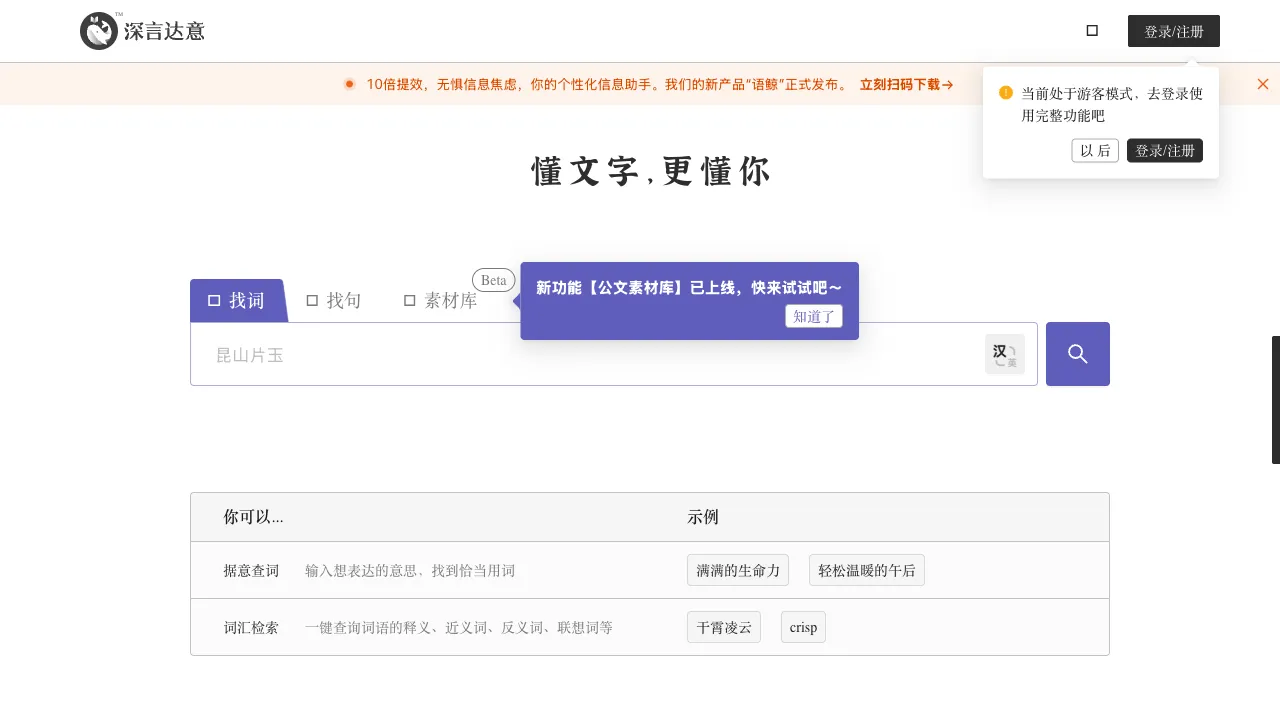
Deep Meaning, Precise Words (shenyandayi.com) is a "meaning-to-word" tool: input a vernacular description of a meaning, and the system retrieves matching words and idioms from its lexicon based on semantic understanding, providing definitions and distinctions. It is completely free, accessible directly via web page, and requires no registration.
Its technical prototype can be traced back to WantWords ("Wan Ci Wang"), a reverse dictionary research project released by THUNLP—a work that attracted widespread attention in both academic and writing circles. Deep Meaning, Precise Words is its more mature, productized form.
Core Features
Meaning-to-Word Search
The main feature, best experienced with examples:
Want to describe "calm on the surface but turbulent within"—input this vernacular phrase, and you will get candidates like "keep a stiff upper lip" (keeping a poker face), "calm as a still pond" (unruffled), and "heart surging with emotion" (heart surging), each with definitions, allowing you to choose based on your specific emphasis.
Want a word to express "a situation that has reached the point of no return"—you will get "deep-rooted and hard to reverse" (hard to reverse after long-standing problems), "spilt water cannot be gathered up" (spilt water cannot be gathered), and "beyond repair" (beyond repair).
Remember there is a word for "deliberately showing off one’s aloofness"—searching yields "admire oneself like a solitary flower" (admiring one’s own purity) and "proudly aloof" (priding oneself on being aloof).
The key is that the retrieval is semantic: your description does not need to contain any character from the target word; if the meaning matches, it will hit. This is the essential difference between it and search engines or traditional dictionaries.
Idiom Search by Meaning
Idioms are compressed packages of Chinese culture and a major pain point for "knowing the meaning but forgetting the characters." The dedicated idiom search allows you to describe a scenario to find corresponding idioms, complete with origins and usage notes—a high-frequency rescue tool for argumentative essays and formal documents.
Word Distinction
The subtle differences between near-synonyms—who has a stronger degree of intensity, "worlds apart" (completely different) or "diametrically opposed" (widely divergent)? How to choose between "would rather" (would rather) and "prefer to" (might as well)?—the distinction feature provides comparative explanations of semantic emphasis, emotional tone, and collocation habits. For writers pursuing precise diction, this offers value beyond simply finding words.
Associative Expansion
Input a word to receive an associative network of synonyms, antonyms, and related terms—a handy tool for avoiding repetition and enriching expression layers during writing, often leading to the pleasant surprise of "oh, there is a better word for this."
Comparison with Alternatives
vs. WantQuotes (Ju Yi Cha Ju): Sibling division of labor—go to Deep Meaning, Precise Words to find "words," and to WantQuotes to find "full-sentence quotes" (poetry lines, famous sayings). Both should be in a writer’s bookmarks.
vs. Traditional Dictionaries (Hanzi Dictionary, Xinhua Dictionary App): Complementary directions, not interchangeable—use dictionaries when you know the word and want the meaning; use Deep Meaning, Precise Words when you know the meaning and want the word; the latter solves exactly what the former’s structure cannot address.
vs. Large Language Models like ChatGPT/Kimi: Asking an LLM to "give me a word expressing meaning X" is entirely feasible and allows for explanation and customization; but the advantage of a specialized tool lies in speed (no pleasantries, direct results), comprehensiveness (returning dozens of candidates at once for comparison), and accuracy (lexicon retrieval will not fabricate non-existent idioms—LLMs occasionally invent words with a straight face). Use it to resolve stuck words in three seconds; turn to an LLM when you need to discuss usage in depth.
vs. Search Engines: Searching for "idioms describing XX" lands you on the hodgepodge pages of content farms; the precision of semantic retrieval is in a completely different league.
Who Should Use Deep Meaning, Precise Words?
Anyone who writes frequently: official documents, academic papers, WeChat public accounts, novels—as long as you write, you will hit word blocks; the frequency of these blocks determines the value of this tool to you.
Students: The classic moment when you want to use an idiom in an essay but can’t recall it, and as a daily vocabulary accumulation tool—reading through the candidate list from one search is itself efficient vocabulary learning.
Copywriters and Editors: Choosing the most precise word among three near-synonyms is part of the daily job; the distinction feature is professionally tailored.
Chinese Learners: Finding Chinese expressions starting from native-language meanings makes reverse dictionaries a necessary supplement to standard dictionaries for second-language learners.
Crossword enthusiasts and poetry writers: It handles all sorts of scenarios where you need to find words based on meaning and constraints.
Usage Tips
Paraphrasing your description can yield vastly different results—if you don’t find the ideal word the first time, try rephrasing in vernacular (be more specific or take a different angle); the hit rate will improve significantly.
Turn "word lookup" into "word learning": look at several candidates and their distinctions each time you search; over the long term, the frequency of word blocks will decrease—the highestrealm (realm) of a tool is to make you gradually less dependent on it.
Pricing
Completely free, no registration required, no ads—a language infrastructure opened to the public by an academic team, as pure as its sibling product.
Deep Meaning, Precise Words belongs to that category of tools that are "so small and so good they become irreplaceable": it solves only one problem—the word on the tip of your tongue—but does so quickly and accurately. When that moment comes again—"it’s that word, oh, what was it called?"—you will be glad it is in your bookmarks.