

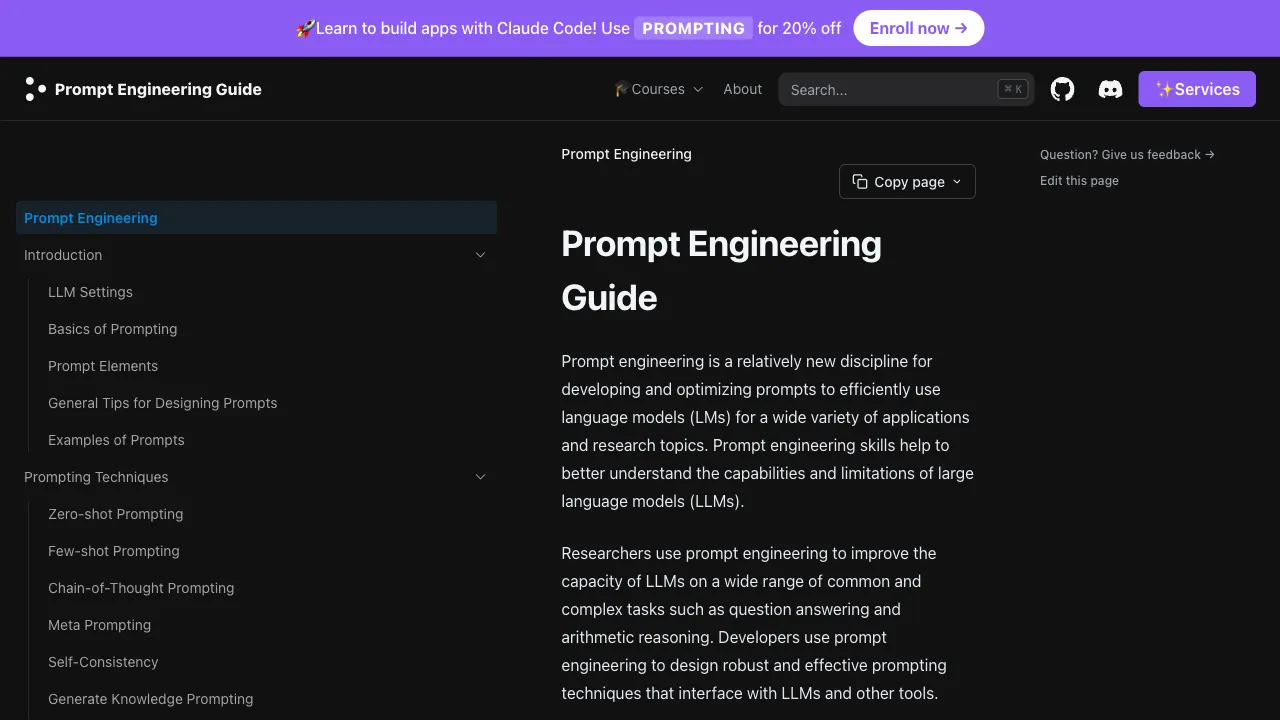
How well you get results from AI depends largely on how you ask. When asking ChatGPT to write an article, one person might get a vague, rambling summary, while another gets structured, genuinely useful content—the gap often lies not in the model, but in the prompt. The Prompt Engineering Guide (promptingguide.ai) is currently one of the most systematic and widely cited resources for learning prompting, covering everything from foundational principles to advanced techniques. It is continuously updated, evolving in sync with advancements in large language models.
What Is the Prompt Engineering Guide?
The Prompt Engineering Guide is an open-source educational project maintained by DAIR.AI (Democratizing Artificial Intelligence Research). Hosted on GitHub, it also features a dedicated website at promptingguide.ai for a better reading experience. The project aims to systematize knowledge in the field of Prompt Engineering, providing useful content for users ranging from beginners to advanced practitioners.
It is not a corporate product manual or a paid course; rather, it is a community-driven knowledge base where anyone can contribute content or submit corrections via GitHub. This openness allows its content to update quickly and stay closely aligned with practical usage needs rather than commercial promotion.
Content Structure
Fundamentals: Basic Principles of Prompting
The guide starts from the basics—what a prompt is, how large language models respond to prompts, and why different phrasings of the same question yield different results. This section is suitable for users just starting with AI tools who are still fuzzy on the concept of prompting.
Fundamental content includes:
- Basic components of a prompt (instructions, context, input data, output format)
- Core settings that affect output quality (meaning of parameters like temperature and top_p)
- Common prompting styles and their corresponding effects
These basics are not abstract theory; the guide provides numerous comparative examples. For the same task, standard phrasing versus optimized phrasing yields noticeably different results, offering an intuitive sense of the gap.
Advanced Techniques: Detailed Explanation of Prompting Methods
This is the most valuable part of the guide, systematically introducing various research-validated prompting techniques:
Zero-shot Prompting: Asking the model to complete a task without providing examples. Suitable for simple, clear tasks that test the model's generalization ability.
Few-shot Prompting: Providing a few examples in the prompt to show the model the desired output format and style. Ideal for tasks with specific formatting requirements, such as data extraction or classification labeling.
Chain-of-Thought (CoT) Prompting: Asking the model to display its reasoning process step-by-step rather than jumping directly to the answer. This technique is particularly effective for logical reasoning, mathematical calculations, and multi-step problems. A simple phrase like "Please analyze step by step" can significantly improve the quality of answers to complex questions.
Zero-shot CoT: Instead of providing examples, you add a trigger phrase to encourage the model to engage in chain-of-thought reasoning spontaneously. It often performs better than direct Q&A and is easy to implement.
Self-Consistency: Generating multiple reasoning paths for the same question and voting for the most common answer. This improves reliability and is suitable for scenarios requiring high accuracy.
Tree of Thought (ToT): Encouraging the model to explore multiple branches of thought, evaluating the feasibility of each path, similar to divergent thinking when humans solve complex problems. Suitable for creative tasks and comparing multiple options.
Retrieval-Augmented Prompting (RAG-related): Prompt design that integrates external knowledge bases, allowing the model to answer based on retrieved content rather than relying solely on training data.
ReAct: Alternating between Reasoning and Acting, suitable for AI Agent scenarios requiring tool invocation or external interaction.
Automatic Prompt Optimization (APE): Asking the model to optimize prompts by automatically generating candidate phrasings and evaluating their effectiveness.
Application Scenarios: Prompting Styles for Various Tasks
After covering theory, the guide provides practical templates for specific scenarios:
- Text summarization, classification, and translation
- Code generation and explanation
- Data extraction and format conversion
- Reasoning and mathematical problems
- Dialogue design and role-playing
Each scenario includes complete prompt examples that can be referenced directly, eliminating the need to start from scratch.
Research Frontiers: Papers and Latest Developments
The guide also curates important research papers in the field of Prompt Engineering, categorized by topic, making it easy for deep-dive users to track academic progress. This section is valuable for AI researchers and practitioners seeking to understand technical principles deeply.
Why It’s Worth Your Time
Many people use AI tools by "asking directly when they have an idea," switching phrasing if the result is poor, and relying on intuition. This approach isn’t wrong, but it is inefficient. Many effective techniques are counterintuitive—for instance, with Chain-of-Thought prompting, those unaware of it wouldn’t think to ask the model to display its reasoning steps. Yet adding this can significantly improve results.
Systematically learning Prompt Engineering is like building a methodology for yourself: knowing which approach to use for different tasks rather than reinventing the wheel each time. This investment yields high long-term returns.
Additionally, as usage scenarios expand—such as AI Agents, code generation, and multi-model invocation—the complexity of prompting increases rapidly. Relying solely on "intuition for asking questions" is becoming insufficient; understanding systematic prompting techniques is increasingly important.
Comparison with Other Learning Resources
vs. OpenAI Official Documentation: OpenAI’s best practices for prompts lean toward API usage scenarios, targeting developers and tightly integrating with platform features. The Prompt Engineering Guide is more general, covering various models and suitable for a broader audience.
vs. Learn Prompting: Another well-known open-source prompting learning site, Learn Prompting has a style more akin to introductory tutorials, with content that is more conversational and accessible. The Prompt Engineering Guide offers greater technical depth and includes more research-oriented content.
vs. Paid Prompt Courses: Quality varies widely among paid courses; many are essentially repackaged free resources. The Prompt Engineering Guide is free, continuously updated, and community-verified, offering far better value than most paid courses.
vs. YouTube Video Tutorials: Videos are intuitive and good for quick introductions. However, they lack the systematic structure and searchability of text guides, making it cumbersome to find specific techniques when needed.
Who Should Use the Prompt Engineering Guide?
Everyday AI Users: Even if you don’t write code or do technical development, understanding basic prompting techniques can make tools like ChatGPT and Claude easier to use. The guide’s foundational sections are understandable without a technical background.
AI Application Developers: Developers who need to design prompt templates and optimize model outputs will find the advanced techniques in this guide essential reading.
Content Creators and Writers: Those using AI for writing assistance can reduce time spent on revisions by understanding how to control style, format, and content depth via prompts.
Researchers and Students: To track academic progress in Prompt Engineering and understand the principles and applications of technologies like CoT, ToT, and RAG, the paper index in this guide is an excellent starting point.
Enterprises and Teams: Those promoting AI tool adoption within an organization can use the Prompt Engineering Guide as training material to help members quickly master effective usage methods.
How to Use This Guide
The simplest way is to browse promptingguide.ai directly. The website has a Chinese version, clear navigation, and content categorized by technique type.
If you have a specific question—such as optimizing prompts for code generation—go directly to the corresponding section. If you want to learn systematically, read from basics to advanced in order; it takes only a few hours to build a complete knowledge framework.
The project is open-source on GitHub. If you find errors or wish to contribute, you can submit a Pull Request directly. This community collaboration model ensures continuous updates and quality maintenance.
Prompt Engineering is not magic; it is systematically understanding how to communicate with AI. Spending time on this guide yields tangible improvements in your daily AI efficiency.