

On the product spectrum of AI image generation tools, there are two extremes: one end features node-based workflow tools like ComfyUI, which are powerful enough to precisely control every stage of the generation process but so complex that merely looking at a screenshot of the interface can deter 90% of ordinary users; the other end consists of "idiot-proof" products that hide all technical details beneath the surface, leaving only an input box and a few style buttons.
These two ends serve entirely different audiences. Users of the former discuss LoRA weights and samplers; users of the latter simply want to see what their cat would look like as an oil painting. The latter group is actually far larger than the former—they just rarely appear in AI image generation discussion circles.
Sohu Simple AI makes its positioning clear right in its name: it is built for users at the simplest end of the spectrum.
What Is Sohu Simple AI?
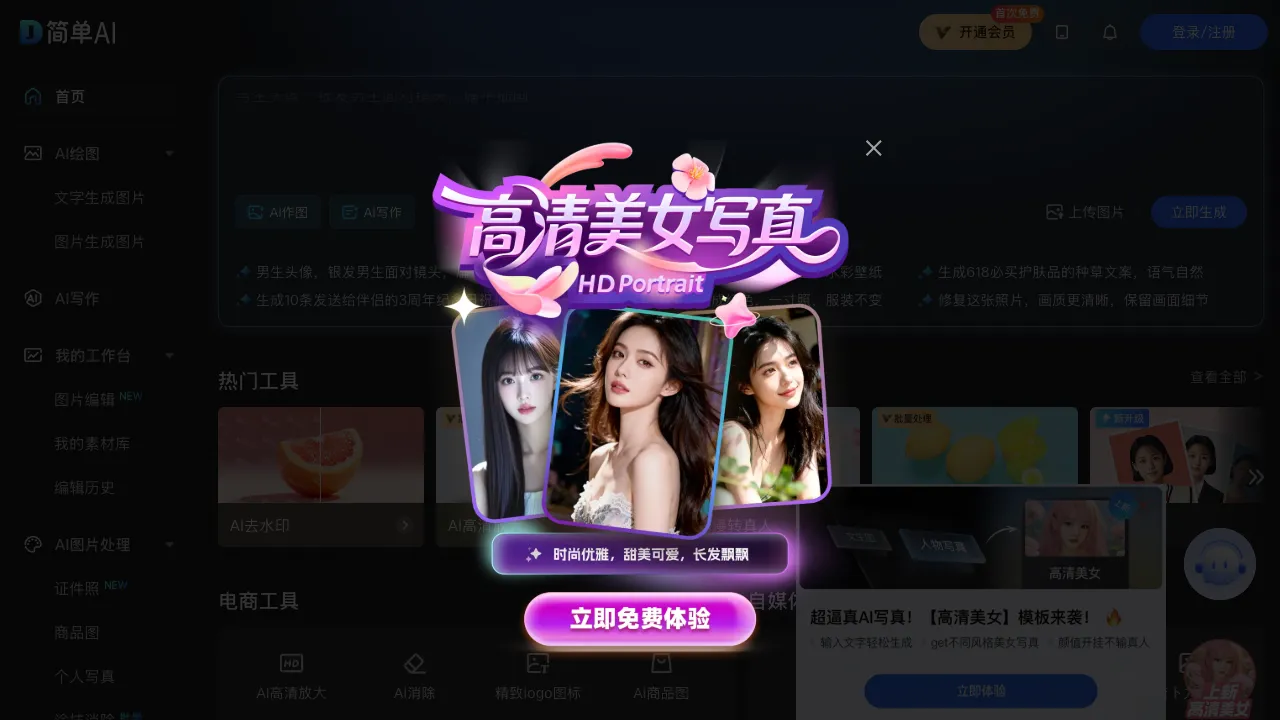
Sohu Simple AI (ai.sohu.com) is an online AI image generation platform launched by the legacy portal Sohu, offering text-to-image and photo style conversion features, along with a user artwork community. The product logic revolves around "zero barrier to entry": a Chinese interface, ready-to-use Chinese prompts, preset style buttons for selection, direct domestic connectivity without any network configuration, and the ability to generate your first AI image within minutes of opening the webpage.
For Sohu, this is also a strategic positioning move by a portal media company in the AI era—using low-barrier tools to attract mass users,precipitate (precipitate/accumulate) content through community engagement, and leveraging its own media channels for distribution.
Key Features
Text-to-Image
Enter a Chinese description, select a style preset, and generate an image. The style presets are the core embodiment of its "simplicity" philosophy: realistic photos, Japanese anime, oil painting, watercolor, ink wash Chinese style, and other directions are offered as one-click options—users don’t need to know jargon like "masterpiece, best quality, ultra detailed"; selecting the "Realistic" button automatically applies these professional incantations.
Chinese semantic understanding is a tangible convenience for domestic users: descriptions like "a woman in a qipao holding an oil-paper umbrella walking down a rainy alley in Jiangnan" can be entered directly, without the loss incurred by translating from Chinese to English.
Photo Style Conversion
Upload a photo, select a target style, and receive an artistic version output by AI—turning selfies into anime avatars, landscape photos into watercolors, or pet photos into oil paintings. This is the feature with the highest interest among mass users, requiring almost zero learning cost, possessing strong entertainment value, and serving as the primary viral hook for such platforms: sharing the result on WeChat Moments is itself part of the product’s customer acquisition loop.
Creation Community
Artworks can be published to the community for browsing, liking, and saving others’ creations. The community has two layers of practical value: first, content consumption—you can browse even without generating; second, prompt learning—studying the descriptions used in artworks you like is the fastest shortcut for zero-basis users to improve their generation quality.
Comparison with Other Tools
vs. Wenxin Yige (Baidu): Both are domestic AI painting platforms aimed at the mass market. Wenxin Yige’s self-developed model has deeper specialized optimization in Chinese traditional styles, more complete product features, and higher brand awareness; Simple AI’s differentiation lies mainly in Sohu’s media channels and its lighter product form. When seriously comparing generation quality, Wenxin Yige is usually the more reliable choice.
vs. Jimeng (ByteDance): ByteDance’s AI creation platform has extremely rapid iteration in image and video generation capabilities, heavy investment in community operations, and is currently one of the loudest voices among domestic mass-market AI creation tools; Simple AI is in a catching-up position regarding feature richness and update pace.
vs. Tongyi Wanxiang (Alibaba): Backed by Alibaba Cloud’s technology, it offers high generation quality and more comprehensive features; while its interface may not be as beginner-friendly as Simple AI’s, its capability ceiling is significantly higher.
vs. Liblib/Haiyi AI: Aimed at AI painting enthusiasts with some experience, these platforms offer massive community models and adjustable parameters, providing high ceilings but also high barriers to entry; they serve users at the opposite ends of the spectrum from Simple AI, so there is no direct competition.
vs. Midjourney: The gap in quality ceiling is objective, but MJ’s fourfold barrier (network access, Discord, English proficiency, subscription) is also objective. The meaning of products like Simple AI lies in serving users who will never cross those four barriers.
Who Is Sohu Simple AI For?
Absolute beginners to AI painting: Those who have never tried AI generation and want to see what it’s about at the lowest cost—without registering for a dozen accounts or learning any concepts, generating an image here in minutes makes it a qualified "first experience" venue.
Casual users seeking entertainment: Converting photo styles, generating funny images for friends, or making holiday greeting cards—when the need stops at "fun," Simple AI’s feature set covers exactly that.
Content creators needing Chinese-language illustrations: Occasionally pairing a WeChat Official Account article or social media post with an AI image; direct Chinese input saves hassle.
Users concerned about network environments: Fully domestic service with no access barriers.
Limitations
The gap in generation quality compared to top-tier tools must be frankly acknowledged: whether comparing Midjourney, DALL-E, or domestic options like Wenxin Yige and Jimeng, Simple AI’s image detail and stylistic expressiveness remain in a follower position. It wins on low barrier rather than quality; serious creators will quickly hit its ceiling.
Controllability is extremely limited—no parameter adjustment, no fine-grained control over image-to-image generation, no custom models. This is the cost of the "simplicity" philosophy. It’s an advantage for beginners but a wall for advanced users.
The platform’s iteration speed is slower compared to AI-native companies and larger tech firms with heavier investments; expectations for feature updates should not be too high.
Pricing
Offers free usage quotas; beyond that, points or membership are required. Specific policies are subject to the official website. For light entertainment use, the free quota is usually sufficient.
A reasonable expectation for Simple AI is: a door, not a palace. It makes the first experience of AI painting nearly cost-free, suitable for every curious but inactive ordinary person to come in and play; once interest is sparked, one will naturally know where to go next—for many who only want to "play around," this place itself is enough.