

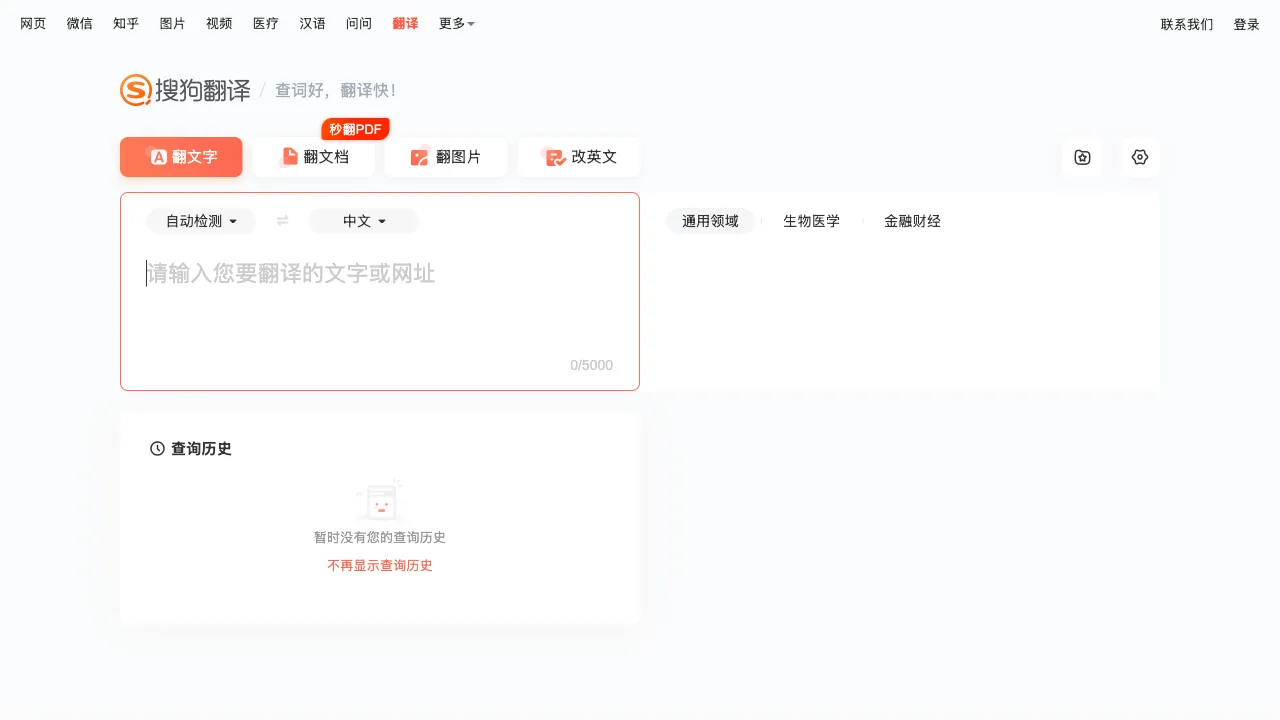
The name Sogou carries the memories of a generation of Chinese internet users—Sogou Pinyin Input and Sogou Search were once standard configurations on countless computers. After being acquired by Tencent, Sogou’s search and translation technologies were integrated into Tencent’s ecosystem, making Sogou Translate a public-facing window for Tencent’s translation capabilities. It may not be the brightest name in the translation sector, but as a domestically accessible, free, stable, and fully-featured general-purpose translation tool, it quietly occupies a spot in many people’s toolbars.
What is Sogou Translate?
Sogou Translate (fanyi.sogou.com) is an AI translation product launched by Sogou (now part of Tencent), supporting mutual translation among dozens of languages including Chinese, English, Japanese, Korean, French, German, Spanish, and Russian. It is available as a web version, mobile app, browser extension, and API. Its Tencent heritage brings two practical benefits: fast access within China without the need for a VPN, and natural integration with other Tencent ecosystem products. Its positioning is clear: a sufficient general-purpose translation tool. It does not aim to excel in any single direction but seeks balanced usability across all features.
Core Features
Text Translation
Foundation: Instant translation upon input, automatic language detection, and better preservation of paragraph structure for long texts compared to early machine translation engines. Chinese-English translation is its core strength, with quality rated as above average domestically; Asian languages like Japanese and Korean perform adequately; European languages like French and German are relatively average, falling short of DeepL, which specializes in European languages. This characteristic of "strong in Chinese, weak in European languages" is almost a common profile for all domestic translation tools.
Document Translation
Translates entire documents in formats such as Word, PDF, Excel, and PPT while preserving layout, eliminating the tedious task of copying text paragraph by paragraph—a practical feature for handling foreign contracts, reports, and materials. PDF format preservation depends on the original file quality; scanned documents perform worse than native digital text versions.
Image and Voice Translation
OCR translation for photos/uploaded images (foreign screenshots, menus, manuals), with recognition rates affected by image clarity; voice input translation is more complete on the app side, suitable for spoken conversation scenarios. The "travel trio" (text + image + voice) is fully equipped.
Terminology Customization (Enterprise)
Enterprise users can upload custom glossaries to ensure industry-specific terms are translated according to standards, reducing manual proofreading—a standard configuration for B2B services.
Comparison with Similar Tools
vs Baidu Translate: The most direct domestic competitor, with nearly mirrored features and comparable quality; Baidu has larger user volume and data, while Sogou’s differentiation lies in Tencent ecosystem integration. Which one to use daily depends on personal preference; the difference does not justify switching tools.
vs Youdao Translate: Youdao excels in dictionaries and vocabulary learning (parsing, example sentences, word lists), making it the first choice for language learners; Sogou focuses on pure content translation with weaker learning features. Use Youdao for looking up words and learning English; use Sogou when you just need translations.
vs Volcengine Translate: A ByteDance competitor with similar features; Volcengine’s API is more open to developers, and it has advantages in Southeast Asian languages; Sogou’s card is the Tencent ecosystem.
vs DeepL: The expert in European language quality; Sogou does not have an advantage in this direction. However, its accumulation of Chinese data and domestic accessibility are reverse advantages for Sogou.
vs Google Translate: The king of language coverage (100+ languages), but the web version is unavailable in China; Sogou offers direct access, with less language coverage but sufficient for daily use.
Who Should Use Sogou Translate?
Users with general daily translation needs: Occasional foreign reading, emails, and document queries—free, instant loading, and straightforward operation make it a qualified answer for general tools.
Professionals needing document translation: Full-document translation of foreign contracts and reports with hassle-free format preservation.
Heavy users of the Tencent ecosystem: Translation needs within WeChat and QQ workflows are more seamless due to ecosystem integration.
High-frequency mobile users: The app’s voice and image translation features are convenient on phones, making them practical for travel scenarios.
Limitations
Honestly, Sogou Translate lacks a distinct differentiating edge: it is inferior to DeepL in European languages, lacks specialized Japanese performance compared toCaiyun Xiaoyi (Caiyun), has weaker vocabulary learning features than Youdao, and offers less API openness than Volcengine—it is a balanced generalist, not an expert in any specific direction.
Machine translation outputs for professional scenarios (legal, medical, literary) always require human proofreading, and Sogou is no exception; the rise of large model translation is also squeezing the space for high-quality refinement by traditional translation engines.
Pricing
Basic features are completely free (text, image translation, etc.); document translation has character limits, with overages requiring payment or waiting for quota restoration; enterprise APIs are billed based on usage. Refer to the official website for specifics.
Sogou Translate belongs to the category of "tools that won’t amaze you but are always there when needed": domestically accessible, free, sufficiently capable across features, and friendly to the Tencent ecosystem. For ordinary users without special professional needs, it is more than sufficient; those with clear directional needs (high-quality European translation, Japanese, vocabulary learning) should seek out corresponding expert tools. Positioning it as a reliable backup in your toolbar is the most appropriate approach.