

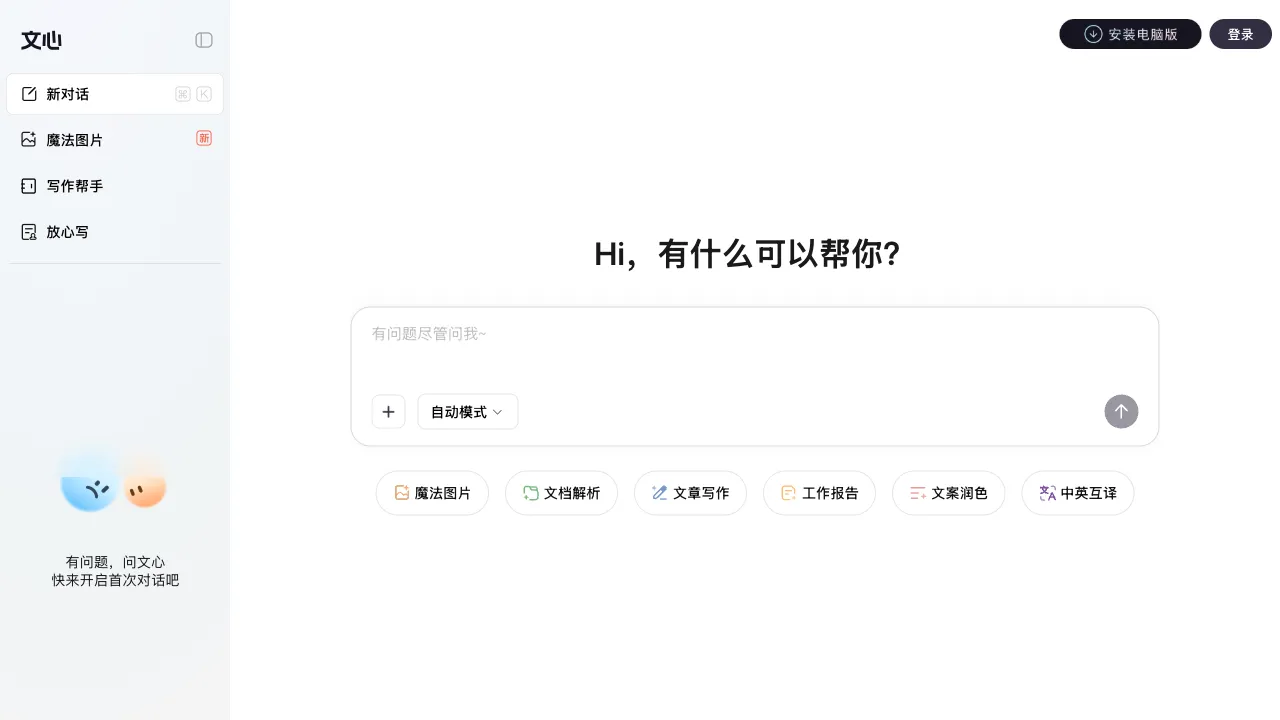
In the competitive landscape of domestic large language models, ERNE (ERNIE) is a name that cannot be ignored. Baidu’s accumulation in the AI field dates back many years; the massive amount of Chinese data accumulated through its search business, long-term investment in natural language processing, and research into knowledge graphs have all laid the foundation for the development of ERNIE. ERNIE is not just a conversational AI but also Baidu’s core platform layout for the commercialization of AI technology.
What is ERNIE?
ERNIE (wenxin.baidu.com) is a series of knowledge-enhanced large language models launched by Baidu. Its underlying technology is called ERNIE (Enhanced Representation through kNowledge IntEgration), and its name reveals its key characteristic—knowledge enhancement. By deeply integrating knowledge graphs with massive amounts of Chinese content during training, Baidu aims to give the model stronger factual accuracy when understanding and generating Chinese content.
For developers and enterprises, Baidu provides API access to ERNIE, allowing integration into various applications; for general users, ERNIE Bot (Wenxin Yiyan) is the most direct interaction entry point.
Technical Features
Knowledge Enhancement ERNIE’s differentiated positioning is “knowledge enhancement”—rather than relying solely on large-scale text pre-training, it incorporates structured knowledge graph data during training. Baidu Search has accumulated knowledge graphs over many years, containing extensive entity relationships and factual data. This structured knowledge helps the model answer factual questions more accurately to a certain extent.
Chinese Optimization As a company that started with Chinese search, Baidu possesses the largest corpus of Chinese content in the country. ERNIE has advantages in understanding Chinese, generating Chinese, and grasping Chinese cultural contexts. Processing long Chinese documents, understanding Chinese context, and generating fluent Chinese expressions are ERNIE’s core capabilities.
Multimodal Capabilities The ERNIE series is also expanding its multimodal capabilities, including image-text understanding, image generation (Wenxin Yige), and voice interaction, gradually evolving from a single-language model into a multimodal AI platform.
Continuous Iteration ERNIE continuously releases new versions—ERNIE 3.0, 3.5, and 4.0. Each update shows improved performance across various benchmarks, reflecting Baidu’s ongoing progress in R&D investment.
ERNIE Product Matrix
ERNIE is not a single product but a platform that has spawned multiple products tailored to different scenarios:
ERNIE Bot (Wenxin Yiyan) A conversational AI product for general users, directly usable on the web and via app. Its functions are similar to ChatGPT—conversational Q&A, text writing, code assistance, and knowledge queries. It is the primary way most general users interact with ERNIE.
Wenxin Yige An AI painting tool based on ERNIE that generates images from text descriptions. It supports Chinese prompts and offers styles including realistic, illustration, and Chinese traditional aesthetics. It has a solid user base among domestic AI art tools, particularly for its friendliness to Chinese prompts.
Qianfan A large model service platform for enterprise developers. It provides ERNIE API access, as well as unified calling interfaces for other mainstream models (including third-party ones), model fine-tuning, vector databases, and other enterprise-grade AI development infrastructure.
Industry-Specific Versions Baidu has launched industry-specific versions for vertical sectors such as finance, healthcare, law, and manufacturing, which have been specially trained and optimized using industry data.
Enterprise Application Scenarios
ERNIE’s layout on the enterprise side is quite deep:
Customer Service and Dialogue Systems: Integrating ERNIE into enterprise customer service systems to handle common inquiries, intelligently route queries, and assist agents in answering questions;
Knowledge Management: Intelligent search and Q&A for internal corporate knowledge bases. Employees ask questions, and the AI finds answers from internal documents;
Content Production Assistance: Marketing copy, product descriptions, and report writing, where AI assists content teams in improving production efficiency;
Code Assistance: Integrating ERNIE’s coding model to assist developers with writing code, debugging, and generating documentation;
Data Analysis: Converting natural language queries into SQL statements, allowing non-technical personnel to query databases.
Comparison with Other Domestic Large Models
vs. Tongyi Qianwen (Alibaba): Alibaba’s large model platform, leveraging the Alibaba Cloud ecosystem, has deep integration in e-commerce and enterprise services. It competes fiercely with ERNIE in the enterprise market, each relying on its own cloud computing and ecosystem advantages.
vs. Hunyuan (Tencent): Tencent’s large model, leveraging the WeChat and WeCom ecosystems, has unique advantages in social and office scenarios. ERNIE and Hunyuan each have their own focus within their respective ecosystems.
vs. Kimi (Moonshot AI): Kimi is known for its ultra-long context capability and performs exceptionally well in processing long documents. It is a new domestic large model force that has attracted significant attention in recent years. Its positioning differs from ERNIE, with Kimi leaning more toward C-end users and long-document processing.
vs. iFlytek Spark: iFlytek’s large model, which has long-term accumulation in speech recognition and natural language processing, with deep layout in the education sector. ERNIE and Spark each have their strengths in various vertical industries.
vs. ChatGPT/Claude: As overseas models, their Chinese understanding and generation capabilities lag behind domestic models, especially when involving specific domestic cultural backgrounds and knowledge. ERNIE has a clear advantage in Chinese scenarios, but international top-tier models still lead in comprehensive capability evaluations.
Who Is It For?
Domestic Chinese Users Needing AI Assistance: ERNIE Bot is a relatively stable domestic AI conversational tool that does not require scientific internet access and handles Chinese content reasonably well.
Enterprise AI Transformation Teams: Looking for a domestically available, data-compliant large model platform with commercial support, Qianfan provides complete enterprise-grade infrastructure.
Developers Building Chinese AI Applications: Calling the ERNIE API, combined with Baidu’s knowledge graph and Chinese optimization capabilities, to build AI products targeting domestic users.
Enterprises with Industry-Specific Customization Needs: For industries such as finance, healthcare, and manufacturing, Baidu has specialized industry versions and implementation teams that can provide customized solutions.
Usage Thresholds
ERNIE Bot’s web version and app are available upon registration, with a free tier; high-frequency calls or commercial use require payment. Qianfan offers a free tier for new users, with API calls billed on a pay-as-you-go basis. Specific pricing is subject to the Baidu Intelligent Cloud official website.
ERNIE represents Baidu’s core strategic product in the era of large AI models. Backed by Baidu’s years of Chinese data accumulation and AI R&D investment, it has a considerable user base among domestic enterprises and developers. For users and enterprises needing to use large models within a compliant domestic environment, ERNIE is an option worth serious evaluation.