

Every graduation season, millions of Chinese college students experience the same collective anxiety: thesis plagiarism checks. The red lines for similarity rates set by CNKI, Wanfang Data, and VIP loom overhead; exceeding them means delayed graduation, rewriting, or blocked defenses. This rigid demand, created jointly by academic norms and detection systems, has spawned an entire market of "similarity reduction" tools—AiGaixie is one of them, specializing in academic text processing. It targets not general writing, but the unique and strict rules of academic writing: precise wording, rigorous logic, standardized formatting, and that most distinctly Chinese requirement—rewriting text to lower similarity rates while preserving the original meaning.
What Is AiGaixie?
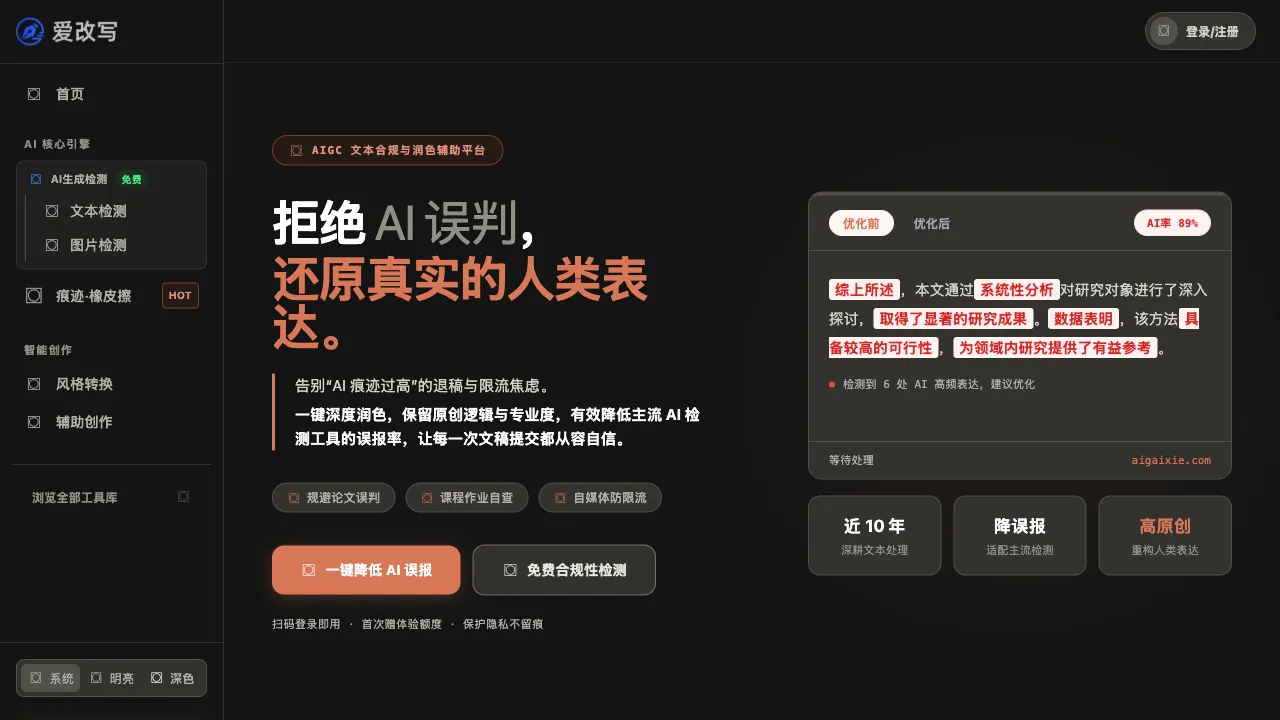
AiGaixie (aigaixie.com) is an AI writing assistant focused on academic and professional text processing. Its functions center on text rewriting, similarity reduction, polishing, and academic translation. It positions itself as "an AI text productivity tool for researchers," targeting students, researchers, and academic authors. Its verticality is strong—it does not attempt to be an all-purpose writing tool but instead focuses intensely on the niche scenario of "academic text," particularly the domestic demand for similarity reduction.
Core Features
AI Rewriting and Similarity Reduction: The Core
For paragraphs with high similarity rates, the AI performs semantic-preserving rewriting—changing words, sentence structures, and word order—to alter the expression while keeping the core content unchanged, thereby reducing overlap with the original text. The granularity of rewriting is controllable (entire paragraph/sentence-by-sentence/specific words).
Here, we must clarify the ethical boundaries: The most legitimate use of similarity reduction tools is optimizing the expression of your own draft (your own research, your own viewpoints, rephrasing to reduce mechanical overlap with literature review sections), rather than "washing" others' text into your own—the latter is academic misconduct, and no tool can help you evade responsibility for integrity. Furthermore, be clear-headed: similarity reduction only lowers "text repetition rates," not "substantive plagiarism." Detection systems (and increasingly prevalent AIGC detectors) are evolving, leaving less room for opportunism; the true moat is always original content itself.
Thesis Polishing
Language-layer optimization: improving sentence structure, unifying academic tone, and enhancing the accuracy and standardization of wording. For researchers with limited writing experience or non-native speakers, polishing can bring language quality closer to academic standards—a function that is more "legitimate" and offers greater long-term value than similarity reduction.
Academic Chinese-English Translation
Translation optimized for academic content, with professional terminology mapping being more accurate than general translation tools: Chinese-to-English (for writing English papers), English-to-Chinese (for reading literature). The difficulty in academic translation lies in the precise correspondence of terminology and domain context, which is its differentiator from general translation.
Text Summarization and Self-Check for Similarity
Automatic summarization of long documents to extract core viewpoints, improving efficiency in reading literature; some versions offer a simple self-check feature to preliminarily assess similarity before formal submission—this cannot replace professional checks like CNKI but serves as a preliminary reference.
Comparison with Similar Tools
vs Metaso Writing Cat: Writing Cat has more comprehensive functions (error correction, rewriting, similarity reduction, general writing), is more mature in product design, has a better interface, and covers broader scenarios; AiGaixie is more vertically focused on academic similarity reduction. Choose Writing Cat for an all-purpose writing assistant; choose AiGaixie if you focus solely on academic similarity reduction.
vs WanNeng XiaoYin and other similarity reduction tools: There are many tools in the domestic similarity reduction track with similar positioning; differences lie in rewriting quality and price—practical comparison testing across multiple tools is a pragmatic approach.
vs Direct Rewriting/Polishing with ChatGPT/Kimi: The quality of general large models for rewriting and polishing is usually not poor, and they are free and flexible; however, you must organize prompts yourself and lack preset workflows for academic scenarios. For frequent needs, using a dedicated tool is more worry-free; occasional use of large models is sufficient.
vs Grammarly (English): The benchmark for English academic polishing, focusing on English; AiGaixie focuses on Chinese academia, making their scenarios complementary. Use Grammarly for English paper polishing and AiGaixie for Chinese paper similarity reduction and polishing.
Who Should Use AiGaixie?
Undergraduate/Graduate Students: The most direct beneficiaries of similarity reduction and polishing under the pressure of thesis checks—but please maintain the bottom line of "optimizing your own draft" rather than "washing others' content."
Researchers: Frequent writing of papers, grant applications, and reports; polishing and rewriting improve efficiency.
Academic Submitters: Polishing text before submission to make language more compliant with academic norms.
Those with Academic Translation Needs: Chinese-English academic content translation; specialized translation is more targeted than general tools.
Limitations
Rewriting quality has limits: Rewriting complex professional content may lead to meaning deviations or unnatural expressions; you must review the output yourself—the most dangerous misuse of AI similarity reduction is "blindly accepting" results, leading to factual errors or logical breaks without realizing it.
The ethical boundaries have been repeatedly emphasized above: reducing text repetition ≠ solving plagiarism; academic integrity is the user's responsibility, not the tool's; the prevalence of AIGC detection also increases the risk of "pure AI similarity reduction."
The effect on English academic writing is inferior to specialized tools like Grammarly; the free version has usage limits, and frequent use requires payment.
Pricing
Free trial quota (free attempts after registration); more features and attempts require a paid membership (monthly/annual plans), subject to the official website.
AiGaixie is a highly functional vertical product: it solves a very specific Chinese pain point (thesis similarity reduction) and is thus tied to the fate of that pain point. A pragmatic evaluation method is simple: try the free version with a draft you wrote yourself, see if the rewriting quality meets your needs and whether it introduces meaning deviations, then decide whether to pay. But a reminder more important than the tool itself is: similarity reduction is technique; originality is the way—focusing more energy on writing truly your own content is the fundamental solution to bypassing plagiarism anxiety.