

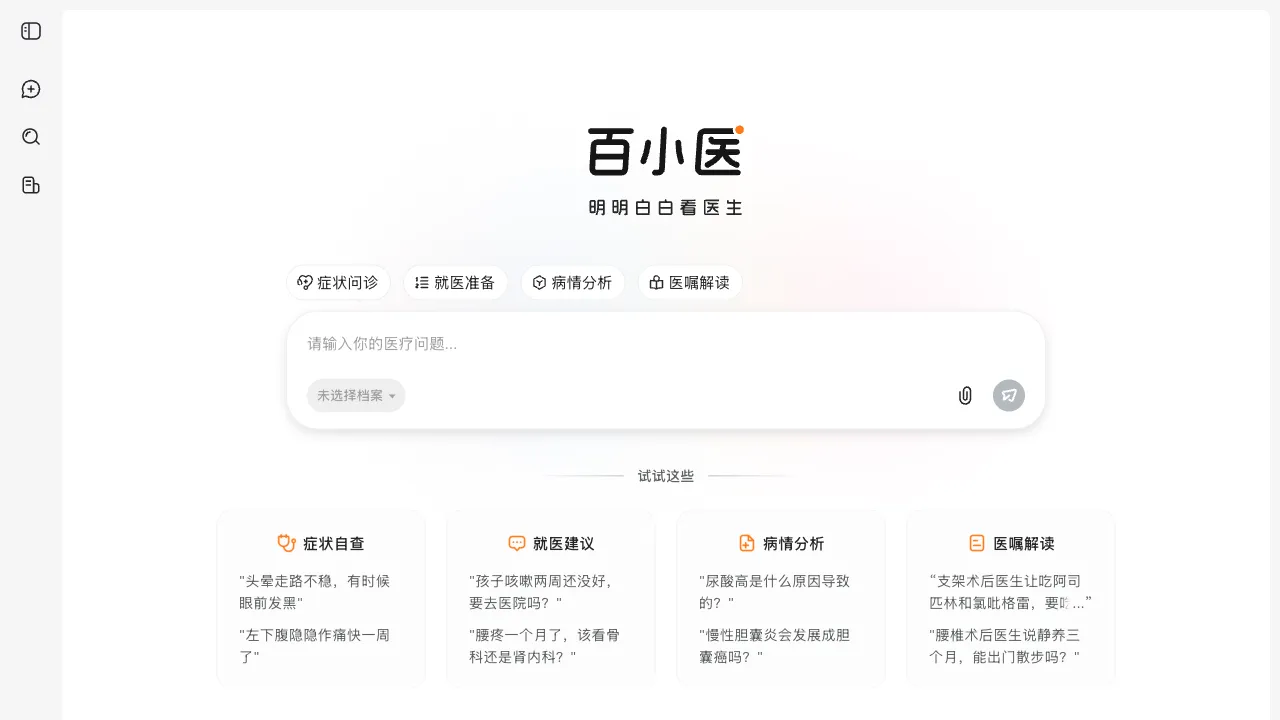
During the peak of China’s large model startup boom in 2023, when the "war of a hundred models" was at its fiercest, the founders’ backgrounds often drew more attention than the companies themselves. Baichuan Intelligence’s appeal stems largely from the name Wang Xiaochuan—founder and former CEO of Sogou, with a background in Chinese search technology. After Sogou was absorbed by Tencent, he remained quiet for a period before choosing to bet his next major career move on large models. The entry of a veteran who hasdeep cultivation (deeply cultivated) Chinese information processing for twenty years is itself a significant signal. Baichuan’s subsequent story further validates Wang Xiaochuan’s persistent personal vision: it has dug deeper and deeper into the vertical field of healthcare—Wang has publicly stated multiple times that "using AI to achieve universal access to healthcare" is his ultimate goal, and Baichuan’s strategic focus has consequently shifted from general-purpose large models to gradually concentrating on medical AI.
What is Baichuan Intelligence?
Baichuan Intelligence (baichuan-ai.com, founded in 2023) is a large model startup whose business covers open-source models (the Baichuan series), commercial API services, and C-end consumer dialogue products. Its technical characteristics lie in deep Chinese optimization and specialized capability building in the vertical healthcare field. Understanding Baichuan today requires grasping its strategic pivot: from competing with others on general-purpose large models in its early days to explicitly making healthcare its main battlefield—this focus gives it a unique identity in a crowded track.
Core Products and Capabilities
Baichuan Large Model Series
Open-source models: Baichuan-7B/13B, Baichuan2, etc., are released as open source, allowing for download, fine-tuning, and deployment. They enjoy high recognition among Chinese open-source large models, perform well in Chinese evaluations, and form an important part of China’s open-source ecosystem (alongside Zhipu ChatGLM, Alibaba Qwen, etc.). Many research teams and startups have built secondary developments on top of them.
Commercial models: Larger-parameter commercial versions are provided via API, targeting enterprise-level applications.
Healthcare Specialization: The Strategic Core
This is the key to understanding Baichuan. Its investment in the healthcare field far exceeds merely "making a vertical version as an afterthought"—specialized medical large models, medical knowledge Q&A, assisted diagnostic references, and medical literature comprehension are the main axis of the company’s strategy. This route is deeply bound to Wang Xiaochuan’s personal obsession: he views healthcare as the most valuable application scenario for large models, and Baichuan’s resources are clearly tilted toward this area.
A serious boundary must be emphasized: AI medical Q&A is a reference tool for health information, and absolutely cannot replace the diagnosis of a licensed physician. Any health issue requires seeking professional medical care. The value of AI in this field is assistance and universal access, not replacing doctors—this red line is more critical in medical AI than in any other scenario.
Dialogue Products and API
The C-end dialogue product provides daily AI assistant capabilities (Q&A, writing assistance); the API offers text generation, Embedding, multimodal, and other capabilities. Pricing is competitive, making it one of the API options for domestic developers building applications.
Comparison with Peers
vs. Moonshot AI (Kimi): A star startup that rose concurrently; Kimi gained fame for its ultra-long context window and strong C-end presence. Baichuan’s differentiation lies in healthcare verticalization and its open-source ecosystem. Both are representative members of the "AI Six Little Dragons," but their strategic routes differ.
vs. Zhipu AI (ChatGLM): Both operate on dual tracks of open source and commerce, and both are leading startups with Tsinghua University/technical backgrounds. Zhipu’s general-purpose and to-B commercialization are more comprehensive, while Baichuan focuses more on the healthcare vertical—this is differentiated competition within the same tier.
vs. MiniMax: MiniMax bets on multimodality, voice, and C-end products (Hailuo, Xingye); Baichuan bets on professional medical knowledge. These are two entirely different paths of verticalization.
vs. Big Tech Models (ERNIE Bot/Tongyi/Hunyuan): Big tech companies crush startups in resources, ecosystems, and scenarios. The survival strategy for startups is focus—Baichuan builds barriers through depth in the healthcare vertical, a specialized area where big tech’s "do-everything" approach makes it difficult to invest deeply.
vs. Llama: The global mainstream open source, strong in English; Baichuan’s open-source models have significantly better Chinese capabilities than Llama and are more suitable for Chinese-optimized scenarios.
Who Should Use Baichuan Intelligence?
Developers needing domestic large model APIs: Good Chinese capabilities, competitive pricing, and an open-source version for local deployment make it one of the API candidates for building AI applications in China.
Research and academic scenarios: Open-source models are free to fine-tune and serve as a common foundation for Chinese NLP research.
Users needing health and medical information references: Baichuan’s healthcare specialization makes it more reliable on health issues than general-purpose models—as a reference for understanding information, not as a basis for diagnosis, this positioning must be clearly understood.
Enterprises in healthcare and specialized fields: For industries like healthcare that require high precision in Chinese professional knowledge, Baichuan’s vertical direction may be more appropriate than general-purpose models.
Open-Source Contributions
Baichuan’s open-source models are an important member of China’s domestic Chinese open-source large model ecosystem. Numerous teams have built secondary developments and fine-tuning on top of them—this strategy of "maintaining technical community influence through open source" is an effective path for startups to maintain presence amidst the squeeze from tech giants.
Pricing
The C-end dialogue product offers a free tier; APIs are billed per token, with small-scale usage often including a free quota; open-source models are free to download, but commercial use requires checking specific licenses. Refer to the official website for details.
Baichuan Intelligence represents a clear-headed approach to large model startups: rather than competing with giants on comprehensiveness, it selects one most valuable direction that it believes in (healthcare), bets resources on building barriers there, and simultaneously uses open source to maintain community influence. Its story also reminds us that when evaluating an AI company, the founder’s personal vision is sometimes a more reliable predictor of direction than technical parameters—Wang Xiaochuan is betting on AI healthcare, and Baichuan’s future will likely be written along this path.