

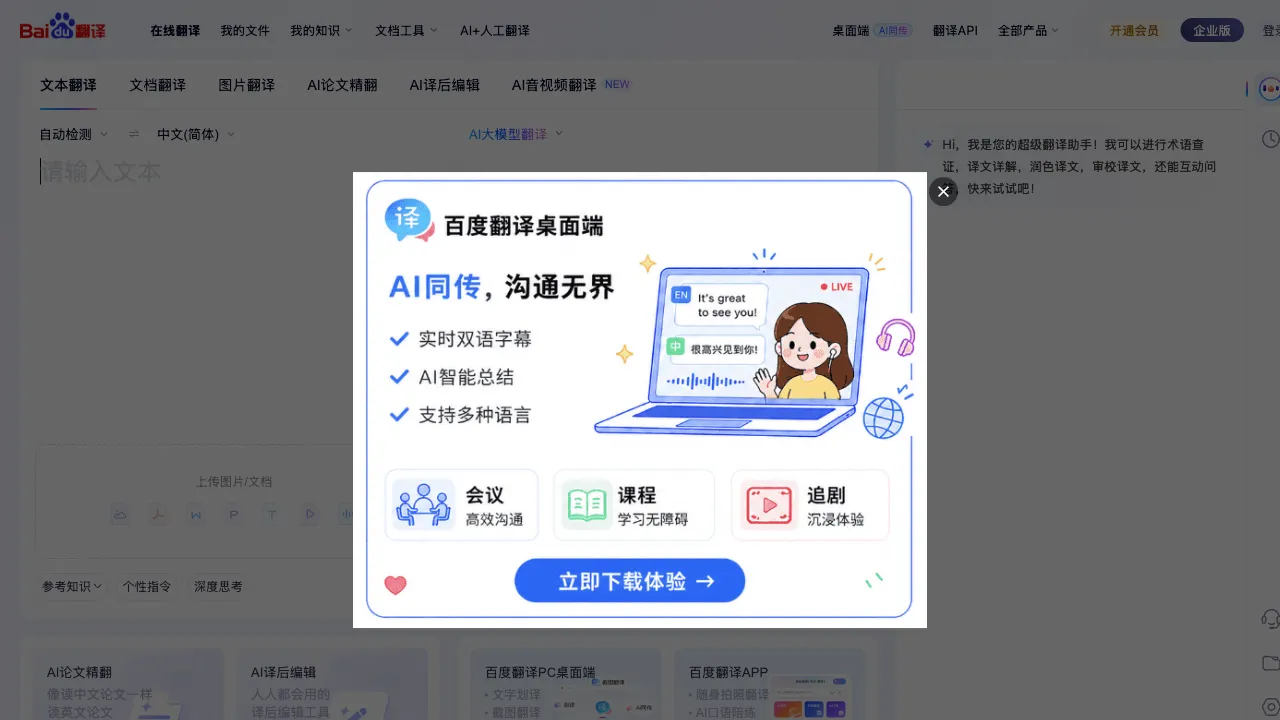
In China, the choice of translation tools is actually more diverse than many people realize, but for everyday quick translations, Baidu Translate is often the first response—because it’s right there, requires no VPN, is free, and works immediately upon opening. It isn’t the coolest tool, nor is it necessarily the highest quality in every scenario, but it has the broadest coverage, the lowest barrier to entry, and the largest user base.
What Is Baidu Translate?
Baidu Translate (fanyi.baidu.com) is an online translation service launched by Baidu, supporting mutual translation among more than 200 languages. It offers various formats including text translation, document translation, and image translation, with the entire service being completely free for ordinary users.
The history of Baidu Translate dates back to 2011. After more than a decade of iterations, its engine has undergone several major upgrades, evolving from rule-based and statistical machine translation to neural machine translation (NMT). The current translation engine is based on deep learning, with overall translation quality showing significant improvement compared to early versions, particularly in the fluency of Chinese-English mutual translation.
Key Features
Text Translation
This is the most basic and widely used feature. Open the webpage, paste or type text, select the target language, and the translation result appears instantly. The translation quality for common language pairs such as Chinese-English, Chinese-Japanese, and Chinese-Korean is generally sufficient for daily use scenarios.
It is worth highlighting that Baidu Translate’s understanding of Chinese is better than many foreign translation engines because its training data contains richer Chinese content, giving it an advantage in the Chinese-to-foreign-language direction.
Webpage Translation
After installing the Baidu Translate browser extension, you can translate the current webpage with one click. When visiting foreign websites, forums, or technical documentation, there is no need to copy and paste; you can simply view the Chinese translation directly on the page.
Document Translation
Supports uploading Word, PDF, Excel, and other documents for full-file translation while preserving the original format. The translated results can be downloaded. For users who need to process foreign contracts, technical specifications, or research reports, document translation is more efficient than paragraph-by-paragraph translation.
Image Translation (OCR)
Upload an image to recognize and translate the text within it. For text found in menus, signs, or screenshots, there is no need for manual input; simply upload the image to translate. The mobile app version also supports real-time camera translation: point your phone’s camera at foreign text, and the translation results are overlaid on the screen.
Voice Translation
Supports voice input for translation, enabling “speak-to-translate” functionality suitable for spoken scenarios. The mobile app also includes a conversation translation mode where two people speaking different languages can take turns; the app automatically translates both parties’ content, making it suitable for simple cross-language communication scenarios.
Multi-Language Support
Coverage of more than 200 languages is a clear advantage of Baidu Translate. Specifically, its translation quality for Asian languages (such as Japanese, Korean, Thai, Vietnamese, Arabic, etc.) is generally better compared to tools focused primarily on European languages (like DeepL).
Comparison with Other Translation Tools
vs. DeepL: DeepL is widely recognized for having top-tier translation quality among European languages (English, German, French, Spanish, etc.), producing more idiomatic and natural results. However, DeepL supports a limited number of languages (primarily European ones) and lacks the accumulation Baidu Translate has in Chinese and Asian languages. Its free version also has character limits. Overall: use DeepL for European languages and Baidu Translate for Asian languages; each has its strengths.
vs. Google Translate: Google Translate also supports over 100 languages, with quality that rivals Baidu Translate—Google’s English-centric language pairs (English to other languages) are typically high-quality, while Baidu holds a home-field advantage in Chinese understanding. However, Google Translate is unstable to access within mainland China, which is why Baidu Translate has a distinct usage advantage domestically.
vs. Youdao Translate: Youdao Translate (owned by NetEase) is Baidu Translate’s direct competitor in China. In terms of quality, the two are evenly matched. Youdao Dictionary offers more comprehensive features for English learning (such as example sentences and root word analysis), while Baidu Translate has broader multi-language coverage.
vs. Tencent Transmart: A translation tool produced by Tencent. The quality difference is minimal, but Tencent Transmart integrates with Tencent’s product ecosystem (such as WeCom).
vs. AI Large Language Model Translation (ChatGPT/Claude): Large language models typically offer higher quality than specialized translation engines when handling complex contexts, professional terminology, or literary translation. However, they require a VPN or payment, and the workflow is not as direct as Baidu Translate’s. For quick daily translations, use Baidu Translate; for scenarios requiring high quality (important business emails, contracts, literary content), use large models for secondary proofreading.
Who Is Baidu Translate For?
Ordinary users needing quick daily translations: For reading foreign news, English documents, or handling foreign emails, Baidu Translate is the most convenient choice for quick translation needs—free, fast, and no account required.
People in foreign trade and cross-border e-commerce: For translation needs between Chinese-English, Chinese-Japanese, and Chinese-Korean, Baidu Translate’s quality fully covers daily communication scenarios. Its image translation feature is also convenient for handling foreign packaging and product descriptions.
Students and researchers: For reading foreign literature and quickly translating unfamiliar paragraphs for reference, Baidu Translate serves as a sufficient auxiliary reading tool (but note: academic translation should prioritize understanding the original text; translation is a reference, not a substitute).
Travelers: The mobile app’s real-time camera translation and voice translation are useful for reading menus and signs abroad and for simple communication with locals.
Limitations
Baidu Translate’s main limitation lies in its quality ceiling—for professional domain terminology (law, medicine, finance), highly literary texts, or content with specific cultural nuances, the translation results may be inaccurate or even misleading. This is not a problem unique to Baidu Translate; all machine translation tools have similar limitations, and important professional translations still require human proofreading.
Additionally, the document translation feature has unstable support for complex PDF formats (those with many charts or multi-column layouts), and the formatting may become garbled after translation.
Overall, Baidu Translate’s value lies in being “good enough, free, and instantly accessible,” a positioning it executes well. It addresses 80% of daily translation needs; for the remaining 20% requiring higher quality, it can be supplemented with DeepL or large model tools.