

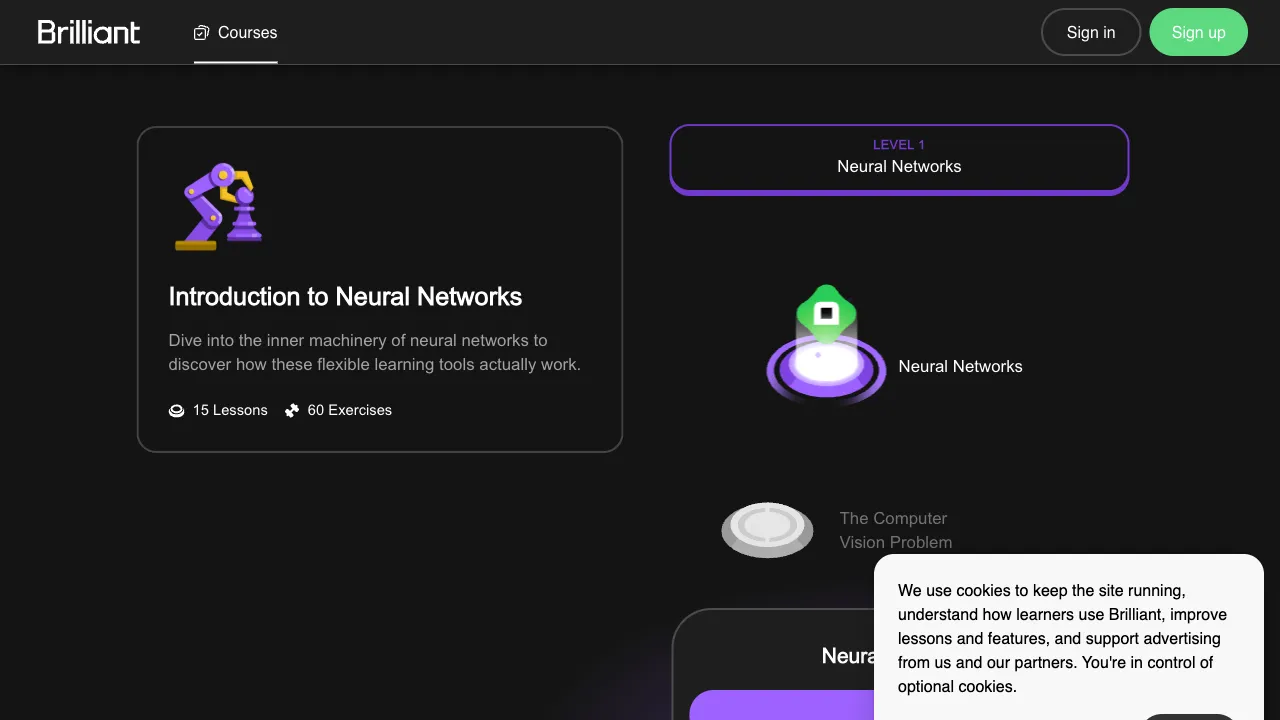
Most people hit the same wall when trying to learn neural networks: textbooks are either too mathematical, diving straight into partial differential equations and backpropagation derivations that scare off half the learners; or they are too superficial, covering concepts without explaining the underlying principles, leaving you still unsure of how neural networks actually work. Brilliant’s Neural Networks course attempts to walk a middle path—using interactive visualizations and hands-on exercises to help learners truly understand how neural networks operate without requiring a background in advanced mathematics.
What This Course Is
Brilliant (brilliant.org) is an interactive learning platform focused on STEM education, known for its "learning by doing" philosophy. Its Neural Networks course (Intro to Neural Networks) is part of the platform’s AI and machine learning curriculum series. Through visual animations, interactive charts, and step-by-step guided exercises, it leads learners from zero knowledge to a clear understanding of how neural networks function.
This is not a video course; it is entirely interactive. You don’t just watch—you directly manipulate neural network parameters within the course, observing real-time changes in network behavior as values shift, thereby building an intuitive sense of the mechanics at play.
Course Content
Perceptrons and Foundational Concepts
The course begins with the simplest neuron model: what a perceptron is, how it accepts inputs, calculates weighted sums, and outputs results through an activation function. This approach, starting from the smallest unit, helps learners establish a clear foundational model first.
Visualizations show how adjusting weights affects the output. You can drag sliders to change weight values and see in real time how the output changes—this interactivity transforms "weights" from abstract numbers into tangible parameters.
Multi-Layer Network Structures
The course expands from single neurons to multi-layer networks—explaining what hidden layers are, why multiple layers are necessary, and what deep networks can learn that shallow ones cannot.
Through visualization, you can observe how data transforms as it flows through multiple layers, understanding what each layer does and why "deep" learning is meaningful.
Forward and Backward Propagation
This section covers the core mechanism of neural network learning—how to learn from errors (gradient descent and backpropagation).
This part is often the hardest for introductory courses. Brilliant explains it intuitively: instead of presenting partial derivative formulas immediately, it first builds the intuition for "which direction reduces error," then introduces the concept of gradients. Combined with visualizations of loss surfaces and gradient descent animations, this helps learners grasp the essence of backpropagation even without advanced math skills.
Activation Functions
The course explains why activation functions are necessary, the characteristics of different activation functions (such as Sigmoid and ReLU), and their impact on network learning.
Common Application Cases
Theory is connected to practical applications: typical neural network use cases like image recognition and text classification help learners understand how neural networks handle these specific problems.
Training Techniques and Common Issues
The course covers what overfitting and underfitting are, how to address them, why loss may oscillate during training, and the impact of batch size on training. These practical insights help learners anticipate issues they will encounter in real-world training scenarios.
Brilliant’s Learning Approach
Brilliant’s defining feature is that all content is interactive:
Not passive viewing: Interactive questions or hands-on exercises appear every few minutes, forcing active engagement and attention.
Visualization-first: Abstract concepts are presented through animations and interactive charts, building intuitive understanding before formula memorization.
Step-by-step progression: Each concept builds on the previous one, with no sudden jumps in difficulty.
Mobile-friendly: The course can be completed on a phone, allowing you to learn during fragmented moments of free time.
Comparison with Other Learning Resources
vs. 3Blue1Brown’s Neural Networks Series (YouTube): 3B1B’s visual videos are classics for neural network beginners and are of extremely high quality. However, they are passive viewing experiences, whereas Brilliant is active participation. The two complement each other well: watching 3B1B first to build a macro-level understanding, then using Brilliant to deepen that understanding is an excellent combination.
vs. fast.ai Deep Learning Course: fast.ai is more comprehensive and includes real coding practice, making it better suited for those who want to actually implement deep learning. For complete beginners, Brilliant has a lower barrier to entry.
vs. Coursera’s Andrew Ng Machine Learning Course: Andrew Ng’s course is a classic introduction to machine learning with a solid mathematical foundation and programming assignments. Brilliant is lighter weight, focusing purely on conceptual understanding without coding, making it suitable for those who do not plan to write code but simply want to understand neural networks.
*vs. Books (e.g., Deep Learning by Goodfellow)*: Textbooks are comprehensive and rigorous but rely on one-way reading without interactivity. Brilliant’s interactive format significantly aids understanding, though it lacks the depth of a systematic textbook.
Who This Course Is For
Those curious about neural networks but lacking a math background: If you want to understand how neural networks work without intending to become a researcher, and simply wish to build correct mental models, Brilliant’s intuitive explanations are ideal.
Non-technical professionals: Product managers, data analysts, and business decision-makers who need to understand the basic workings of neural networks to make informed AI-related decisions will find Brilliant’s no-code learning path suitable.
A starting point for AI beginners: If you want to learn AI systematically but don’t know where to start, Brilliant’s Neural Networks course serves as a low-barrier entry point, helping you build foundational knowledge before diving deeper.
Those who prefer learning on mobile devices: Brilliant offers an excellent mobile experience, allowing you to complete lessons during commutes or other fragmented waiting times.
Limitations
The Brilliant neural network course does not include hands-on coding practice. While you will understand the concepts after completing it, you won’t be able to write code to implement a neural network. If you want to get your hands dirty, you’ll need to supplement this with Python and practical deep learning courses.
The depth of the content is limited; it serves as an introduction rather than a comprehensive guide, making it a starting point rather than an endpoint for those looking to dive deeper.
All content is in English, requiring a solid ability to read and comprehend English.
Pricing
Brilliant operates on a monthly subscription model. Subscribing grants access to all courses (not just this neural network introduction). The monthly fee is approximately $25, with annual discounts bringing the cost down to roughly $100–$150 per year. Limited free content is available for trial purposes; please refer to the official website for specific details.
Brilliant’s neural network course does a commendable job at the "conceptual introduction" level. If you are curious about how neural networks work but have previously been deterred by mathematical formulas, Brilliant’s interactive approach has a high probability of helping you truly grasp the subject.