

When using general-purpose AI to write Chinese workplace documents, there is an invisible wall that many people hit: the model can produce fluent text, but it fails to grasp the "unspoken rules of formatting." Ask it to write a year-end summary, and the output reads like a machine-translated English essay; ask for a formal request (request for instructions), and the bureaucratic conventions at the beginning and end miss the mark entirely; ask for a Xiaohongshu post, and the density of emojis and the "sisters" tone feel slightly off. These issues are not problems of language proficiency, but of scenario knowledge—each Chinese writing style has its own unwritten set of formats, tones, and reader expectations that general models are not specifically designed to serve.
BiLing AI’s product philosophy is to "solidify" this scenario knowledge into the product itself: hundreds of templates and features tailored to specific Chinese writing scenarios. Behind each template lies a set of fine-tuned prompt engineering techniques—you don’t need to know how to "train" AI; simply select the right template, fill in the key points, and produce text that "knows the industry."
What is BiLing AI?
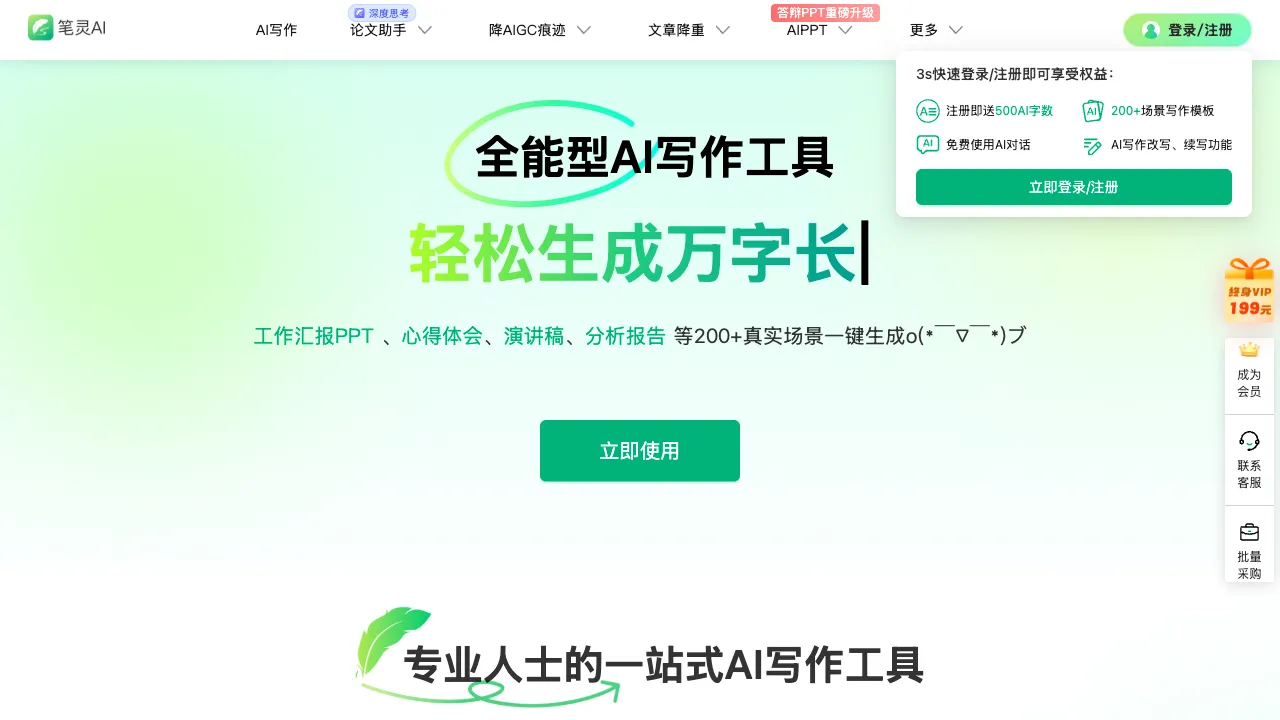
BiLing AI (ibiling.cn) is a domestic Chinese AI writing tool positioned to cover all Chinese writing scenarios: workplace documents, business documents, self-media content, marketing copy, academic assistance, and polishing/rewriting of existing text. Its core asset is not the underlying model (as model capabilities are converging across the industry), but its vast scenario template map—breaking down the diverse writing needs in the Chinese world into ready-to-use functions one by one.
Core Features
Scenario Template Library: The Product’s Mainstay
The breadth of templates is BiLing’s signature feature, covering several major categories:
Workplace Documents: Weekly/monthly reports, year-end summaries, performance reviews, speech drafts, applications, meeting minutes, and company regulations—the unique ecosystem of Chinese workplace genres, with the formatting conventions for each pre-built into the templates. "Year-end summary" is likely its highest-traffic feature of the year; every December, it becomes a lifeline for countless professionals.
Business Documents: Business plans, market analyses, bidding documents, and product introductions—for complex, long-form documents, the chapter frameworks provided by the templates are valuable in themselves.
Self-Media Content: WeChat Official Account articles, Xiaohongshu posts (with appropriately styled emojis), Douyin spoken scripts, and Zhihu answers—optimized for the specific tone of each platform, this is the most intuitive manifestation of "productizing scenario knowledge."
Marketing Copy: Product descriptions, promotional posts, live-streaming scripts, and brand stories.
AI Generation, Continuation, and Expansion
Generate a complete first draft from a topic + key points, specifying word count and style; when stuck, use continuation or expand key points into paragraphs—this is the standard configuration for AI writing capabilities, with quality rising alongside the integrated large language model.
Polishing, Rewriting, and "Reducing the AI Flavor"
Processing existing text: polishing for quality, condensing, and style conversion (formal ↔ colloquial). Among these, "reducing the AI feel" is a particularly intriguing feature—transforming robotic-sounding text into something that reads more human. As platforms and schools increasingly deploy AIGC detection tools, the demand for this feature is both real and nuanced; its legitimate use is to make AI-assisted drafts more natural and readable, while the risks of gray-area usage are left to the user to weigh.
Academic Assistance
Features such as literature review frameworks, paper outlines, and academic polishing are officially positioned as "auxiliary references." The boundaries must be clear: using it to organize thoughts and improve expression is reasonable use; directly submitting AI-generated content is academic misconduct, and AIGC detection in universities is rapidly expanding—where this line is drawn determines whether the tool is an assistant or a liability.
Title and Abstract Generation
Generate ten candidate titles for an article—new media editors know well that the title determines the open rate, and the value of comparing multiple options is realized daily.
Comparison with Similar Tools
vs Meta Writing Cat (Misa): The most frequently compared competitor. Misa’s technical depth lies in error correction and rewriting (its Chinese grammar engine), while BiLing’s strength is its breadth of template ecosystems. A rough division of labor: use Misa for editing existing text, and BiLing for scenario-based generation from scratch; try the free versions of both to decide.
vs ChatGPT/Kimi/Doubao: General models offer higher ceilings and more flexible dialogue, but require you to craft prompts for each scenario yourself; BiLing has pre-built prompt engineering into buttons. Experienced users who know how to "train" AI might find templates restrictive, but for the majority who don’t want to tinker, templates equal efficiency.
vs Yizhuan: Yizhuan focuses on self-media data (viral content analysis, topic mining), while BiLing focuses on writing production; self-media users often use both in tandem.
vs Jasper and other overseas tools: These are mature solutions for English marketing content, but their Chinese optimization and understanding of local scenarios operate on a different frequency than domestic tools; Chinese users need not take the long way around.
Who Should Use BiLing AI?
Professionals trapped by document labor: For roles with high volumes of writing and heavy formatting conventions (weekly/monthly reports, summaries, proposals), template-based generation reduces the startup cost per document to just a few minutes—this is BiLing’s largest core user base.
Multi-platform self-media operators: When the same content must adapt to the different tones of WeChat, Xiaohongshu, and Douyin, generating separate versions via platform-specific templates saves the labor of manual "style translation."
E-commerce and marketing roles: For batch needs like product copy and promotional pushes, it enables a pipeline of AI first drafts + human-injected selling points.
Those who struggle with expression but must produce output: For those with ideas but difficulty articulating them, the template’s framework guidance combined with AI’s language capability removes much of the "can't write" barrier.
Usage Advice
Template outputs are always a "generically correct" baseline; your real data, specific cases, and personal viewpoints must be injected manually—AI doesn’t know what you actually accomplished this year; the substantive content in your year-end summary can only be filled in by you.
Generate multiple versions for the same request, taking the best parts of each to assemble a final draft; quality is more stable this way than relying on a single output. Read through the generated text to check for factual errors—AI’s habit of fabricating details applies equally across all tools.
Guard the red lines in academic and formal settings yourself: assistance is fine, ghostwriting is not. The evolution speed of detection technology always deserves respect.
Pricing
The free version includes basic functions and limited generation word counts; paid memberships unlock more word counts, all templates, and advanced features via monthly/annual subscriptions. Refer to the official website for specifics.
To judge BiLing’s value to you, one number is enough: how many hours per week do you spend on writing labor where "format matters more than content"? If it exceeds three hours, a tool that pre-builds these conventions will likely pay for its subscription fee—the time saved can be used to write things that truly require your thinking.