

There are many translation tools available, but most can only process text input. In reality, much of the content that needs translation comes in audio and video formats—foreign-language videos, meeting recordings, live-stream subtitles, and speech transcripts. This creates a gap for ordinary translation tools. NetEase Jianwai fills this void: it focuses on transcribing and translating audio-visual content, helping users convert spoken content into readable text in multiple languages.
What is NetEase Jianwai?
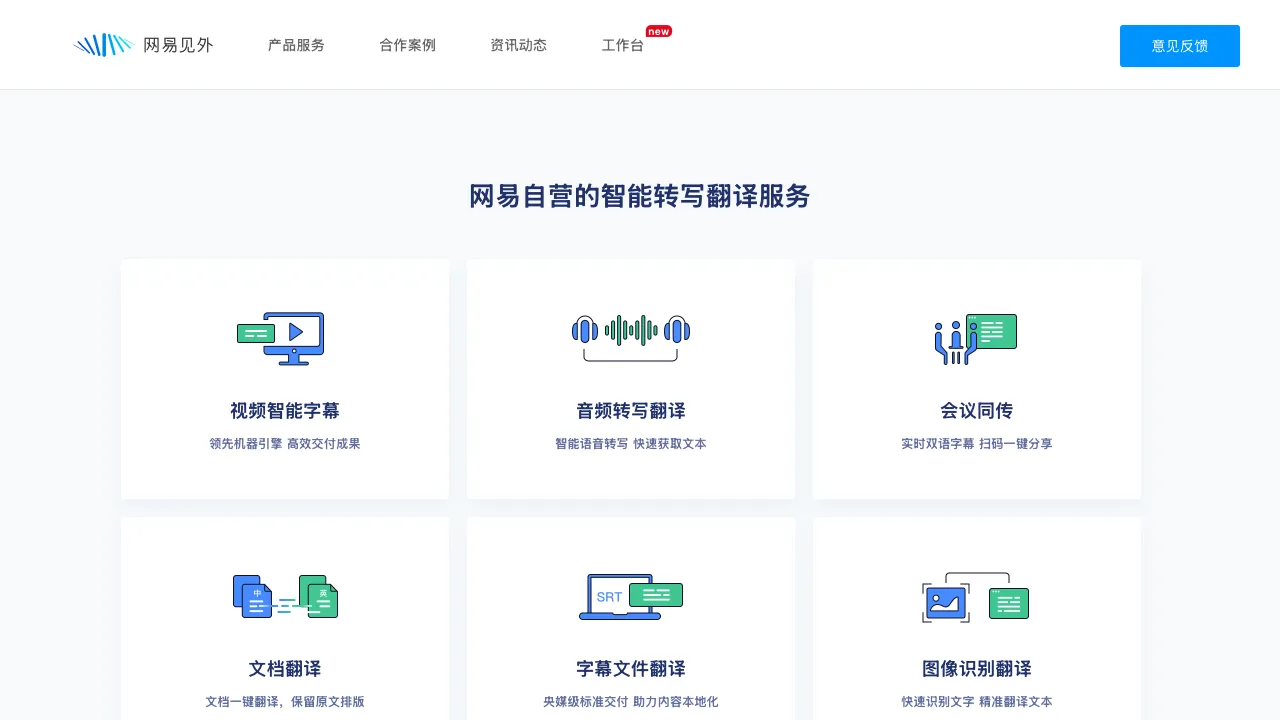
NetEase Jianwai (sight.youdao.com) is an AI subtitle and translation tool under NetEase Youdao. Its core function is to transcribe audio and video content into text and translate it into other languages. Key features include: video subtitle generation, audio transcription, simultaneous interpretation (real-time subtitles), and document translation.
Youdao is NetEase’s brand dedicated to language technology, best known for its Youdao Dictionary. It has years of experience in speech recognition and machine translation. Jianwai is Youdao’s specialized product focused on the audio-visual translation niche.
Core Features
Video Subtitle Generation
Upload a video file, and the AI automatically identifies the spoken content to generate corresponding subtitle files (in SRT format). You can select the source and target languages; if the video is in English, it can directly generate Chinese subtitles, and vice versa for international content distribution.
The subtitle timecodes are matched automatically, eliminating the need for manual alignment. After generation, you can edit the subtitle content within the platform to correct any recognition errors.
This feature saves time and effort for creators who need to add subtitles to their videos. Previously, this might have required manual typing or hiring specialists; now, the AI generates a draft that only requires human proofreading.
Audio Transcription
Supports voice-to-text conversion for pure audio files (such as MP3, WAV, etc.), with support for multi-language recognition and translation. Meeting recordings, podcasts, interview tapes—any spoken content can be converted into readable text using Jianwai.
The transcription results are segmented by speaker. If there are multiple speakers in the recording, Jianwai attempts to distinguish them (speaker identification capability depends on audio quality).
Simultaneous Interpretation (Real-Time Subtitles)
Supports real-time subtitle generation for spoken audio, allowing subtitles to be displayed live during meetings, broadcasts, and events. This feature is suitable for organizations with online event subtitle needs or international conferences requiring simultaneous interpretation support.
The accuracy of real-time subtitles is affected by network conditions and audio quality, with stricter requirements for microphone quality and background noise levels.
Document Translation
In addition to audio and video, Jianwai supports the translation of entire documents such as Word and PDF files while preserving the original layout. While this overlaps with many other translation tools, it offers convenience for users who need to handle multiple content formats on a single platform.
Multi-Language Support
Supports recognition and translation for major languages including Chinese, English, Japanese, Korean, French, German, and Spanish, covering the language needs of most international communication scenarios.
Typical Use Cases
Education and Learning: Processing subtitles for foreign-language open courses, TED talks, and academic lectures, allowing learners without time for manual organization to quickly obtain readable text.
Content Creators: YouTube creators or video bloggers who need to add subtitles to their videos can use Jianwai to quickly generate subtitle drafts, significantly reducing manual workload.
Corporate Meeting Records: Transcribing meeting recordings from international conferences or multi-language teams to produce searchable meeting minutes.
Academic Research: Transcribing spoken content from foreign-language interviews, podcasts, or research materials for easier citation and analysis.
Global Content Localization: Generating English or other language subtitles for Chinese video content intended for overseas publication.
International Event Interpretation: Meeting real-time subtitle needs for academic seminars, product launches, and corporate events.
Comparison with Other Tools
vs iFlytek Tingjian: An audio transcription tool under iFlytek. It has strong technical accumulation in Chinese speech recognition, with functions similar to Jianwai (audio-visual transcription + translation). Its Chinese speech recognition accuracy is excellent, particularly adapting well to Chinese accents and dialects. The two tools have highly overlapping features; you might try both to see which fits your workflow better.
vs Feishu Miaoji: A meeting record tool built into Feishu (Lark) that automatically transcribes Feishu meeting content with multi-language support, offering a seamless experience for Feishu users. However, it is limited to the Feishu meeting scenario and does not support uploading arbitrary audio files. Jianwai offers greater flexibility.
vs Otter.ai: Otter is an English-centric meeting transcription tool with extremely high accuracy in English recognition, speaker identification, and keyword extraction. However, its Chinese support is weak, targeting primarily English-speaking users. Jianwai’s optimization for Chinese is better, making it more suitable for domestic users.
vs Adobe Premiere (Auto Captions): Adobe’s video editing software includes a built-in voice-to-subtitle feature usable directly within the editing workflow. However, the full Adobe subscription is expensive; if you only need subtitle functionality, a specialized tool like Jianwai is more cost-effective.
vs Tencent Cloud Subtitle Generation: Tencent Cloud offers speech recognition APIs that can be integrated into custom systems, suitable for developers. Jianwai provides a product interface designed for general users, requiring no technical expertise.
vs YouTube Auto-Captions: YouTube’s auto-caption feature is convenient but has inconsistent accuracy, especially for Chinese content. Jianwai typically offers higher recognition accuracy, and the generated subtitle files can be downloaded and edited.
Accuracy and Quality
Speech recognition accuracy is influenced by several factors: audio quality (clear vs. noisy), speaker accents (standard Mandarin vs. dialects), and the density of specialized vocabulary (general terms vs. industry jargon).
For clear recordings in standard Mandarin, Jianwai’s transcription accuracy is quite high and can be used directly for formal occasions with only minor edits. For content with heavy accents, significant background noise, or dense technical terminology, accuracy may drop, requiring more extensive human proofreading.
Translation quality depends on the language pair; Chinese-English translation generally yields good results, while translations into less common languages may be less stable than those for major languages.
Free Quota and Pricing
NetEase Jianwai offers a free quota, allowing users to experience core features after registration. Beyond the free quota, billing is based on processing duration or character count. Specific pricing is subject to the official website; different features (subtitle generation, simultaneous interpretation, document translation) may have different billing methods.
For occasional personal use, the free quota is usually sufficient. For enterprises processing large volumes or high-frequency usage, paid plans should be considered.
NetEase Jianwai provides a complete solution for the niche scenario of audio-visual translation. If you frequently need to process video subtitles or transcribe meeting recordings, it saves considerable hassle compared to hiring humans or switching between multiple tools.