

For many domestic users, generating Asian portraits with Midjourney is a shared source of frustration: despite describing a "Chinese girl," the resulting faces always carry an indefinable "East Asian vibe imagined by Westerners"—the proportions of facial features, makeup logic, and aesthetic temperament are subtly off in every way. This isn’t mysticism; it’s determined by the demographic structure of the training data: models fed on Western internet images have a layer of separation when understanding East Asian aesthetics.
If we ask which company in the world best understands "what Chinese people consider a good-looking portrait," Meitu must be at the very front of the candidate list—its decade-plus, hundreds-of-millions-of-users beauty retouching business is essentially a super-large-scale "Asian aesthetic preference annotation project." Pouring this accumulation into an AI generation model is the underlying logic of Meitu Whee.
What is Meitu Whee?
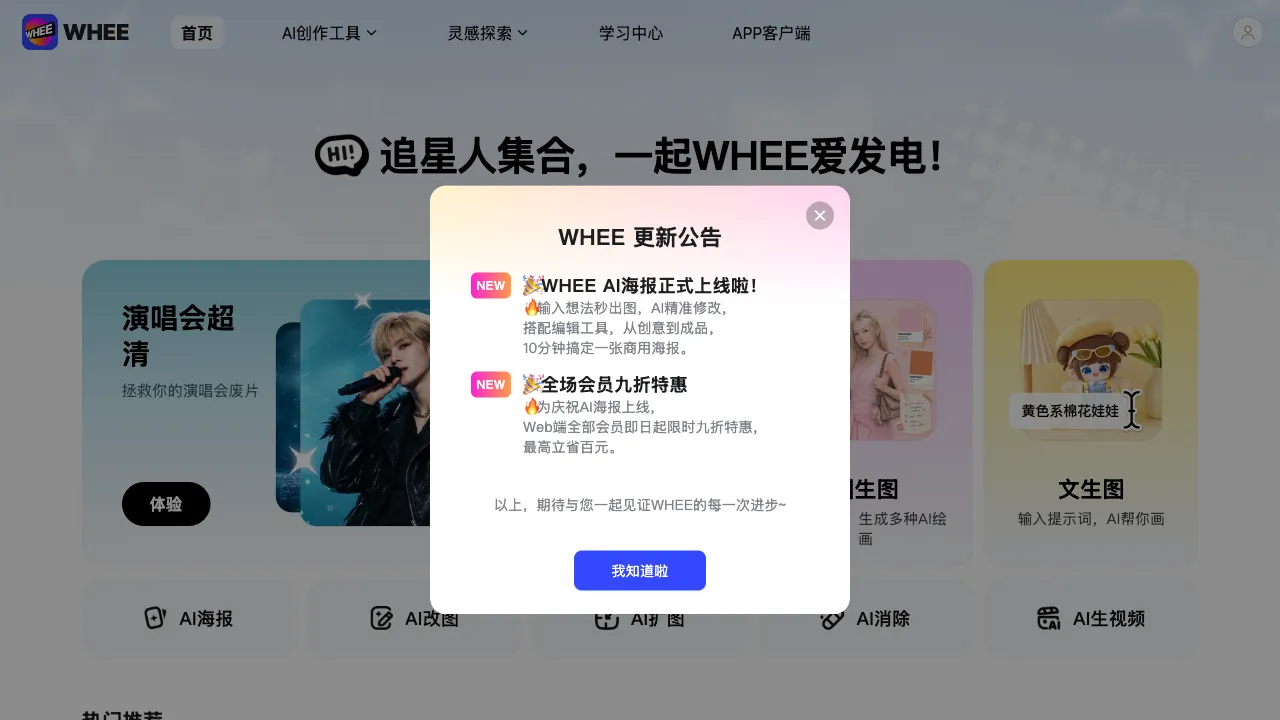
Meitu Whee (whee.com) is an AI visual creation platform launched by Meitu, with an extremely focused main direction: portrait generation in photo-realistic styles. Unlike general AI painting platforms that draw everything, Whee concentrates its firepower on one thing: "generating high-quality portraits that conform to Asian aesthetics"—fashion photos, ancient-style Hanfu, Japanese fresh style, and personal AI portraits are all centered around "people."
For Meitu, this is a logical strategic extension: from "beautifying your photos" to "directly generating a beautiful version of you." The technical paradigm has changed, but the core asset (understanding Asian portrait aesthetics) is fully reused.
Core Features
Portrait Style Generation
The flagship capability. Input a description or select a style template to generate portraits with photographic texture:
- Fashion Editorials: Magazine-cover-level lighting and composition language
- Ancient-style Hanfu: A top-tier category on content platforms in recent years, with specialized tuning for clothing patterns, hair accessories, and scene atmosphere—this is precisely the area where overseas models collectively stumble
- Japanese Portraits: An aesthetic direction featuring film grain, natural light, and a fresh, transparent feel
- Urban Lifestyle: Xiaohongshu-style lifestyle portraits
- Creative Concepts: Artistic, stylized portrait expressions
The value of "specialized models" is most clearly reflected in stability: generating portraits with general models is like pulling gacha cards, whereas Whee has significantly higher success rates and style consistency within the styles it specializes in—for creators who need to produce unified-style content in batches, stability is more important than the ceiling of a single image.
AI Portrait (Personal Image Generation)
Upload several of your own photos, let the AI learn your facial features, and then generate "your portraits" in various styles: professional headshots, artistic portraits, or ancient-style costumes. Benchmarking against overseas tools like Lensa and PhotoAI, but with aesthetic tuning entirely aimed at domestic users—the generated "you" is someone you can recognize as good-looking when looking in the mirror, not a stranger under Western filters.
The practical scenarios are more immediate than one might think: social media avatars, resume photos, dating profile pictures—professional photography costs hundreds or thousands of yuan per set, while AI portraits cost just a few yuan for dozens of images. Although the quality doesn’t reach top-tier studio levels, it is more than sufficient for online use.
Guided Creation
A considerate design for users who struggle with prompts: combine tags for scenes, clothing, hairstyles, lighting, and camera angles to create an image without writing a single word of English prompt. Breaking down the "description ability" threshold into "multiple-choice questions" is substantially more user-friendly for the general public.
Image-to-Image and Style Transfer
Reference-image-driven generation, selfie-to-art-style conversion, and local adjustment capabilities centered around portraits form a closed loop with the main features.
Comparison with Similar Tools
vs Midjourney: MJ has higher comprehensive quality and creative ceiling, but aesthetic accuracy for Asian portraits is its structural weakness, with thresholds (network access, English proficiency, subscription) stacking up layer by layer. On the specific task of "generating good-looking Chinese people," Whee’s specialized tuning is a genuine advantage.
vs Lensa / PhotoAI: Overseen representatives of similar AI portrait tools; Whee’s differentiation lies in the localization trifecta—Asian aesthetics, Chinese user experience, and RMB pricing. Domestic users have no reason to go far when the solution is nearby.
vs Miaoya Camera: A phenomenon-level product in the domestic AI portrait sector, with its 9.9 yuan digital avatar going viral once; both compete head-on in AI portrait functionality, but Whee, backed by Meitu’s imaging technology foundation and product matrix, has a wider platform scope (generation capabilities beyond portraits).
vs Wenxin Yige / Tongyi Wanxiang: Large-tech general painting platforms with broad subject coverage and accumulation in directions like Chinese style; Whee trades "doing only portraits" for "doing portraits exceptionally well." It doesn’t specialize in landscapes, architecture, or abstract art, nor does it plan to—a classic division between vertical and general tools.
vs Meitu Xiuxiu: Fellow brand siblings; Xiuxiu is for "beautifying existing photos," while Whee is for "generating non-existent photos." One handlesexisting stock (existing stock) beautification, the otherincremental volume (incremental) creation; they are often used together.
Who Should Use Meitu Whee?
Ordinary users needing personal headshots: For avatars, resume photos, and social profile images, AI portraits are a new option with vastly superior cost-performance compared to studios, serving as Whee’s most mass-market entry point.
Content creators on Xiaohongshu/Douyin: Batch production of portrait-style, outfit-style, and ancient-style content; stable portrait generation directly lowers content costs—the platform’s aesthetics and Whee’s tuning direction are highly synchronized.
Hanfu and ancient-style enthusiasts: If you want to see yourself in ancient costumes or produce ancient-style visual content, Whee’s specialized Chinese-style portrait capabilities are among the most serious globally.
E-commerce and apparel industry: A low-cost alternative for model shots and buyer-show style images (note commercial licensing terms).
Users with zero prompt-writing experience: Guided tag creation ensures that "not knowing how to describe" is no longer a barrier.
Limitations
The flip side of vertical positioning: generation capabilities outside portraits (landscapes, products, illustrations, abstract art) are not its battlefield; for general needs, please move to general platforms.
AI portraits require uploading real face photos for training, and the privacy sensitivity of facial data objectively exists; those concerned should carefully read its data usage terms before deciding.
Free quotas are limited; the computational cost of portrait generation is high, so serious use will likely lead to paid plans; before using generated portraits for commercial purposes, be sure to confirm the platform’s licensing policies and portrait rights boundaries.
The "plastic feel" of AI portraits can still be identified under strict scrutiny; in scenarios requiring extreme realism (formal business headshots), it cannot yet replace photographers.
Pricing
Offers free experience quotas; paid formats include membership subscriptions and per-use portrait packages, with prices one to two orders of magnitude lower than real-person photography services. Refer to the official website for specifics.
Whee’s judgment logic is simple: Is "people" the protagonist in your need? If yes—its specialized Asian aesthetic tuning will likely give you a more worry-free result than general tools; if no—go directly to a general platform. Such vertically focused tools with clear boundaries are actually among the easiest to choose from in AI applications.