

The interior design industry faces a persistent efficiency bottleneck: from receiving client requirements to presenting initial proposals, designers spend significant time creating visual renderings. The traditional paths are either 3D modeling and rendering (requiring days of time and specialized skills) or hand-drawn sketches (which lack intuitive clarity). This creates an awkward dilemma: clients struggle to make a definitive "this is the style" decision until they see a sufficiently clear visual presentation, while designers remain uncertain about whether to invest substantial time in detailed rendering before the client confirms the direction.
Meijian’s AI tools offer a solution to this efficiency bottleneck by rapidly generating interior renderings suitable for presentation and communication, making the visualization work during the design proposal phase more efficient.
What is Meijian?
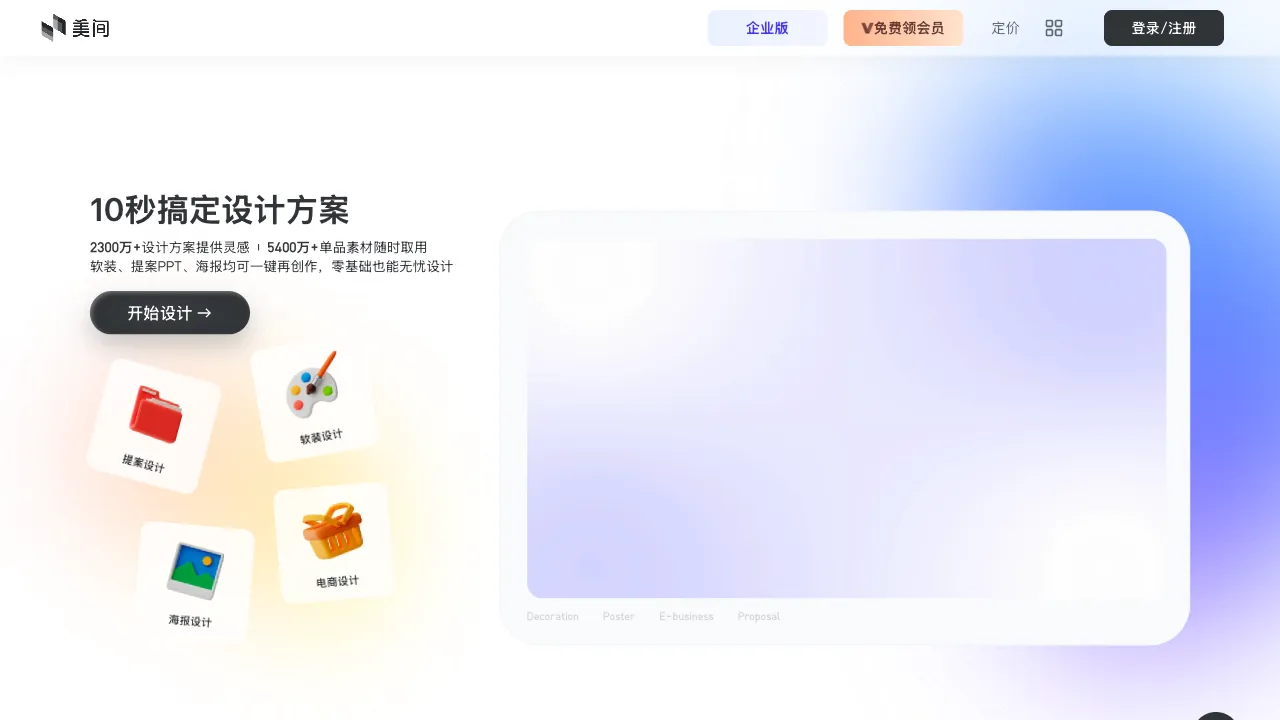
Meijian (meijian.com) is an AI tool platform tailored for the interior design and soft furnishing industries, offering features such as AI-generated interior renderings, spatial renovation visualization, automated generation of design proposal documents, and creation of home marketing materials.
Its target audience includes industry professionals such as interior designers, soft furnishing consultants, home retailers, and renovation company staff, helping them improve efficiency during the proposal presentation and client communication stages.
Core Features
AI Interior Rendering Generation
This is Meijian’s core capability. Upload a photo of an existing room, select a target decoration style, and the AI automatically generates a rendering of the renovated space—walls, floors, furniture, and soft furnishings are all re-presented according to the selected style.
Available style directions cover the most mainstream home decoration preferences in China:
- Nordic Minimalist: White base tones, raw wood elements, clean lines
- Modern Light Luxury: Marble, metal details, high-saturation accent colors
- New Chinese Style: Traditional cultural symbols combined with modern simplicity
- Industrial Style: Exposed brick, metal pipes, distressed textures
- American Country: Wooden furniture, warm tones, patterned fabrics
- French Retro: Elegant curves, light color palettes, refined details
AI generation typically takes just tens of seconds, a stark contrast to the hours or days required for traditional 3D rendering. For designers showing multiple directions to clients during initial communication, this represents a substantive efficiency gain.
This feature also serves another use case: helping clients visualize "what your specific room will look like after renovation" rather than showing reference images of other spaces—clients feel more confident in their decisions when they see what their own home could look like.
Style Comparison Display
Generate multiple style versions for the same room at once, allowing clients to intuitively compare different directions and make style choices more easily. This "A/B/C comparison" communication method is far more effective than designers verbally describing the characteristics of different styles.
AI Spatial Planning Assistance
Based on room area, floor plan structure, and lifestyle needs, the AI provides suggestions for soft furnishing coordination and layout:
- Furniture selection and size recommendations (furniture dimensions suitable for this space)
- Color scheme proposals (combinations of primary, secondary, and accent colors)
- Soft furnishing decoration suggestions (coordination of wall art, plants, lighting, rugs)
- Functional zone division advice (integration of living and dining areas, bedroom functional zoning)
This aligns more closely with the role of "AI providing reference proposals," where designers supplement professional judgment on top of the AI’s output rather than relying entirely on AI for decision-making.
Automated Design Proposal Document Generation
This feature addresses the problem of "the proposal is ready, but compiling it into a document is troublesome." Meijian can automatically integrate design concepts, renderings, and product selections into a standardized proposal document:
- Design philosophy and style description
- Rendering display pages
- Framework for main materials and soft furnishing product lists
- Budget estimation tables
For designers who frequently create proposals, this saves significant time on formatting and organization, allowing them to focus more on the proposal content itself rather than document structure.
Home Marketing Material Creation
Addresses marketing needs for home retailers and design firms by generating:
- Product display images (furniture and soft furnishings in various spatial styles)
- Marketing posters (promotional events, brand awareness)
- Social media assets (image specifications for Xiaohongshu, Weibo, WeChat Official Accounts)
For home brand operations teams that need to continuously produce content, the efficiency advantage of AI-generated assets is obvious, eliminating the need for on-site photography or commissioning design firms each time.
Moodboard Generation
Designers frequently use moodboards during the proposal phase to convey design concepts—collaging colors, materials, furniture, and atmospheric images to present the design feel. Meijian can automatically generate professional-looking moodboards based on style directions, serving as a key component of proposals.
Comparison with Other Solutions
Compared to Traditional 3D Rendering (3ds Max / SketchUp + V-Ray): Professional 3D rendering achieves photorealistic quality with full control over every detail, making it the standard path for high-quality final renderings; however, the learning curve is extremely steep (learning 3ds Max takes months), and rendering a single scene may consume an entire workday. Meijian’s AI generation speed is on the order of minutes, with lower precision than professional rendering, but it meets the basic needs for proposal presentation and initial communication. The positioning of the two in use cases is: Meijian for early rapid communication, and professional rendering for final proposal delivery.
Compared to Midjourney-Generated Interior Images: Midjourney can generate interior images with excellent visual quality, but it creates "an interior space in a specific style" rather than "a renovation effect based on this specific room." For scenarios where designers want to show "what your room will look like if renovated this way," specialized tools like Meijian are more accurate; for creating inspiration reference images or demonstrating the possibilities of a certain style, Midjourney’s visual quality is often higher.
Compared to Stable Diffusion + Interior Design LoRA: SD paired with specially trained interior design LoRAs can also generate interior renderings with flexible technical routes; however, it requires a high technical threshold (SD installation/configuration, prompt engineering skills). Meijian packages this into a user-friendly tool where professionals simply upload images and select styles without needing to understand technical details.
Compared to RoomGPT: RoomGPT is an overseas interior AI tool with similar positioning, and its functions and usage are highly similar to Meijian; the main differences lie in language and localization. Meijian offers a Chinese interface, better optimization for mainstream domestic decoration styles, and more stable access within China.
Who Is Best Suited for Meijian?
Interior Designers: During the proposal communication stage with new clients, rapidly generate multiple style renderings to help clients make style decisions. Compressing work that traditionally takes days into hours allows them to serve more clients.
Soft Furnishing Consultants: When presenting soft furnishing coordination plans to clients, AI renderings transform abstract color scheme advice into intuitive visual displays, making it easier for clients to understand and approve.
Renovation Company Sales Staff: Show potential clients the post-renovation effect during sales pitches. Compared to "imagine what style would look good," intuitive AI renderings substantially improve conversion rates, at a cost much lower than bringing in professional designers for sales meetings.
Home Retailers: Display how furniture products coordinate with different spatial styles, which is more persuasive for sales than uniform white-background product images. Product images with contextual settings on platforms like Xiaohongshu and Taobao typically attract users better than white-background images.
DIY Homeowners: Not industry professionals, but individuals renovating their own homes who want to quickly see the approximate effect of renovating a room. Meijian’s low barrier to entry is user-friendly for ordinary people.
Limitations
AI-generated renderings are not real photographs and have limited precision—particularly regarding specific furniture dimensions and proportions, material texture details, and lighting realism, showing a clear gap compared to professional 3D rendering. It is suitable for initial proposal communication and style direction confirmation, but final renderings delivered to clients usually still require support from professional rendering.
For rooms with complex shapes or non-standard layouts (curved walls, irregular spaces, significant level changes), the AI’s spatial understanding may deviate, resulting in less accurate generated renderings.
The presentation of specific products—what a specific brand’s sofa looks like in this space—is currently not achievable with true precision by AI renderings; it offers more of an approximate representation of style feel.
Pricing
Meijian offers a free trial allowance that lets you experience its core indoor rendering generation features. High-quality outputs and heavy usage require a paid plan, with different packages available for individual designers and corporate teams. Refer to the official website for specific details.
Before deciding whether to pay, we recommend using the free allowance to test generation results on your most frequently handled room types (living rooms, bedrooms) and design styles. Real-world results are far more informative than promotional screenshots.
For interior design professionals looking to improve proposal efficiency, Meijian is a tool worth serious consideration. It addresses a genuine industry pain point and delivers tangible efficiency gains when used in appropriate scenarios.