

Every person who persists in creating video content has experienced the same pain: the script is clear in your mind, but it changes as you speak; you record dozens of takes in front of the camera, getting stuck at different points each time; and in the end, you either settle for an acceptable take or splice together two or three clips, spending more time on post-production editing than on recording.
The root cause of this issue is not that the content wasn’t prepared well enough, but that your attention splits when facing a camera—one part focuses on expression, another worries about which points haven’t been covered yet, while simultaneously controlling tone and facial expressions. When the information density exceeds a certain threshold, this system collapses, manifesting as forgetting lines or speaking incoherently.
Teleprompters solve exactly this problem: they shift the cognitive burden of remembering key points from your brain to the screen, allowing you to focus all your attention on "how to say it" rather than "what to say." This was once professional equipment only accessible to TV news anchors; Asparagus AI Teleprompter has turned it into a mobile app available to everyone.
What is Asparagus AI Teleprompter?
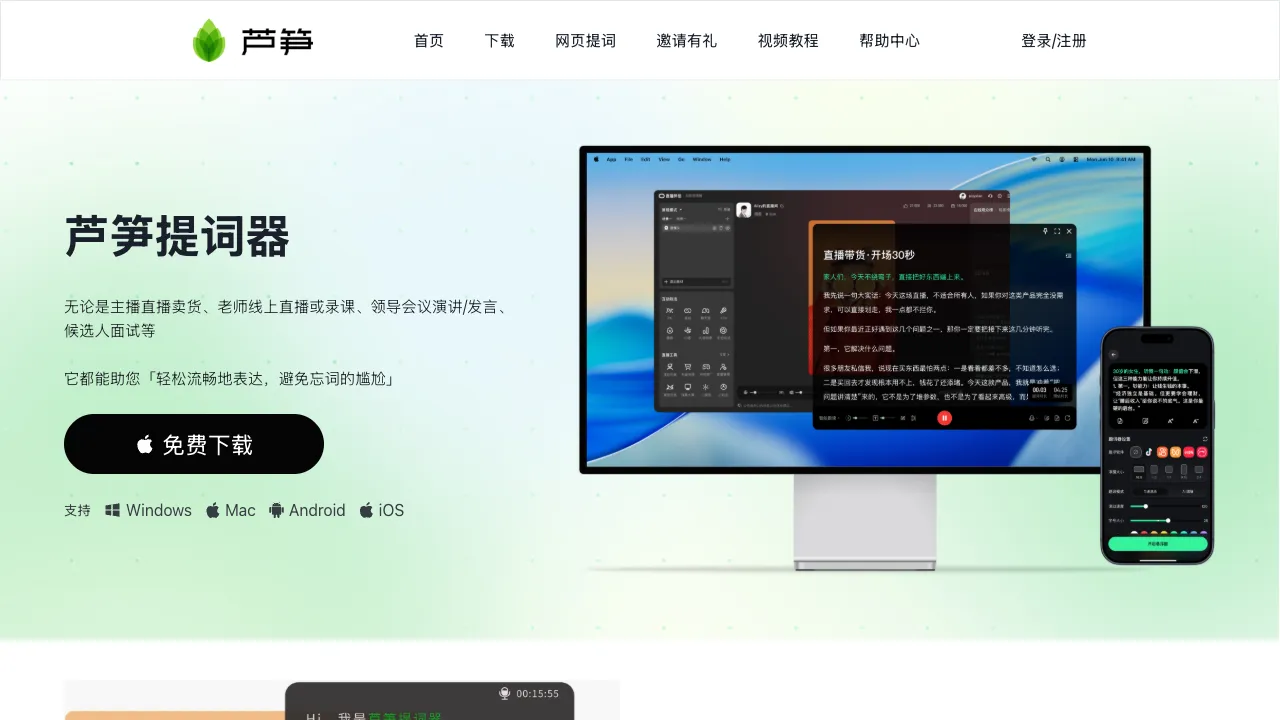
Asparagus (lusun.com) is an AI teleprompter app designed for content creators, covering iOS and Android platforms, as well as a Web version. Its core function is to display the teleprompting text in sync while recording video, paired with AI speech-speed recognition that automatically adjusts the scrolling rhythm. This allows creators to read their scripts smoothly and speak naturally, rather than sounding like they are reading from a script.
The primary users of this tool are short-video creators, knowledge-sharing bloggers, online course instructors, corporate training video producers, and anyone who needs to express content in front of a camera. In China’s domestic market, where the number of short-video creators exceeds tens of millions, Asparagus targets a real and growing demand.
Detailed Core Features
AI Speech-Speed Following: Truly Solving the "Human Chasing Teleprompter" Problem
The core flaw of traditional teleprompters is fixed-speed scrolling, forcing humans to adapt to the machine’s rhythm. If you speak too fast, you can’t keep up and need to speed up; if you pause, the teleprompter doesn’t wait, and by the time you realize it, you’ve missed your spot. This problem causes many people to abandon traditional teleprompters, feeling that "it’s worse than not using one at all."
Asparagus’ AI speech-speed following feature listens to voice in real-time via the microphone. The AI identifies speaking speed and pauses, dynamically adjusting the teleprompting scroll speed to stay synchronized with your speech: if you speak faster, the scroll accelerates; if you pause or speak slowly, the scroll pauses and waits. Logically, this resolves the fundamental contradiction of "human chasing machine," turning it into "machine following human."
In practice, the accuracy of AI speech-speed recognition is affected by the microphone environment—it works well in quiet settings but drops in noisy ones. Overall, the experience is much better than manually adjusting speed on traditional teleprompters, making it Asparagus’ true differentiating feature.
AI Script Generation: From Topic to Full Script
For many creators, writing the script itself is another hurdle. You know the topic you want to discuss, but organizing it into a script that can be read fluently requires time and skill. Asparagus’ AI script generation function allows users to input video topics and key points, automatically generating a structurally complete and fluently expressed video script.
The quality of the generated script is practical as a first draft—structurally sound and clearly expressed—allowing for modification on top of it rather than starting from scratch. For creators with high update frequencies and large content output volumes, this is an efficiency tool that saves time on writing.
It is worth noting that AI-generated scripts tend to be generic. Content involving personal viewpoints, professional depth, or specific domain knowledge still requires significant editing to reflect the creator’s unique voice.
Integrated Recording and Teleprompting
Asparagus includes a built-in camera recording function, completing both teleprompting and recording within the same app. There is no need to switch between a teleprompter app and a camera app. The practical value of this "integrated" design lies in the fact that during use, the phone screen is fully occupied by the teleprompting text; switching apps would disrupt your rhythm. Integration makes the entire recording process smoother.
It supports both front and rear cameras, allowing for horizontal or vertical shooting. The position and size of the teleprompting interface can be adjusted to fit different recording setups.
Basic Teleprompter Features
Script import methods are diverse: you can type directly in the app, paste from the phone clipboard, share from other apps, or import from third-party documents. A common use case is writing the script on a computer using Word or WPS, copying it, and pasting it into the mobile app.
Font size, color, and line spacing can be adjusted according to personal vision and shooting distance to ensure the teleprompting text is clearly visible during recording. The position of the teleprompting area can be adjusted to avoid obscuring important visual elements.
The mirror flip function is suitable for use with physical teleprompter devices—when using the phone screen as the display for a physical teleprompter, the text direction needs to be flipped.
Script Management
You can save multiple scripts for easy switching between different video contents. For creators with fixed series or those who repeatedly cover similar content, script library management is practical. Historical recording logs are linked to scripts, making it easy to review corresponding content.
Comparison with Similar Products
vs. Professional Hardware Teleprompters: A professional teleprompter is a standalone device, including a semi-transparent glass in front of the camera, a separate display screen, and a controller, priced from thousands to tens of thousands of dollars. It is mainly used for professional film production and news broadcasting. Its advantages are professional teleprompting effects and not occupying phone screen resources, but it is bulky, expensive, and complex to set up, making it fundamentally unsuitable for individual creators. Asparagus targets a completely different market; there is no direct substitution relationship between the two.
vs. Teleprompter+ / BIGVU (International Similar Apps): Internationally, there are teleprompter apps like Teleprompter+, BIGVU, and Elegant Teleprompter. Asparagus’ differentiation lies in Chinese optimization (higher accuracy for Chinese speech recognition), a local user community, and an interface that aligns with domestic user habits. For creators primarily speaking Chinese, the accuracy of Chinese speech recognition directly impacts the user experience, which is Asparagus’ main advantage.
vs. Memorizing Scripts in Advance or Improvising: The advantage of memorizing scripts in advance is that expression is most natural, with no tool dependency; the disadvantage is high memory costs, increasing difficulty with longer scripts, and the need to re-memorize after any changes. Improvisation suits creators with good eloquence and clear logic, but for those needing to express professional content accurately or who are nervous in front of the camera, the gap in effectiveness is significant. A teleprompter is a compromise between these two methods: preparing a script but using it by looking rather than memorizing during recording.
vs. Post-Production Subtitles (Record First, Add Subtitles Later): Some creators’ approach is to record casually first and add subtitles and content later. This method requires significant time in post-production for editing and processing, making overall efficiency lower than recording good content upfront. Teleprompters help record high-quality material in the early stages, reducing post-production workload.
vs. WeChat Reading / Screen Mirroring: Some creators’ makeshift solution is to use another device (iPad, computer) to display the script next to the camera, or to mirror phone content onto a TV screen for teleprompting. These temporary solutions are unstable; Asparagus provides a professional, fully-featured dedicated solution.
Who Is Best Suited for Asparagus?
Short-Video Bloggers (Knowledge/Education): Bloggers who need to accurately convey knowledge-based content rely on scripts. In high-frequency recording scenarios, a teleprompter is a necessary tool. Knowledge bloggers in finance, healthcare, law, and technology, which require professional accuracy, are especially suitable.
Online Course and Training Instructors: Recording course videos usually involves systematic content and rigorous logic, requiring complete information without omissions. The longer the class hours, the harder it is to memorize the script, and the higher the value of a teleprompter.
Corporate Promotional Videos and Product Introductions: Enterprises and brands recording official video content have high accuracy requirements and cannot afford errors. Teleprompters ensure accurate expression, reduce the number of retakes (NGs), and lower shooting costs.
Newcomers to Video Creation: Those just starting with video content, lacking sufficient experience in front of the camera, are prone to nervousness and forgetting lines. A teleprompter serves as psychological support; having content as a safety net helps you get into the zone faster.
Pre-recorded Content Production for Live Streams: Some streamers have needs for pre-recorded content outside of live streams. The value of a teleprompter in pre-recording scenarios is higher than in real-time live streaming (real-time live streaming is not suitable for reading from a teleprompter, as it appears unnatural).
Usage Suggestions
It is recommended to write scripts in a conversational tone, avoiding formal written language. What is displayed on the teleprompter is the script; if you read it directly, it must sound natural. Write sentences in the app as you would speak them; what the teleprompter displays should be content you can read directly.
Prefer larger font sizes over smaller ones. During recording, your attention is on expression, and your eyes won’t specifically focus on the teleprompter. If the font is too small, finding words becomes difficult, affecting your speaking rhythm. Test by recording a segment and reviewing playback to observe your eye movement—if your eyeballs move noticeably, you are "chasing words," so increase the font size or slow down the scroll speed.
Do a few dry runs with the teleprompter before formally recording. The first time using a teleprompter to record video will feel unfamiliar; it takes time to establish the rhythm of "reading while speaking."
Pricing
Asparagus AI Teleprompter has a free version containing basic teleprompting functions. The paid Pro version unlocks AI speech-speed following, AI script generation, unlimited script saving, and other features. Specific pricing is subject to the official website and app stores, with monthly and annual subscription options available. The average monthly cost of an annual subscription is lower than paying monthly.
For those with fixed video creation needs, a teleprompter is a tool that genuinely changes efficiency, not just a nice-to-have feature. Once used correctly for the first time, most people are unwilling to return to recording without a teleprompter.