

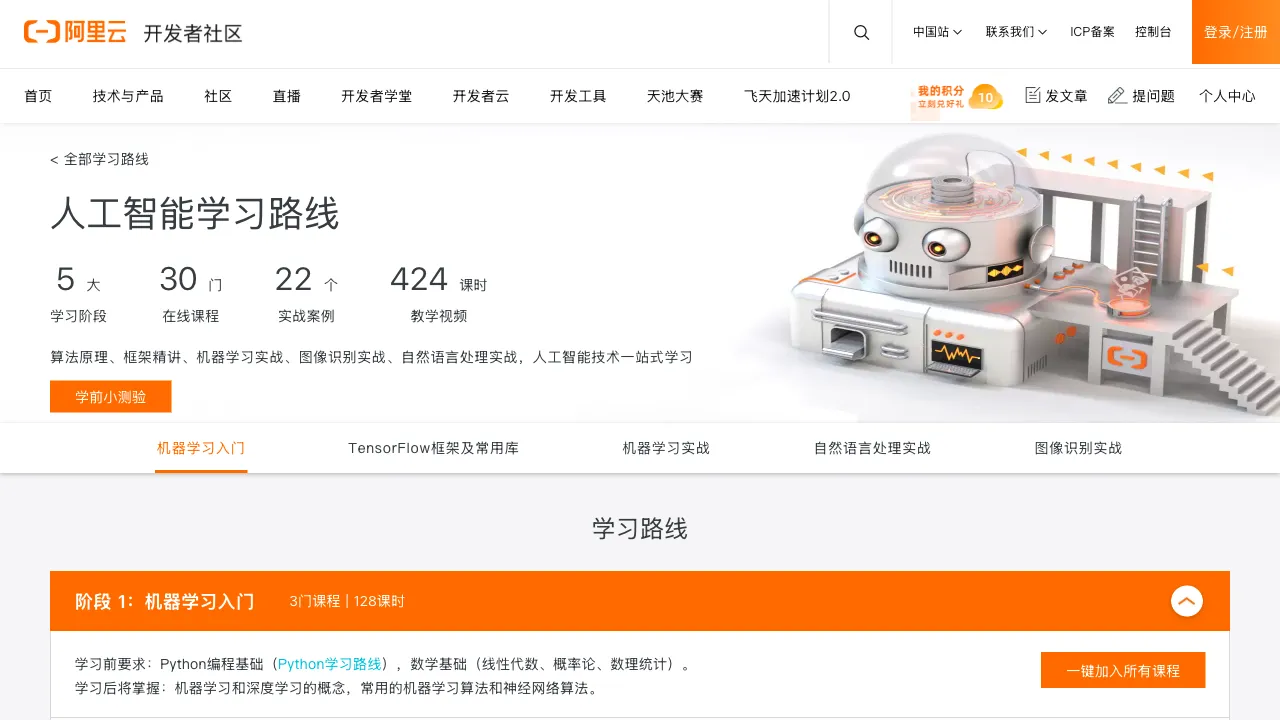
The first hurdle beginners face in AI is rarely a lack of materials, but rather an overwhelming abundance of disorganized content—uncertainty about what to learn first or next, conflicting advice across tutorials, and the endless discovery of new "must-learn" topics with every search. The AI Learning Roadmap launched by the Alibaba Cloud Developer Community offers a solution to this problem: a structured, systematic path from zero to practical application, with a significant portion of the content available for free.
What Is the Alibaba Cloud AI Learning Roadmap?
The Alibaba Cloud AI Learning Roadmap (developer.aliyun.com/learning/roadmap/ai) is a structured AI learning path provided by the Alibaba Cloud Developer Community. It integrates various learning resources, including course videos, documentation, practical cases, and certification exams, covering everything from foundational AI concepts to machine learning, deep learning, NLP, computer vision, and the application of Alibaba Cloud AI services.
This roadmap is not a single course but a content map—it tells you what to learn at different stages of your AI journey, where to find those resources, and organizes them into a coherent learning sequence.
Learning Content Structure
AI Foundational Awareness Layer
Overview of Artificial Intelligence: A survey of AI’s history, major schools of thought, and current application domains; suitable for beginners new to AI concepts to build a basic cognitive framework.
Fundamentals of Machine Learning: Core concepts (supervised/unsupervised/reinforcement learning) and the principles behind common algorithms (linear regression, decision trees, SVM, etc.). Deep mathematical derivation is not required; the focus is on intuitive understanding.
Python Data Science Basics: The use of Python in AI and data analysis, including core libraries such as NumPy, Pandas, and Matplotlib. This forms the foundation for all subsequent practical work.
Machine Learning Practical Layer
Feature Engineering: Data preprocessing, feature selection, and construction. This is a critical step often overlooked by beginners but essential for machine learning projects.
Model Training and Evaluation: How to train models, evaluate their performance (accuracy, F1, AUC, etc.), and avoid overfitting.
Scikit-learn Practice: Completing typical classification, regression, and clustering tasks using the Python machine learning library.
Deep Learning Direction
Fundamentals of Neural Networks: The principles and applicable scenarios of backpropagation, activation functions, and various network architectures (CNN, RNN, Transformer).
Deep Learning Frameworks: Primarily TensorFlow/Keras or PyTorch, used to complete practical projects such as image classification and text processing.
Pre-trained Models and Transfer Learning: How to fine-tune open-source pre-trained models (BERT, ResNet, etc.) to achieve good results quickly on your own tasks.
Alibaba Cloud AI Service Applications
This is the distinctive part of the Alibaba Cloud learning roadmap—integrating learning content with Alibaba Cloud’s specific services:
PAI (Platform for AI): Alibaba Cloud’s MLOps platform, providing end-to-end tools from data processing to model training and deployment. Its visual interface lowers the engineering barrier.
Visual AI Services: Calling Alibaba Cloud’s visual APIs for image recognition, face recognition, OCR, etc., to understand how to integrate AI capabilities into your own applications.
NLP Services: The calling and application of NLP APIs for sentiment analysis, text classification, machine translation, etc.
Voice Services: The use of APIs for Automatic Speech Recognition (ASR) and Text-to-Speech (TTS).
Large Models and AIGC Direction
Focused on the current hottest trends, including:
- Calling and application development using the Tongyi Qianwen API
- Fundamentals of prompt engineering
- RAG (Retrieval-Augmented Generation) architecture
- Enterprise application scenarios for large models
Types of Learning Resources
Video Courses: On-demand videos allowing self-paced learning, with a large number of courses available for free.
Documentation and Tutorials: Detailed written tutorials paired with code examples, systematically organized in the Alibaba Cloud Developer Documentation.
Practical Projects: Hands-on experiments where you can run code directly in the cloud environment provided by Alibaba Cloud, without needing to configure a local environment.
Certification Exams: After completing the learning path, you can take Alibaba Cloud’s AI certification exams to earn an official certificate, which has reference value for job hunting.
Community Q&A: If you encounter problems, you can ask questions in the developer community, where answers are provided by other developers and Alibaba Cloud officials.
Comparison with Other Learning Paths
vs. Andrew Ng’s Coursera Courses: Andrew Ng’s machine learning and deep learning courses are internationally recognized entry-level standards with solid content; they are taught in English and are relatively expensive. The Alibaba Cloud roadmap offers easier-to-understand Chinese content, more free resources, and tighter integration with practical applications of domestic cloud services.
vs. fast.ai: fast.ai is free, practice-driven, and has an active international community; it is in English and the community is overseas. The Alibaba Cloud roadmap targets Chinese learners, offering better support through Chinese tutorials and a Chinese-speaking community.
vs. Self-Study on Bilibili/YouTube: While self-study resources are abundant, they lack structure and require significant time to filter. The Alibaba Cloud roadmap provides a structured path, reducing the problem of information overload.
vs. Geek Time: Geek Time’s AI courses are of high quality, with instructors who are industry practitioners; however, most content is paid and relatively expensive. The Alibaba Cloud roadmap offers more free content, though its systematicity is slightly inferior to Geek Time’s specialized single-track courses.
Who Is the Alibaba Cloud AI Learning Roadmap For?
Zero-Basis Beginners in AI: Those needing a starting point but unsure where to begin will find clear entry points and paths provided by Alibaba Cloud’s learning roadmap.
Developers Wanting to Use Alibaba Cloud AI Services: After completing the learning path, you can directly start using Alibaba Cloud’s AI products, with a complete path from learning to application.
Technical Professionals with Business Needs: Companies with AI-driven business requirements need to quickly understand AI technology and assess its feasibility for implementation. The practical orientation of the Alibaba Cloud roadmap helps build actual capabilities rapidly.
Students Preparing for Alibaba Cloud AI Certification: The learning path aligns with certification exams; systematic learning followed by certification can enhance job competitiveness.
Limitations
The quality of courses varies; some are highly advanced while others are relatively superficial, requiring users to filter content themselves.
The content is interspersed with extensive promotion of Alibaba Cloud services. Sometimes you end up learning "how to use Alibaba Cloud services" rather than "how AI technology itself works," which are not entirely equivalent.
The update speed in cutting-edge technical directions (such as the latest developments in large models) sometimes fails to keep pace with actual industry progress.
Pricing
The Alibaba Cloud AI Learning Path offers a wealth of free foundational courses. Some advanced courses and hands-on boot camps require payment, while participating in labs consumes Alibaba Cloud resources, incurring modest fees that are typically low; new users receive free credits. For exact details, refer to the official website.
For learners who want to get started with AI, prefer Chinese-language materials, and wish to integrate their learning with real-world cloud services, the Alibaba Cloud AI Learning Path is a high-value resource. You can start for free and follow the path to build at least a systematic understanding of AI technologies and foundational practical skills.