

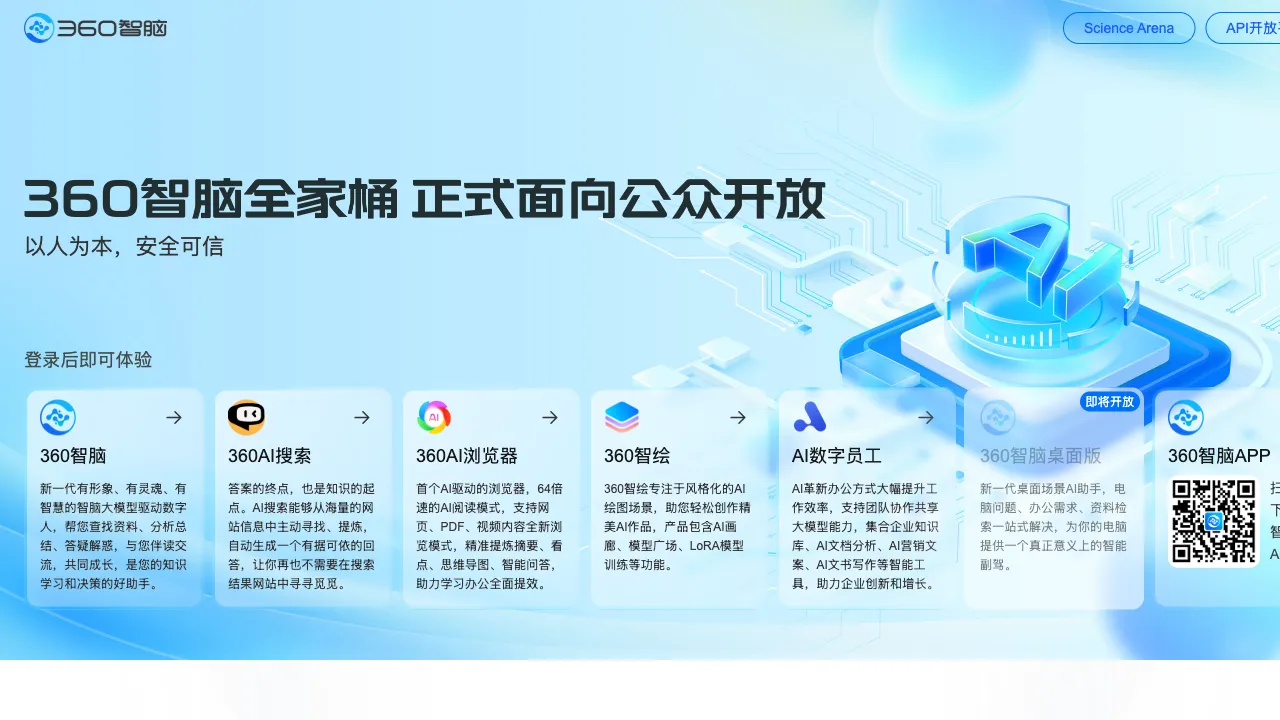
The tiering of domestic AI art platforms is quite clear: on one end are "zero-threshold lottery-style" options like Wenxin Yige and Jimeng, where you select a style to generate an image—simple but with shallow controllability; on the other end lie SD community-based platforms like Libuli (Libu), offering vast libraries of models and parameters—a paradise for players but bewildering for beginners. In between lies an underestimated need: wanting Stable Diffusion-level controllability (especially training your own style models) without fiddling with local GPUs or environments—360 Zhihui fits right into this niche, making its most noteworthy feature the cloud-based simplification of LoRA training. Among major corporate art platforms, such a configuration is quite rare.
What Is 360 Zhihui?
360 Zhihui (aigc.360.com) is an image generation platform within the AI product matrix of the 360 Group. Its technical approach is based on the Stable Diffusion ecosystem, with capabilities covering: text-to-image, image-to-image, style transfer, and image editing (inpainting/outpainting/upscaling), plus LoRA model online training for advanced users. It natively supports Chinese prompts and offers direct access from within China without login hurdles—the platformized version of Stable Diffusion's playstyle.
Core Features
Text-to-Image and Multi-Style Models
Chinese descriptions generate images directly with built-in foundational style models: realistic photography, anime illustration, oil painting/watercolor, 3D rendering, Chinese ink wash—switching the base model by subject matter. This is a platform-level embodiment of SD ecosystem logic where "the model determines the art style," offering far greater output stability than hard-coding stylistic keywords into a single model.
Image-to-Image and Style Transfer
Reference image-driven generation (with adjustable similarity to the original), applying A's style onto B's content—ready-made workflows for turning sketches into polished drafts, converting photos into artistic styles, and batch-unifying visual tones.
LoRA Training: Signature Feature
This deserves a closer look because it is where this tool differentiates itself. LoRA (Low-Rank Adaptation) is a lightweight model fine-tuning technique that can teach an AI a "specialized capability" using just dozens of images:
Style LoRA: Upload a set of images sharing the same style (e.g., a specific illustration aesthetic or brand visual identity); after training, all generated outputs carry this stylistic signature—effectively allowing content teams to mass-replicate their unique "visual fingerprint";
Character/Object LoRA: Upload multi-angle images of specific people, IP characters, or products; the resulting model can stably generate consistent depictions of "the same entity." Character consistency—the top challenge in commercial AI art generation—is currently best solved by LoRA. This makes production pipelines for serialized content, brand IPs, and virtual avatars viable.
Traditionally, working with LoRA training meant setting up a local environment, having a capable GPU, and debugging hyperparameters—a technical hurdle fraught with pitfalls. 360 Zhuihui has streamlined this into an end-to-end cloud workflow: "upload images → set parameters → wait for results." The barrier to entry shifts from requiring technical expertise to simply needing patience—this is precisely its core value proposition for target users.
Image Editing Suite
Inpainting (redrawing specific areas), outpainting (extending the canvas), super-resolution upscaling, and background processing—these refinement steps are fully integrated within our platform. We provide a complete suite of standard post-production capabilities aligned with the Stable Diffusion ecosystem.
Comparison with Similar Platforms
vs LiblibAI / Toosh: Our community-driven model ecosystem far outperforms these platforms; we offer an extensive library of ready-to-use LoRAs and Checkpoints, making us the home for advanced users. 360 Zhuihui excels in stability as a major enterprise platform and offers a gentler learning curve. If you want to "use others' models" on community sites or are afraid of the hassle involved in training your own models, our streamlined workflow at 360 Zhuihui is far more convenient.
vs Wenyi Yige / Jimeng: These two platforms follow an "out-of-the-box" approach with a heavier investment in generation quality and product refinement. Our strength lies in controllability and advanced training capabilities—choose the former for users who prefer random sampling, or choose us if you need custom models.
vs Local Stable Diffusion (WebUI/ComfyUI): This offers maximum freedom of action and zero marginal cost per infinite generations; however, it requires a high-end GPU and ongoing environment maintenance. 360 Zhuihui is "lightweight SD in the cloud," trading ecosystem breadth for zero configuration overhead—this makes us a practical option for Stable Diffusion enthusiasts without access to powerful graphics cards.
vs Midjourney: While quality ceilings and aesthetics remain Midjourney's domain, it lacks LoRA-level customization capabilities (the sref style codes operate on an entirely different logic) and presents three barriers: network requirements, English proficiency, and subscription fees. For users who need to "train exclusive styles," Stable Diffusion-based platforms are the only viable route.
Who Should Use 360 Zhihui
Creators needing character consistency: Those producing serialized comics, virtual IPs, or brand identities—character LoRAs are your essential production assets. Cloud-based training removes technical barriers, making this the ideal solution for you.
Content teams aiming to solidify a unique artistic style: Train a team-style LoRA so all outputs carry a unified visual fingerprint—a cost-effective infrastructure for content branding.
Stable Diffusion users without GPUs: If you understand prompts, parameters, and LoRA concepts but lack hardware—cloud platforms ensure your expertise remains valuable.
E-commerce and design professionals: Style product images or generate batched custom materials; converting products into LoRAs turns "one item across thousands of scenes" into an assembly line.
Usage Recommendations
The golden rule for LoRA training is garbage in, garbage out. The quality, angular diversity, and background cleanliness of your training set directly determine model performance—prefer 20 carefully selected images over 100 casual snapshots; ensure character LoRAs cover multiple angles and expressions, while style LoRAs maintain high stylistic consistency.
Training on artwork styles you do not own or likenesses belonging to others carries legal and ethical risks—in commercial scenarios, strictly adhere to the boundary of "own materials or authorized assets." This precaution is especially critical in LoRA workflows.
Pricing
Free generation credits are provided; LoRA training and advanced features are billed via points or membership plans. For specific details, please refer to the official website. Compared with "local GPU investment for on-premise training" or "outsourced custom model quotes," cloud-based pricing typically offers a cost-effective solution for target users.
The positioning of 360 Zhuihui can be summarized in one sentence: It provides an effortless path for those who want to own their own models. If your needs have evolved from simply "generating good images" to "having AI consistently render my characters/my style"—gather a few dozen high-quality reference images and run a LoRA training session here. When the first generated image bearing your unique characteristics appears, AI art generation transforms from a toy into productive assets for you.