

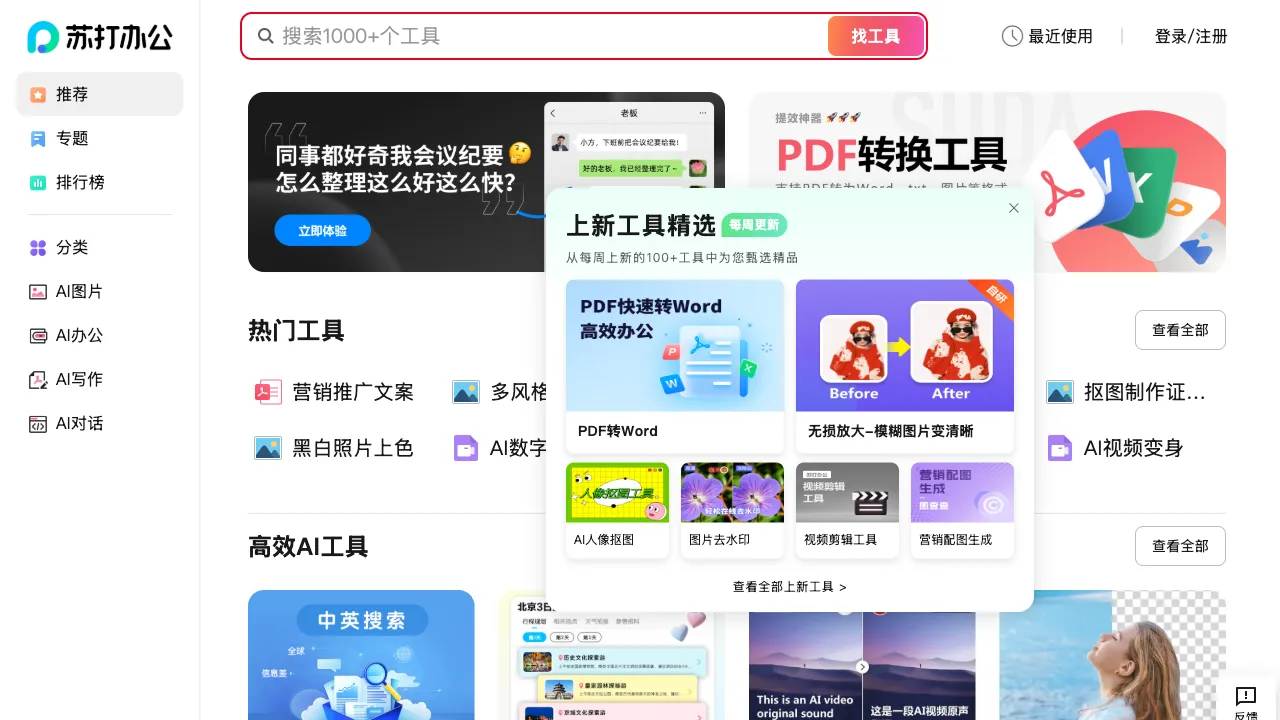
There is an underestimated user segment in China's internet ecosystem: the hundreds of millions of people behind the computers running the full suite of 360 software—small business owners in county towns, administrative clerks in townships, and older office workers. They don't browse Product Hunt or know Notion, yet they share needs for writing summaries, creating posters, and editing videos; however, information about the AI tool wave almost never reaches them. 360 Soda Office is the bridge built specifically for this "silent majority": it bundles AI productivity capabilities into a low-barrier collection of tools, delivered to their desktops via entry points like 360 Security Guard (the antivirus) and its browser—hence the name "Soda," evoking lightness and effervescence, with positioning centered on "easier office work."
What is 360 Soda Office?
360 Soda Office (soda.360.cn) is an AI productivity platform under the 360 umbrella, structured as a "tool supermarket" rather than a single application: it aggregates dozens of function entry points—including AI document writing, video creation, design tools (logo/poster/image processing), code assistance, and file utilities like PDF handling and OCR—under one site, powered by 360's self-developed Zhiniao large model system. The target user profile is clear: individual users and small-to-medium enterprises with light AI productivity needs—they aren't seeking professional depth but rather "open-and-use" immediacy, where tools are ready to use instantly and can be abandoned after a single task.
Core Feature Modules
AI Document Processing
The foundation for office needs:
- AI Writing: Template-based generation of summaries, proposals, notices, and emails—the "Monday morning savior" for county-level offices.
- Document Summarization: Extracting key points from long texts to quickly digest materials.
- Smart Formatting: Automating the manual labor involved in organizing document layouts.
AI Video Creation
- Text-to-Image to Video: Turn articles into videos with one click; voiceovers, subtitles, and music are all included—a streamlined production line for lightweight content creators.
- AI Voiceover & Subtitles: Tools that automate the two most labor-intensive aspects of video production: multi-style text-to-speech voices and automatic subtitle generation.
AI Design Tools
- Logo Generation: A visual starter pack for launching a new small business.
- Poster & Image Editing: Quick solutions for daily assets, including background removal, enhancement, size adaptation, and AI-generated imagery.
- PPT Assistance: Framework generation and content suggestions.
AI Code and File Utilities
Code generation explanations tailored for light development needs; file utilities like OCR text extraction and PDF conversion/merging—those "unsung but daily-use" tools—are precisely the glue that keeps users engaged in a tool supermarket.
Comparison with Competing Products
vs WPS AI: The true giant of the office document sector, its depth in document scenarios (format compatibility, professional features) is overwhelming; Soda Office counters with breadth—it handles all the miscellaneous tasks WPS ignores, such as video editing, design, and coding. Main documents go to WPS; for a medley of utilities, look to Soda.
vs Jianying/Canva (Vertical Tools): In every vertical domain, professional tools are clearly deeper—this is the fate of the tool supermarket model. Soda's only card is this: People who don't want to install five apps or register five accounts can get by with one stop.
vs Feishu/DingTalk: The AI in enterprise collaboration platforms operates at an organizational level (approvals, coordination, knowledge bases); Soda Office is a personal toolkit without collaborative ambitions, serving different user segments.
vs Baidu/Tencent Ecosystem AI Tools: Big-tech AI tools rely on their ecosystems for traffic; 360's unique asset lies in its installed base enabling reach into lower-tier markets—product strength may not be superior, but distribution channels are its moat.
Who Is This For?
Mass-market users with light AI office needs: Occasionally writing a summary, creating a poster, or converting PDFs—professional tools are overkill; this free tool supermarket is just right. These are the core target audience.
Small business owners in lower-tier markets: Shopkeepers and sole proprieturers needing startup logos, promotional posters, and marketing videos with zero design skills—a one-stop "good enough" solution. Note that "good enough" here isn't pejorative; it's an accurate description of real-world needs.
Existing 360 ecosystem users: Long-time browser and security suite users who can access accounts seamlessly from familiar entry points, incurring zero migration costs.
AI tool skeptics: Those who haven't yet used any AI office tools—this free, Chinese-language, no-barrier experience platform lets them first build a tangible sense of "what AI can do for me" before deciding whether to move on to professional tools.
Limitations
The eternal Achilles' heel of the tool supermarket: none are the best—videos aren't as good as CapCut (Jianying), documents don't match WPS, design falls short of Canva, and code assistance lags behind Copilot. Heavy users will quickly hit ceilings in any single area; when that happens, it's time to switch to professional tools.
Feature refinement and iteration speed lag behind top-tier products. Additionally, 360's brand equity in the office software domain is weaker than its reputation in cybersecurity, making the company's long-term investment commitment worth watching closely.
Pricing
The free tier covers basic features (subject to daily usage limits); paid memberships unlock additional quotas and advanced capabilities. Specific pricing details are subject to the official website. Positioned for mass adoption, this offering falls into a lightweight category.
The significance of products like Soda Office does not lie in competing head-to-head with professional tools, but rather in delivering the first AI-powered office experience directly to those who would never proactively seek it out—the final mile of technology democratization is often traversed by such "unsexy yet accessible" solutions. If someone around you—an elder or a small business owner—asks, "Can AI help me get work done?"—sending them this link is far more likely than promoting any professional tool to result in actual adoption and usage.