

The biggest barrier for ordinary people learning AI is not the difficulty of the technology itself, but rather a poor information environment: on social platforms, AI content often consists either of anxiety-mongering clickbait ("You'll be obsolete without AI"), course ads with hidden agendas, or superficial tool listings; meanwhile, truly systematic and high-quality resources are largely in English, buried within research papers, official documentation, and overseas communities—language barriers and search skills filter out a large portion of potential learners. The Chinese-speaking world has never lacked AI news; what is missing is AI learning content that filters the noise, forms a coherent system, and speaks plainly.
This is precisely where AI Star Trail Island fits in: an AI knowledge aggregation and learning platform for Chinese users that consolidates scattered tool tutorials, technical explanations, and industry trends into a structured roadmap you can follow step by step.
What Is AI Star Trail Island?
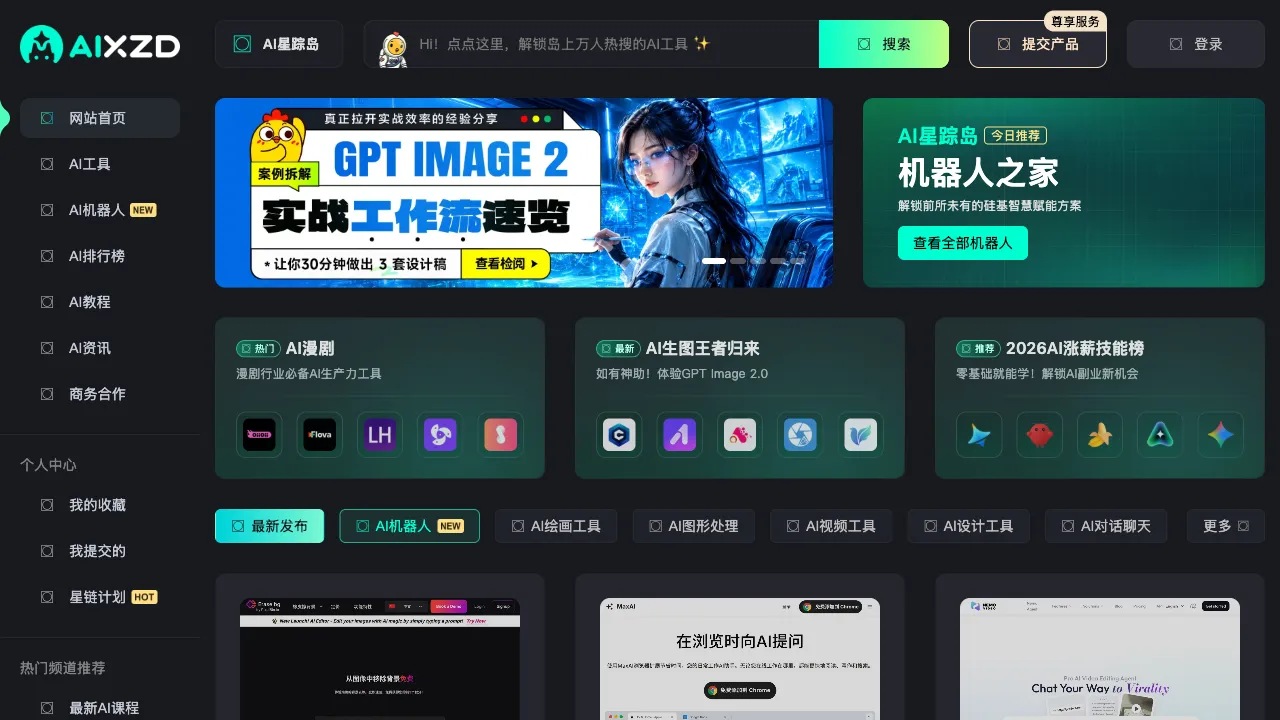
AI Star Trail Island (aixingzong.com) is a Chinese-language AI learning and news platform covering four key areas: introductions to and usage guides for AI tools; technical content tailored to different skill levels; tracking of industry developments; and curated recommendations for learning resources. It's free to browse with no registration required.
Its character aligns more closely with an "AI Learning Library + Guide" in Chinese than that of a media outlet or community—it prioritizes organizing knowledge so it’s easy to find and digest, rather than chasing breaking news headlines or fostering social interaction.
Main Content Directions
AI Tool Tutorials and Reviews
The platform's core content spans the mainstream tool ecosystem:
- Conversational Agents & Large Models: Usage tips and comparisons for tools like ChatGPT, Claude, Kimi, Doubao, and others
- Image Generation: Getting started with Midjourney, Stable Diffusion, and domestic Chinese drawing tools, plus advanced techniques
- Video & Audio: AI-powered video generation, voice cloning/editing, and editing utilities
- Productivity & Programming: Practical guides for AI-assisted writing, PPT creation, and code-generation assistants
The tutorials are action-oriented—featuring screenshot-backed step-by-step instructions, copy-paste-ready prompts, and warnings about common pitfalls. The goal is that readers can immediately apply what they've learned after finishing a guide, rather than just memorizing terminology. For beginners with zero prior experience, this level of detail hits the mark perfectly.
Layered Technical Learning Content
Organized by reader proficiency:
Beginner Level: Demystifying concepts such as what large models are, how to write prompts, and what tokens mean—explaining these ideas in plain language for the majority who want to understand but currently know nothing.
Intermediate Level: Systematic approaches to prompt engineering, Stable Diffusion parameters and model ecosystem, ComfyUI workflows, and local deployment guides—serving players aiming to move from "knowing how to use" to "using well."
Advanced/Practical Level: End-to-end case studies for specific scenarios (creating self-media content with AI, leveraging AI for side hustles, building efficiency workflows)—translating tool capabilities into tangible benefits in daily life and work.
Industry Trends
Chinese summaries of model releases, product updates, funding rounds, and policy changes—positioned to "help you keep up." In-depth analysis is best paired with professional media outlets; for ordinary learners, knowing "what happened" plus "what it means" at this level is sufficient.
Learning Resource Navigation
Curated recommendations for books, courses, GitHub projects, and high-quality creators—performing the first round of filtering on the question of "what to read when learning AI." This is arguably one of the most valuable services in an era of information overload.
Comparison with Other Information Sources
vs MachineHeart / Quantum Post: These are professional AI media outlets where depth and timeliness are strengths, assuming a technical background from readers; Xingzong Island targets a more general audience with content that is easier to get started on. Readers typically progress by reading the latter before moving to the former.
vs Bilibili Tutorial Videos: Video tutorials offer visual clarity and are friendly for following along, but they suffer from poor searchability and high rates of filler content; text-based platforms allow for quick location and review of information. The two media types complement rather than exclude each other.
vs WeChat Official Account AI Articles: Official accounts operate on a push-feed model where articles sink to the bottom after reading; platform-hosted content can be archived, searched, and organized into systems—highlighting the difference between fragmented reading and structured learning.
vs Asking an AI Directly: Having ChatGPT teach you how to use ChatGPT is a genuinely viable—and increasingly mainstream—learning method; however, beginners often don't know "what to ask," which is precisely where structured tutorials provide a problem map. The two approaches relate as map and guide.
vs English Primary Sources: Official documentation and overseas communities remain the ultimate source of information; capable learners must eventually drink directly from the well. The value of Chinese aggregation platforms lies in lowering that barrier, allowing more people to enter the door first.
Who Should Use AIXingzongdao?
Professionals with no prior AI experience: If you've heard too many buzzwords and want to systematically fill your knowledge gaps, starting from the foundational content is far more reliable than piecing together fragmented insights from short videos.
Creators looking to refine their tool skills: If you already know the basics but want to advance in prompt engineering or build workflows, our advanced tutorials are exactly what you need for self-study.
Users needing help selecting tools: Unsure which AI tool to choose? Our review and comparison content can significantly reduce trial-and-error costs.
AI enthusiasts who aren't industry professionals: If you're not working in the field but want to stay informed, regularly browsing our dynamic updates section will keep your knowledge current without falling behind.
Usage Tips
Bring specific questions for maximum efficiency: Searching "How do I use AI for Xiaohongshu posts" yields direct answers much faster than simply asking "I want to learn about AI"—for the latter, please start with our foundational system content first.
Pay attention to timeliness in tutorial content: AI tools iterate rapidly; operational steps may change between versions. Always refer to the tool's current interface during hands-on practice, as tutorials provide conceptual frameworks rather than static instructions.
The goal of learning is action: Reading ten tutorials isn't nearly as effective as actually using a tool once. Treat this platform as a launchpad for your skills, not a comfort zone—a principle that applies universally across all learning platforms.
Pricing
Content is free to browse with no paywalls. While many similar sites feature sponsored content, maintain standard judgment when reading such material.
In the vast ocean of AI information, ordinary people often don't need more data—they need an island marked by signposts. The value of Chinese aggregation platforms like AIXingzongdao lies precisely here: ensuring that the thought "I want to learn about AI" doesn't get drowned out by noise within the first minute of opening a search engine. Bookmark this site as a supply station along your journey in learning AI.