

The number of AI tools has exploded over the past two years, with new ones launching weekly and several standout products emerging monthly. This abundance presents a counterintuitive challenge for users: too many options can make it harder to find the right tool—you might not even know certain tools exist or that an open-source project could solve your problem.
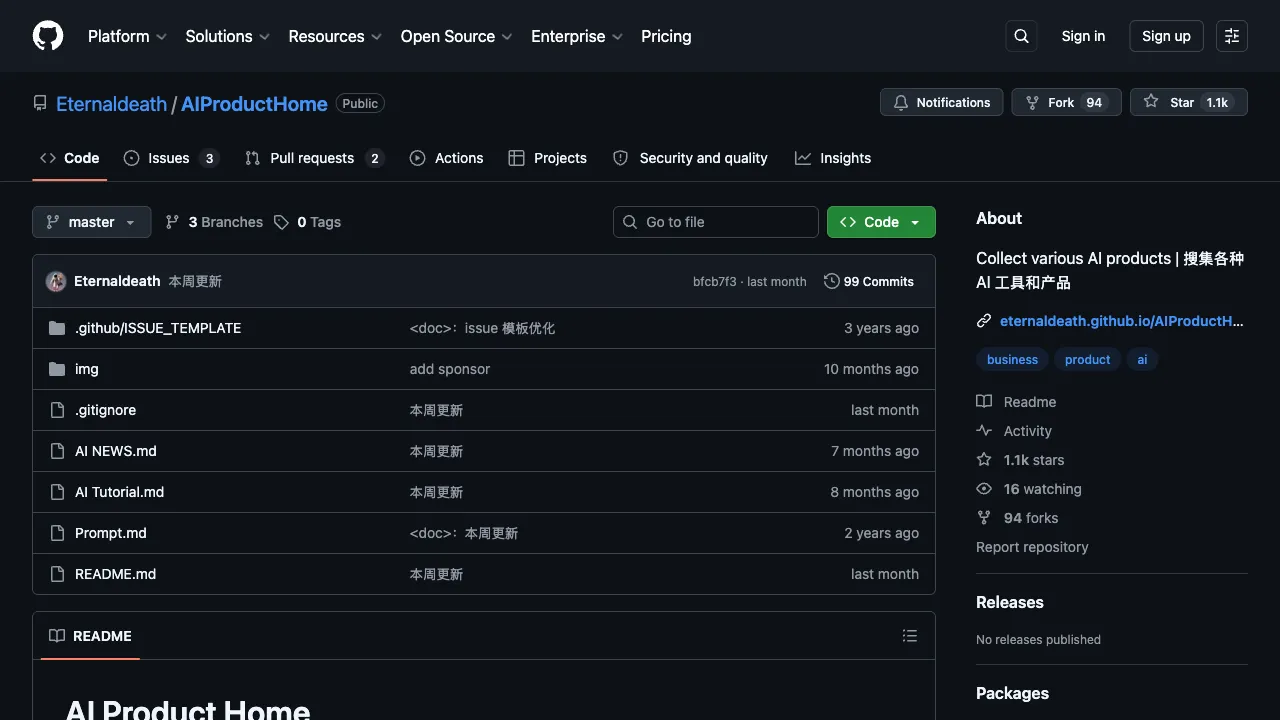
AI Product Home is a continuously maintained open-source directory of AI tools on GitHub, organizing commercial AI products and open-source projects into categorized lists so you don't have to search aimlessly; simply opening it reveals a clear overview.
What Is AI Product Home?
AI Product Home (github.com/Eternaldeath/AIProductHome) is an open-source repository initiated and maintained by the GitHub user Eternaldeath, which curates AI-related products and tools in "awesome list" format. It covers two main categories: commercial AI services and open-source AI projects, organized by functional direction. Each entry includes the tool name, a brief description, and links.
Such GitHub awesome lists have long-standing traditions within developer communities—repositories like awesome-python and awesome-react are widely used. AI Product Home serves as an equivalent curation for the AI tools landscape; in this field particularly prone to information overload, a well-organized list offers practical value.
Repository activity is a core metric of such projects' worth. AI Product Home maintains consistent update records with relatively timely inclusion of new tools—a significant advantage over those "comprehensive AI tool lists" that are built once and never updated again.
Scope of Inclusion
AI Product Home achieves comprehensive coverage across its included content:
Language and Conversation Tools
This category includes mainstream commercial conversational AIs like ChatGPT, Claude, and Gemini; domestic offerings such as Baidu's ERNIE Bot (Wenxin Yiyan), Alibaba's Tongyi Qianwen (Tongyi Qianwen), iFlytek's Spark Desk (iFLYTEK Spark), Moonshot AI's Kimi, and other similar products; plus various vertical applications built on large models—AI writing tools, customer service systems, content generation platforms, and more.
The open-source LLM section features links to major projects including the LLaMA series, Mistral, Qwen (the open-source version of Tongyi Qianwen), ChatGLM, Baichuan, and others, enabling researchers and developers to quickly locate official repositories for these initiatives.
Image Generation and Processing
Tools and wrappers related to Midjourney, DALL-E 3, and Stable Diffusion; various domestic Chinese AI painting platforms; image processing tools such as background removal, super-resolution enhancement, and style transfer; and open-source projects for AI generation interfaces (e.g., Stable Diffusion WebUI, ComfyUI).
Video and Audio
AI video generation (projects related to Runway, Sora), video editing assistance (Opus Clip, etc.), AI voice dubbing and speech synthesis (ElevenLabs, Microsoft Azure TTS, etc.), and speech recognition and transcription tools (Whisper and various wrappers).
Developer Tools
AI coding assistants (GitHub Copilot, Cursor, CodeGeeX, Tabnine, etc.); code generation tools; projects related to AI code review; and LLM application development infrastructure—including LangChain, LlamaIndex, vector databases (Chroma, Pinecone, Weaviate, etc.), and prompt management tools.
This section is particularly valuable for AI application developers: choosing a vector database for RAG applications, selecting a framework for building Agent systems, or identifying tools for LLM evaluation—answers to these questions can be found in the categories of AI Product Home.
Search and Knowledge Tools
AI search engines (Perplexity, You.com, etc.), AI knowledge base tools, AI note-taking assistance; as well as various AI tools integrated with knowledge management.
Multimodal and Specialized Tools
The curation of specialized tools—including AI for 3D generation, music creation, game development assistance, data analysis, and more—covers niche yet genuinely needed directions.
How to Use It
Using AI Product Home is straightforward: open the GitHub repository, browse the README.md file, navigate through the directory structure to find categories of interest, and review the corresponding tool lists and links.
For users with specific needs—for example, "I need an open-source text-to-speech tool" or "I'm looking for an LLM that supports local deployment"—simply press Ctrl+F in the repository to search for keywords; relevant entries are usually found quickly.
For those who want a systematic overview of the entire AI tools ecosystem—such as newcomers entering the field seeking to understand what tools exist across different domains—reading through the README once by category can help build macro-level awareness of the landscape within a short time. This "sense of mapping" is highly practical when encountering specific problems; knowing roughly which direction hosts certain types of tools makes searching more purposeful and efficient.
For developers, starring this repository is the simplest way to track updates—GitHub's Star feature allows you to revisit items from your personal starred list at any time as needed. Watching the repository provides notifications about new tool inclusions, keeping you informed when fresh resources are added.
Comparison with Other AI Tool Directories
vs Professional Navigation Sites (e.g., FuturePedia / There's An AI For That): These dedicated platforms offer more comprehensive features including search, filtering, categorization, and ratings, update frequently daily, and are maintained by specialized teams; their interfaces are user-friendly for general audiences. AI Product Home, with its minimalist design (pure Markdown), feels more approachable to developers who can Fork the repo or submit Pull Requests (PRs) to contribute, ensuring transparent version history and a stronger community-driven nature.
vs Domestic AI Navigation Sites (e.g., AIbase, Yu Congming): Local platforms provide timely and comprehensive coverage of domestic tools with Chinese interfaces and superior user experiences; however, they often suffer from ad-based ranking interference and opaque inclusion criteria for certain tools. AI Product Home, driven by an open-source community, maintains relatively objective curation unaffected by commercial interests, covering both international and domestic tools equally.
vs Self-Maintained Notion Collections or Bookmarks: Many users habitually save discovered high-quality tools in personal bookmarks or Notion databases, enjoying full customization. However, given the explosive growth of AI tools, self-maintained collections quickly fall behind pace with rising maintenance costs. AI Product Home serves as a pre-curated public resource maintained by others, requiring only on-demand usage from you.
vs Subscribing to AI Newsletters: The advantage of newsletters lies in their timeliness and depth—weekly curated selections of noteworthy tools and trends filtered through an editorial lens. AI Product Home, conversely, offers systematic organization as a structured directory forView Anytime (consulting at any time) specific categories rather than linear information streams; combining both approaches yields ideal complementary results.
Core Value
The value of AI Product Home does not lie in replacing professional AI tool reviews or curated recommendations but exists because it is an open-source, community-maintained, systematic reference directory:
- Open and Transparent: All editing history on GitHub is publicly verifiable—showing exactly who submitted what and when tools were included—with no room for behind-the-scenes ad ranking manipulation.
- Community-Driven: Contributors submit new tools via PRs; community perspectives are far more diverse than any single editor's view. Reviewing PR records also reveals which recent innovations the community deems worthy of inclusion.
- Developer-Friendly: For developers accustomed to working on GitHub, this README-style tool list aligns better with their workflow than browsing various websites; tracking via Stars or cloning locally for use feels entirely natural.
- Completely Free: No registration walls, no paywalls, and no algorithmic recommendations—open access upon loading with zero barriers to entry.
Limitations
As a GitHub Markdown repository, the interface has limited interactive capabilities. As more tools are added to this collection, finding specific ones in certain scenarios relies primarily on Ctrl+F keyword searches or manually browsing categories, which is less convenient than professional websites that offer search and filtering functions.
Repository updates depend on the activity of maintainers and contributors. If a maintainer remains inactive for an extended period, the inclusion of new tools may lag behind, and some links could become invalid due to tool discontinuation. It is recommended to check recent commit records before use to assess the repository's active status.
This collection serves as a directory of tools; it does not provide in-depth reviews or comparative analyses. There remains a gap between knowing that a tool exists and understanding whether it suits your specific needs, requiring you to click through for further details.
For users who want to quickly locate certain types of tools and build an awareness of the AI tool ecosystem—particularly developers and technical professionals accustomed to using GitHub—AI Product Home is a reference resource worth starring.
Pricing
Open source and free. It is a GitHub repository — browsing, cloning and contributing all cost nothing.
The value and the risk of this kind of project come from the same fact: it is community-maintained. Whether entries are current and still valid depends on how active the maintainers and contributors are — check the date of the most recent commit before relying on it.