

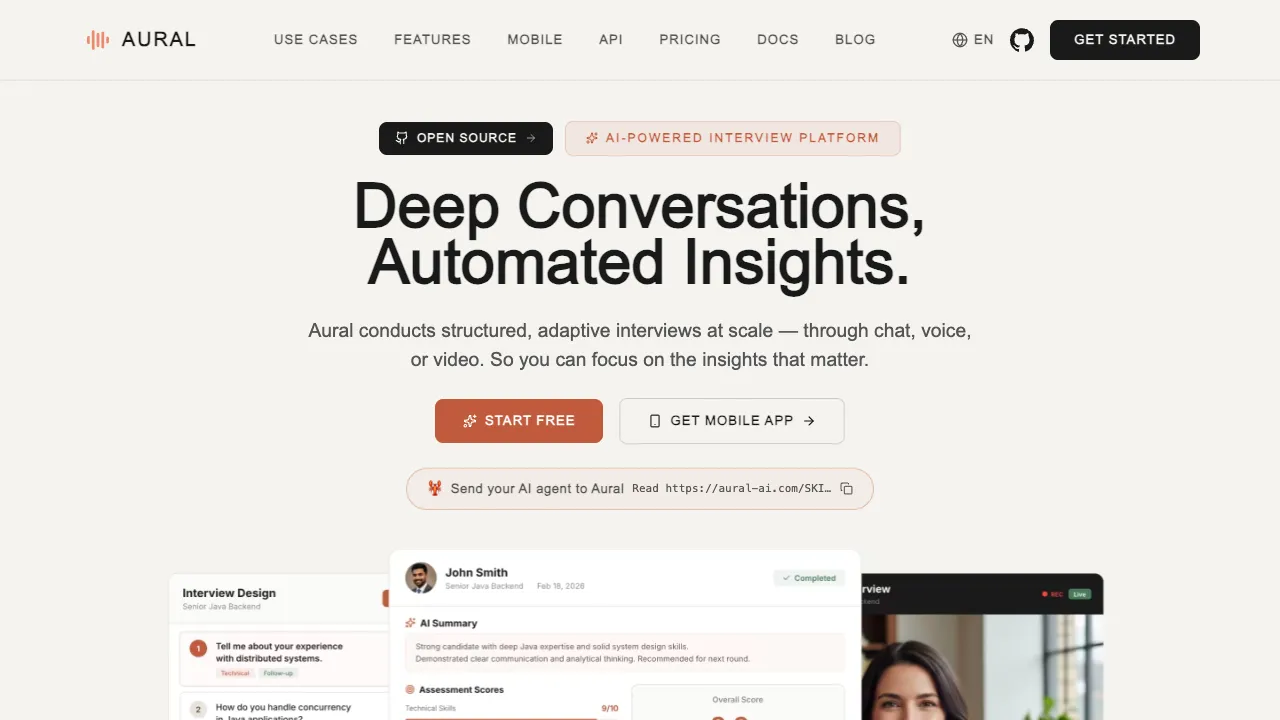
Conducting recruitment interviews is a labor-intensive process: during the screening phase, you must schedule and conduct conversations one by one. Whether questions are asked consistently or evaluation criteria remain uniform largely depends on the interviewer's state of mind that day. Aural aims to solve this specific segment—by having AI execute structured interviews. You describe your interview goals, and the AI generates corresponding questions and evaluation standards. Candidates enter via a provided link; the AI handles asking questions, probing for details, and managing the session flow. Upon completion, it automatically generates per-question scores and analysis reports. It is open-source under the MIT license and can be fully self-hosted.
What Is Aural?
Aural is an open-source platform for AI-driven interviews and structured assessments that supports voice, text, and video interview formats. Its positioning goes beyond simply "AI-generated questions"; it enables the AI to conduct a full-fledged interview: dynamically adjusting dialogue based on candidate responses in real time, probing into details as needed, and finally outputting structured evaluation results.
The code is hosted at GitHub under the MIT license. The technology stack consists of Next.js 14 + TypeScript + Supabase (PostgreSQL). As of July 2026, it has garnered over a hundred stars and belongs to an earlier wave of open-source projects. Officially, cloud-hosted versions are also available at aural-ai.com, allowing users who prefer not to self-deploy to use the service directly.
Core Features
Generate Interviews via Natural Language
When creating an interview, you describe your goals in natural language (for example: "Hire a frontend engineer with three years of experience, focusing on React and engineering capabilities"). The AI will then generate a complete list of questions, evaluation standards, and recommended settings; alternatively, you can manually build the structure using its editor. Question types support open-ended responses, single-choice, multiple-choice, online coding challenges, and whiteboard exercises.
Voice, Text, and Video Interviews
Candidates enter the interview via a shared link to respond using voice, text, or video. The AI dynamically adjusts the conversation in real time based on their answers—probing for details where responses are vague and moving forward to the next question when answers are thorough, rather than rigidly reading from a script. Before launch, you can preview the entire interview flow from the candidate's perspective.
Online Coding and Whiteboarding
Technical interviews include an integrated Monaco editor (built on the same core as VS Code) for coding challenges and Excalidraw whiteboards for system design questions, eliminating the need to separately start a video conference to share screens.
Structured Scoring Reports
Upon completion of each interview, an analysis report is automatically generated: item-by-item scoring, key highlights, areas for improvement, and an overall summary. For hiring teams, this ensures all candidates are evaluated against the same standardized criteria, providing a solid basis for direct comparison across applicants.
Anti-Cheating Mechanisms
Built-in features include page-switching monitoring, external paste interception, multi-screen detection, and integrity logging to provide basic fraud prevention in remote written exams and initial screening scenarios.
Simulated Interview Practice
In addition to the recruiter perspective, Aural also offers a candidate practice mode: voice-simulated interviews with real-time feedback, reference answers, and score tracking. This can be used to prepare for actual job interviews.
Team and Developer Capabilities
Supports organization, project, and role-based access control; provides a complete REST API with OpenAPI specifications for easy integration with existing recruitment systems. The interface includes built-in Chinese and English support, and the localization system is extensible.
Pluggable Large Model Integration
The model layer is pluggable, supporting OpenAI, Gemini, Kimi, MiniMax, as well as any OpenAI-compatible interfaces. This is particularly friendly for users in China—you can connect to your own existing model services without being locked into a single vendor.
Deployment Options
Aural supports full self-hosting: it requires a Node.js 18+ environment and uses Supabase for the database. Local development and deployment are initiated via Docker, which starts the Supabase service; database migrations apply automatically. All interview data remains on your own infrastructure—a key differentiator for teams concerned about candidate data compliance.
If you don't want to deal with self-hosting setup, official cloud services offer a ready-to-use experience; specific pricing is subject to confirmation from the official website.
Who Is Aural For?
Recruitment teams with high initial screening volumes: Delegate the first round of structured filtering to AI, standardizing questions and scoring criteria so human resources can focus on subsequent rounds.
Companies concerned about data compliance: Interview recordings, candidate responses, and evaluation data are sensitive; a self-hosted solution ensures this data never leaves your own servers.
Job seekers preparing for interviews: Use the mock interview mode to practice speaking aloud, receiving feedback per question along with reference answers. This approach is closer to real-world scenarios than simply quizzing yourself against a static question bank.
Teams conducting user research or training assessments: Aural positions itself as a general-purpose structured interviewing platform; it is equally applicable for use-case interviews and internal training evaluations where the goal is "asking standardized questions while recording and assessing responses."
Pricing
The site advertises a free tier and states plainly that getting started needs no credit card.
Its trial route is unusual: you can run a real interview without signing up — pick a scenario, spend under 18 minutes, and get a personalised report at the end. For evaluating whether it works, that beats reading a features page.
Tiers and amounts are on the site's pricing page — check there. An API, a mobile app and documentation are also available.
The project itself is open source, which the homepage states directly.
Limitations
The project is still in early stages: As of July 2026, the community size around the open-source repository remains small; ecosystem resources and third-party materials are limited. When issues arise, users primarily rely on official documentation and GitHub Issues for support.
Inherent controversies surrounding AI interviews: Discussions within the industry continue regarding the fairness and accuracy of AI scoring. Evaluation results should serve as references or basis for initial screening only; final judgments for critical roles must still be made by humans.
Self-hosting has a certain threshold: You need to prepare Node.js, Docker/Supabase environments, and large model API keys. For HR teams with no technical background at all, using the cloud service directly is more practical.
Practical Recommendations
Test a small workflow first before committing: Generate an interview for a real job posting, then walk through the entire process yourself as if you were the candidate. Evaluate whether the follow-up question quality and report granularity meet your requirements before deciding to integrate it into formal workflows.
Position AI interviews at the initial screening stage: Let them replace "the first round of repetitive standardized questioning," not final-round judgment; use reports for horizontal comparison and eliminating candidates who clearly do not match.
Prioritize OpenAI-compatible interfaces for domestic usage: Integrate models like Kimi, MiniMax, or your own proxied model services. Latency and stability are better than connecting directly to overseas endpoints.
As an MIT-licensed, self-hostable AI interview platform, Aural fills a gap in the combination of "structured assessment + data sovereignty." The project is young but features a complete architecture and clear documentation; it deserves attention from recruitment teams with high volumes or those concerned about data compliance.