

The deeper you go with Midjourney, the more many users encounter a common dilemma: knowing exactly what style they want but being unable to describe it in text. Typing "retro movie poster style" into the prompt might yield twenty different styles from various decades; telling MJ "Japanese manga illustration feel" could result in an output that is worlds away from your intention.
This highlights the fundamental limitation of describing styles with words—style is a visual language, and many subtle textures, color tendencies, and line characteristics are distorted when translated into text.
Midjourney's Style Tuner feature (used via the --sref parameter) fundamentally shifts this approach: instead of describing a style, you provide a "style code" directly, allowing MJ to generate images based on that code's visual features. While powerful, random style codes are just strings of numbers with unknown effects; finding what you want requires blind testing one by one.
Catjourney solves exactly this problem.
What is Catjourney
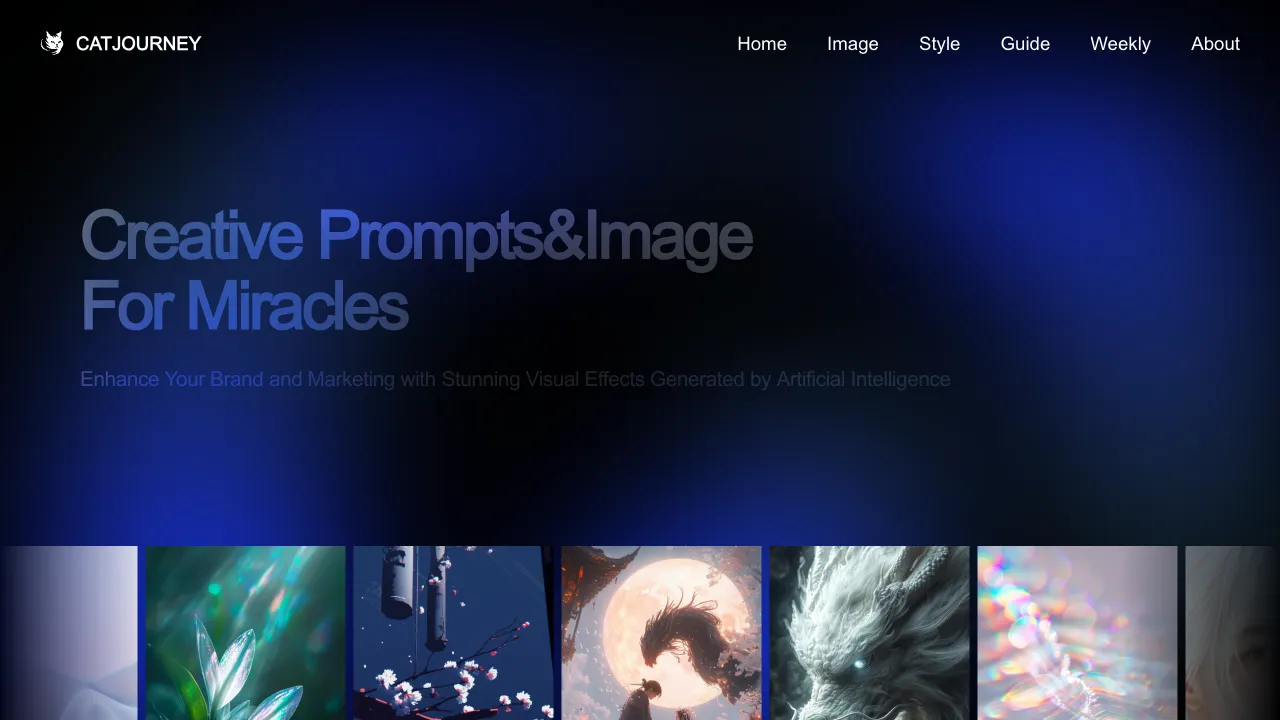
Catjourney (catjourney.life) is a resource library dedicated to the Midjourney Style Tuner (Style Reference) feature, collecting and displaying the actual visual effects of numerous MJ style codes (sref codes). It allows users to "see images first, then select style codes" rather than blindly experimenting.
It is not an image generation tool itself; it is a meta-tool—a companion resource station designed to help you use Midjourney's style system more efficiently.
Why the Style Tuner Feature Deserves Deep Understanding
First, let's clarify what --sref is so that Catjourney's value becomes clear.
Midjourney's --sref (Style Reference) parameter allows users to specify a style reference when generating images—this can be an image URL or an MJ-generated style code itself. When using a specific sref code, the generated image mimics the visual characteristics of that referenced style in dimensions such as composition, color tone, brushstrokes, lighting/shadows, and texture, while your prompt still controls the content.
The feature's power lies in consistency control:
Style Uniformity for Series: If you are creating a set of illustrations with a fixed visual identity, using the same sref code ensures that every generated image maintains stylistic consistency without subtle style drifts between images. This is difficult to control precisely with prompt keywords but can be stably reproduced with an sref code.
Breaking Through Language Description Bottlenecks: Many visual styles suffer inherent information loss when described in text. An sref code carries direct visual information, bypassing every conversion error along the chain of "Chinese → English → AI Understanding → Generation."
Efficient Exploration of Style Diversity: Placing multiple codes after --sref allows mixing various styles to see fusion results. This is a systematic way to explore visual possibilities, far more intuitive than adding and subtracting keywords in prompts.
However, the problem remains: sref codes have no textual descriptions, only strings of numbers. You don't know what style corresponds to which code until you try them one by one.
Catjourney's Core Content
Massive Style Code Library
Catjourney is primarily a continuously expanding library of MJ style codes. Each entry includes:
Effect Preview Images: Multiple example images generated using that sref code, demonstrating how different content types look under this style. Typically featuring character portraits, scene backgrounds, and object illustrations to help you judge if the style fits your use case.
Style Description Tags: Labels annotating key characteristics such as "watercolor texture," "flat illustration," "cinematic tone," "retro feel," or "high contrast." These tags help you quickly gauge direction without viewing every single image first.
Complete sref Code: Ready to copy and paste directly into your MJ prompt in the format --sref [code].
Weight Recommendations: Some entries note suggested weight parameters for the sref (--sw, range 0-1000). Higher weights increase style influence; these suggestions help you avoid trial-and-error detours.
Classification System
Styles are organized by major categories, including:
Painting and Illustration Styles: Watercolor illustrations, oil painting aesthetics, ink wash landscapes, pencil sketches, acrylic textures, sketch styles, etc., suitable for creative projects.
Digital Art and Concept Design: Cyberpunk, steampunk, psychedelic art, fantasy concept art, sci-fi scenes, etc., ideal for game or film-related creation.
Graphic Design Styles: Bauhaus geometry, retro posters, minimalism, Art Deco decorative arts, etc., perfect for branding and design projects.
Photographic Aesthetic Styles: Film stock looks, portrait photography, architectural photography, street documentary feel, etc., suitable for scenarios requiring a "photorealistic" look.
Anime and Cartoon: Ghibli/Miyazaki style, Disney aesthetic, Japanese manga line art, flat cartoons, covering various animation styles.
Chinese Traditional Art: National-style ink wash, detailed brushwork paintings (gongbi), mural aesthetics, traditional Chinese pattern motifs, etc.—particularly practical for creators making "Guofeng" content.
Pop Culture Styles: Y2K aesthetics, Lo-fi style, Cottagecore pastoral vibes, and other recent visual languages trending in pop culture.
Search and Filtering
The keyword search function allows you to input style keywords (in Chinese or English) to quickly locate relevant entries without browsing categories one by one. For users with a specific target style in mind, searching is far more efficient than category browsing.
It also supports filtering by multiple tags simultaneously—for example, combining "illustration + cool tones + minimalism"—to gradually narrow down and find the most matching style code.
Community Contributions and Updates
Catjourney features user contribution capabilities where MJ users can submit beautiful sref codes they discover along with effect preview images. This keeps the resource library continuously expanding without relying solely on platform team testing. Active community contributions are key to maintaining freshness in the database.
Comparison with Similar Resources
vs PromptHero: PromptHero is a comprehensive AI prompt community covering Midjourney, Stable Diffusion, DALL-E, and more, where users share and discover prompt recipes; however, it lacks specialized organization for MJ sref style codes specifically. Catjourney focuses exclusively on this aspect, offering greater depth and specialization.
vs Official Midjourney Style Tuner Tool: Midjourney's official tool can generate custom sref codes but does not provide a preview library of existing codes—it is purely a generator, not a discovery tool. Catjourney fills the gap in the "discovery" phase.
vs Civitai (Stable Diffusion Model Community): The value Civitai offers SD users is similar to what Catjourney provides MJ users—both help discover directly usable visual style resources. While Civitai hosts LoRA models and Catjourney hosts sref codes, the underlying usage logic remains analogous despite technical differences.
vs Randomly Testing sref Yourself: Starting from scratch to test sref codes is feasible; Midjourney's Vary(Style) function can also generate variants. However, this process is highly inefficient, requiring massive consumption of MJ credits (points) just to find a satisfactory style. Catjourney aggregates prior experience, saving you the cost of trial and error.
vs Prompt Sharing on Weibo/Xiaohongshu: Domestic social platforms host countless fragmented shares of MJ prompts and sref codes scattered across posts; Catjourney is a systematically organized database where search and classification functions make lookup far more efficient.
Who Should Pay Closest Attention to Catjourney
Heavy Midjourney Users: Those who create daily in MJ, already familiar with prompt techniques but seeking further precision in controlling style output quality—Catjourney belongs in your advanced toolkit.
Creators Needing Uniform Style Series: For those producing e-commerce product series, book illustrations, game character encyclopedias, or brand visual content where uniformity is a baseline requirement. Once you find a suitable sref code, using the same one for an entire series guarantees visual consistency far more reliably than manually describing styles in prompts.
Designers Exploring Visual Styles: When taking on new brand identity projects requiring exploration of multiple style directions within tight deadlines to prepare proposals; Catjourney allows browsing hundreds of styles in minutes—far surpassing self-generation testing efficiency.
Content Creators and Social Media Operators: Platforms like Xiaohongshu, Bilibili, or WeChat Official Accounts require recognizable visual identities. Finding an sref code matching your personal aesthetic helps maintain long-term consistency, aiding audience recognition building.
Guofeng Content Creators: For those creating Guochao brands or traditional culture content, the dedicated Chinese Traditional Art category offers a vast collection of curated "Guofeng" style codes—a shortcut to quickly finding suitable national-style aesthetics.
Practical Usage Methods
After finding a satisfactory style code on Catjourney, use it in Midjourney as follows:
/imagine [your image description prompt] --sref [the code copied from Catjourney]To strengthen style influence, add the --sw parameter to control weight:
/imagine [prompt] --sref [code] --sw 500The --sw value ranges from 0-1000 (default is 100); higher values increase style impact while lower ones amplify content prompt influence.
If you wish to blend two styles:
/imagine [prompt] --sref [code 1] [code 2]Using both codes simultaneously causes MJ to fuse the visual characteristics of both styles.
Limitations Note
Catjourney focuses exclusively on Midjourney's sref functionality and has no direct utility for other image tools like Stable Diffusion, DALL-E, or Flux. If you primarily use those platforms, Catjourney's content is not applicable.
sref code effects may vary with Midjourney version updates—after a major MJ update, the visual output of an sref code might deviate from its preview images. Preview images on Catjourney correspond to the version when the code was added and do not necessarily reflect latest release performance.
Using discovered style codes still requires an active Midjourney subscription (minimum $10/month); Catjourney itself does not provide image generation capabilities.
Pricing
Browsing and one-click copying of prompts is free — no payment is needed to take them.
No paid tiers are published on public pages, so trust what the site shows you.
To be clear: it provides prompts and finished-image references only. Generating images still costs money on the model's side — Midjourney has no free tier, and other models each have their own allowances.
It also runs a weekly email (Catjourney Weekly) covering tips, beginner tutorials and updates.