

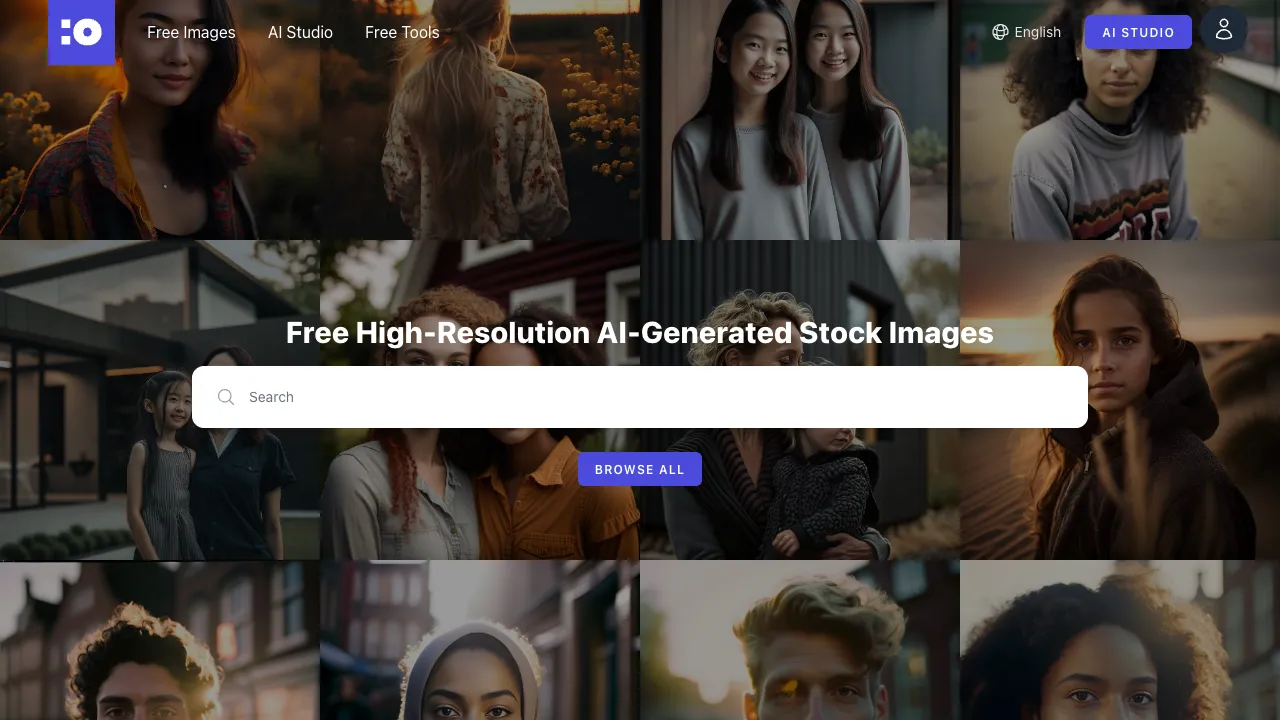
Designers frequently encounter an awkward dilemma: the need for a human face—whether as app user avatars, team photos on websites, or illustrations accompanying "client testimonials"—but using real photographs comes with complications. Scraping one from the internet? You risk legal trouble over portrait rights and copyright issues. Buying stock images? It costs money, licensing terms are cumbersome, and commercial usage may still be restricted. More subtly: this face belongs to a specific, living person. Placing an unfamiliar stranger's likeness in your product promotion is legally and ethically murky. CG Faces offers an elegant solution: use people who do not exist—AI-generated faces that have no real counterparts naturally avoid portrait right issues entirely, are free of charge, and fully commercializable.
What Is CG Faces
CG Faces (cgfaces.com) is an AI-generated portrait library offering a vast collection of freely downloadable AI character avatars covering various ages, genders, races, and styles. All faces are generated by AI and correspond to no real individuals; therefore, there are no concerns regarding portrait rights, allowing for direct commercial use. The material style leans toward realistic photography (resembling actual photos rather than cartoon illustrations), making it suitable for design scenarios requiring authentic-looking human subjects.
Why You Need AI-Generated Portraits
CG Faces solves four persistent challenges in using real person photographs within a single platform:
Portrait Rights and Copyright: Using real photos requires authorization and involves portrait rights; AI-generated "non-existent" people bypass the entire issue entirely.
Diversity: Projects often require showcasing diverse groups across ages, races, and backgrounds; assembling varied authentic materials in appropriate proportions is difficult; an AI library allows filtering as needed.
Consistency: When a series of stylistically uniform avatars are required (e.g., default app icons or blog author portraits), AI generation maintains visual consistency effectively.
Cost: Commercial human portrait assets are expensive; free AI alternatives serve as ideal substitutes for designers and personal projects with limited budgets.
Platform Features
High-Quality AI Portraits
AI face generation has advanced remarkably in recent years—from the eerie "uncanny valley" feel of a few years ago to skin details, lighting, and facial features now approaching real photographic quality today. CG Faces' assets sit on the mature end of this progress curve; most images withstand scrutiny for standard usage well.
Diverse Coverage
Categorized by age (from children to seniors), gender, race (various ethnic facial characteristics), and style (business/casual/different attire), designers can find characters matching project requirements easily.
Free Commercial Use with Filtering
Clearly marked as free downloads with commercial rights; download permissions expand after registration while maintaining an extremely low barrier to entry; supports filtering by features for quick location without sifting through massive image volumes unnecessarily.
Comparison With Other Portrait Sources
vs Unsplash/Pexels (Free Real Photo Libraries): While real photos offer high quality and diversity, they involve actual person portrait rights with commercial usage restrictions; CG Faces' AI faces have no portrait right issues—enabling freer commercial use—which is its core raison d'être.
vs ThisPersonDoesNotExist: Another pioneering site for AI-generated faces that refreshes to produce a new face each time with decent quality; however, it only supports random generation without categorization or filtering options; CG Faces provides a more complete browsing and filtering experience overall.
vs Paid Stock Libraries (Shutterstock/Getty): Professional libraries offer clear licensing terms but at high costs; CG Faces is free, making it ideal for those on tight budgets.
vs Self-Generated with MJ/SD: Generating your own offers full control over arbitrary features but requires time spent generating and selecting; CG Functions as a ready-made asset library saving this step entirely—perfect for designers who don't use AI painting tools regularly.
Who Should Use CG Faces
UI/UX Designers: Filling avatars in app prototypes or interface designs works directly out of the box—it's one of the most frequent usage scenarios.
Web Designers: Character portraits for client case studies, team introductions, and user review modules are diverse with zero copyright risks attached.
Marketing & Advertising Professionals: Marketing materials featuring human imagery reduce portrait right and copyright exposure significantly.
Content Creators: Blog or social mediaStock Photo Models (character assets) are more convenient and secure than hunting for real person photos manually.
Students & Personal Projects: Limited budgets paired with demands for high-quality character assets; free libraries solve this problem directly without friction.
Usage Considerations
Verify Licensing Terms: Read CG Faces' specific usage guidelines thoroughly before use (whether attribution is required or other restrictions apply); commercial projects especially need confirmation here first.
Inspect AI Artifacts: While overall quality remains high, subtle detail issues may still appear (odd ear shapes, teeth anomalies, background glitches, strange accessories); always zoom in to inspect carefully before critical commercial deployment—this is a common trait of all AI-generated faces unfortunately.
Avoid Homogeneity Across Projects: Drawing every character from the same single AI library might make your entire project lookPlagiarism (too similar/mirrored); appropriately mixing different style assets creates more natural results overall.
CG Faces fills an increasingly glaring gap in design resources: today, with portrait rights around real person photographs becoming ever more complex while AI content grows indistinguishable from reality, "using a face that doesn't exist" has become both safe and free—an elegant solution indeed. When you need diverse, high-quality character avatars without copyright worries, it's worth bookmarking as a practical resource—just remember to zoom in once before use to spot those occasional small imperfections AI occasionally reveals.