

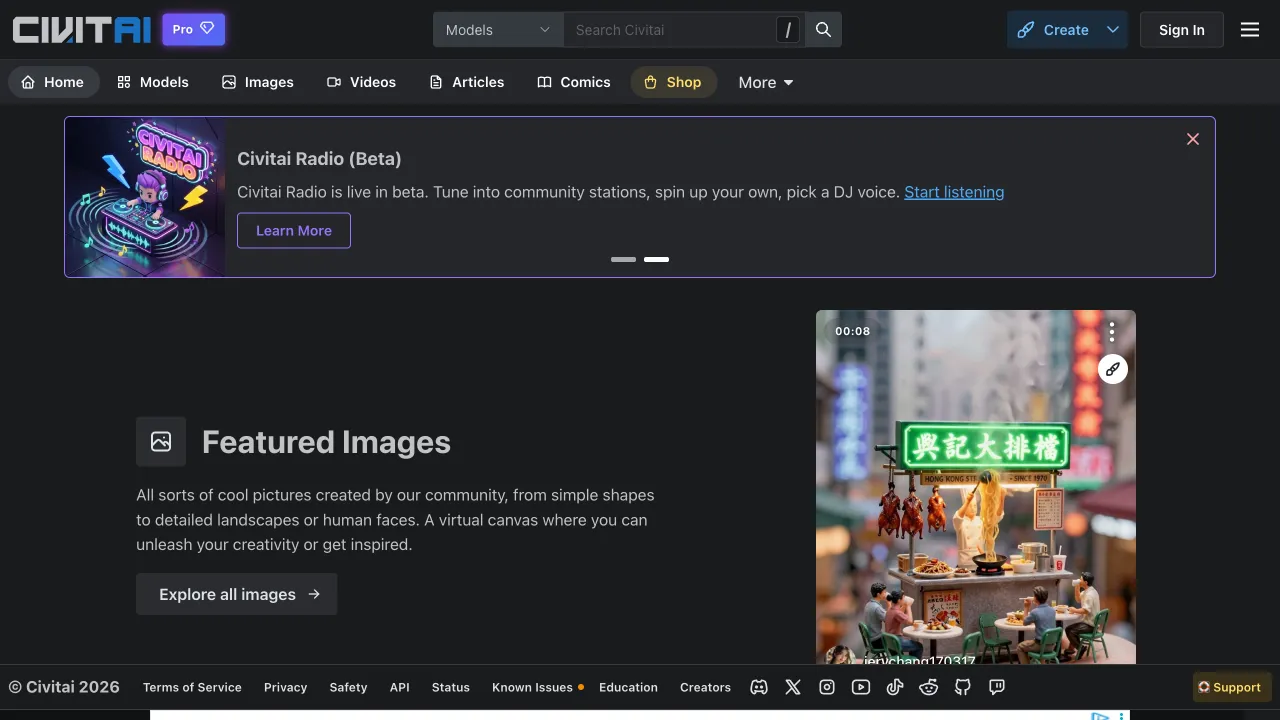
If you’ve used Stable Diffusion, Civitai is practically unavoidable. It is currently the world’s largest community for sharing AI art models, hosting tens of thousands of Stable Diffusion models—everything from base models (Checkpoints) to LoRAs, Textual Inversions, VAEs, and ControlNet models. You could say that for almost any style or character you want to realize in SD, there is likely a corresponding model on Civitai.
What is Civitai?
Civitai (pronounced similarly to "civil AI") is an AI model sharing platform launched in late 2022. Its core function allows creators to upload and share their trained Stable Diffusion models, which other users can download and use for free. It is more than just a file download site; it functions more like a community—each model page includes creator notes, recommended usage parameters, prompt examples, and showcases of works generated by other users using that model.
The platform’s growth has been remarkable, taking less than a year from launch to become the core infrastructure of the SD community. Today, the number of models on Civitai runs into the hundreds of thousands, with a large volume of new models uploaded daily.
Platform Content
Checkpoint Models
Checkpoints are complete SD model files and serve as the foundation for image generation. The Checkpoints on Civitai cover various stylistic directions:
- Realistic Style: Models optimized specifically for portraits and photographic textures, capable of generating images that closely resemble real photographs.
- Anime/2D Style: Optimized specifically for Japanese anime art styles, making them the top choice for 2D creators.
- Artistic Styles: Specialized models for oil painting, watercolor, pixel art, concept art, and other artistic styles.
- General Models: Balanced models that attempt to cater to multiple styles, suitable for a wide variety of scenarios.
LoRA Models
LoRA (Low-Rank Adaptation) is a lightweight fine-tuning technology. Its file size is significantly smaller than a full Checkpoint, but it can add specific styles or characters to a base model. The number of LoRAs on Civitai is likely the highest among all model types, covering:
- Character LoRAs: "Teach" the model the appearance of specific anime, game, or movie characters so you can generate them later.
- Style LoRAs: Specific artists’ styles or visual aesthetics (e.g., cyberpunk, Hayao Miyazaki style).
- Concept LoRAs: Specific clothing, props, or scene elements.
- Real Person LoRAs: Some creators have uploaded LoRAs trained on real people; this area is governed by the platform’s content policies.
Textual Inversion (Embedding)
Embeddings are another form of lightweight model extension. They have very small file sizes but can influence the model’s understanding of specific concepts. They are commonly used for negative prompt embeddings (to reduce undesirable generation results) or to reinforce vocabulary for specific styles.
Community Showcase of Generated Images
Each model page on Civitai displays images generated using that model. More importantly, these showcase images usually come with complete generation parameters: the prompts used (positive and negative), sampler, steps, CFG scale, seed number, etc. This is a valuable learning resource for beginners—you aren’t just downloading a model; you are seeing how others have successfully used it to create high-quality works.
How to Use Civitai
Basic usage workflow:
- Search on Civitai for the style or purpose you want (keywords can be English style terms, character names, or you can browse categories directly).
- View the model page and check if the showcase images meet your needs.
- Review the creator’s usage suggestions and recommended parameters.
- Download the model file and place it in the corresponding directory in your local Stable Diffusion installation (Checkpoints go to
models/Stable-diffusion, LoRAs go tomodels/Lora). - Select this model in SD WebUI or ComfyUI to start generating.
Most models are free to download, though some creators have set up early access fees or require Civitai points.
Content Policy
Civitai allows NSFW content, which is one of the reasons it attracts a large number of creators, but also the source of its long-standing controversy. The platform categorizes NSFW content by rating; you must log in and enable relevant options to view adult content. By default, unlogged-in users only see safe-for-work (SFW) content.
The platform also prohibits certain types of content, including material involving minors, which are subject to review and removal.
For users who only want to find painting style models or tool-based models, the platform’s content categorization and filtering features can effectively focus on SFW content.
Two Structural Changes in 2026
The site split in two. civitai.com is now the primary platform for content that meets stricter compliance standards, while civitai.red hosts the less restricted material. Payments drove the split: isolating stricter content on the main site is what keeps credit cards and subscriptions viable. Relatedly, Civitai removed all models and images depicting real people — regardless of context or rating — describing it as a requirement for continuing conversations with specialist payment partners.
Creator earnings moved to creator-set pricing. Previously, when someone generated an image with your model you earned a flat 25% of the buzz, a rate Civitai set that creators could neither see nor change. That system, along with tips, retired at the end of August 31, 2026, replaced by fees creators set themselves — a model with no fee set now earns nothing on generation. Civitai suggests starting around 1 buzz per image for base models and 1 buzz per 10 images for LoRAs. Creators can also sell model access directly and run their own shop, all managed in the new Creator Studio, with membership unlocking higher fee caps and buzz payouts.
Comparison with Other Resources
vs. Hugging Face: Hugging Face is a larger AI model hosting platform covering various types such as language models and vision models. However, in the vertical niche of Stable Diffusion-specific models, Civitai offers better quantity, community activity, and user experience. Many creators upload to both platforms, but premier releases often happen on Civitai first.
vs. Official SD Models: Stability AI’s official models (SDXL, SD 3, etc.) serve as the foundation. The models on Civitai are largely fine-tuned versions of these base models, providing specific styles and character capabilities that the official models lack. They are complementary, not mutually exclusive.
vs. Training Yourself: Users with strong technical skills can train their own LoRAs using tools like Kohya. Civitai essentially aggregates and shares the results trained by others, significantly lowering the barrier to acquiring specific style models.
Who Should Use Civitai?
Stable Diffusion Users: This is almost Civitai’s core user base—if you use SD, Civitai is a resource site you must know about.
Creators with Specific Style Needs: If you want to generate images in a specific anime or game style, finding the right model on Civitai is the fastest path, saving significant time compared to training your own.
Beginners Learning AI Art: The parameter examples and community discussions on model pages are great places to learn generation techniques. Learning by doing works well here.
AI Image Content Producers: If you need to consistently produce images in a specific style, finding a reliable dedicated model is more stable than relying on prompt adjustments every time.
Civitai brings together Stable Diffusion models, example images and community notes. Review outputs and settings when choosing a model, and check the version, license and file source before downloading.
Pricing
Browsing and downloading models is free; on-site generation is billed in the site currency, Buzz.
The whole economy was replaced during 2026. Creators used to earn a flat 25% of the buzz a generation made — a rate the platform set, whose calculation creators could neither see nor change. That has been replaced by creator-set pricing:
- July 31, 2026: setting a licensing fee, selling paid access, and tier-based caps went live for everyone
- End of August 31, 2026: the cutover completed, the old compensation and tips system went away entirely, and generations now charge only the licensing fees creators set
Because the old compensation and tips were baked out of prices, most generation costs actually dropped by roughly a buzz or two.
On the creator side: you earn on every generation, member or not, with no subscription required. Membership unlocks higher fee and price caps, buzz banking and payouts, and higher tiers — the platform caps how much you can charge, scaled by tier, rather than how many models you can sell. Already-earned buzz can also be put toward a membership's perks (the perks, not the monthly buzz a paid membership includes). Management lives in the new Creator Studio.
Check the site's current pricing and creator terms.