

Software engineering has a repeatedly validated cost curve: the later a defect is discovered, the higher the cost to fix it—fixing it while coding is just changing a line; fixing it during Code Review involves back-and-forth iterations; discovering it after launch might require an incident post-mortem. "Shift left" on checks has thus become a core tenet in engineering efficiency: flag issues the second they are written, much like spell-check in a text editor.
Codiga is a product born of this tenet: real-time code quality and security analysis running inside your IDE, checking as you write. It also has a noteworthy ending—acquired by Datadog in 2023, its static analysis technology became the foundation for Datadog’s Code Analysis/Code Security product line. The independent Codiga has faded into history, but the tool paradigm it represented and the value confirmed by that acquisition are worth understanding.
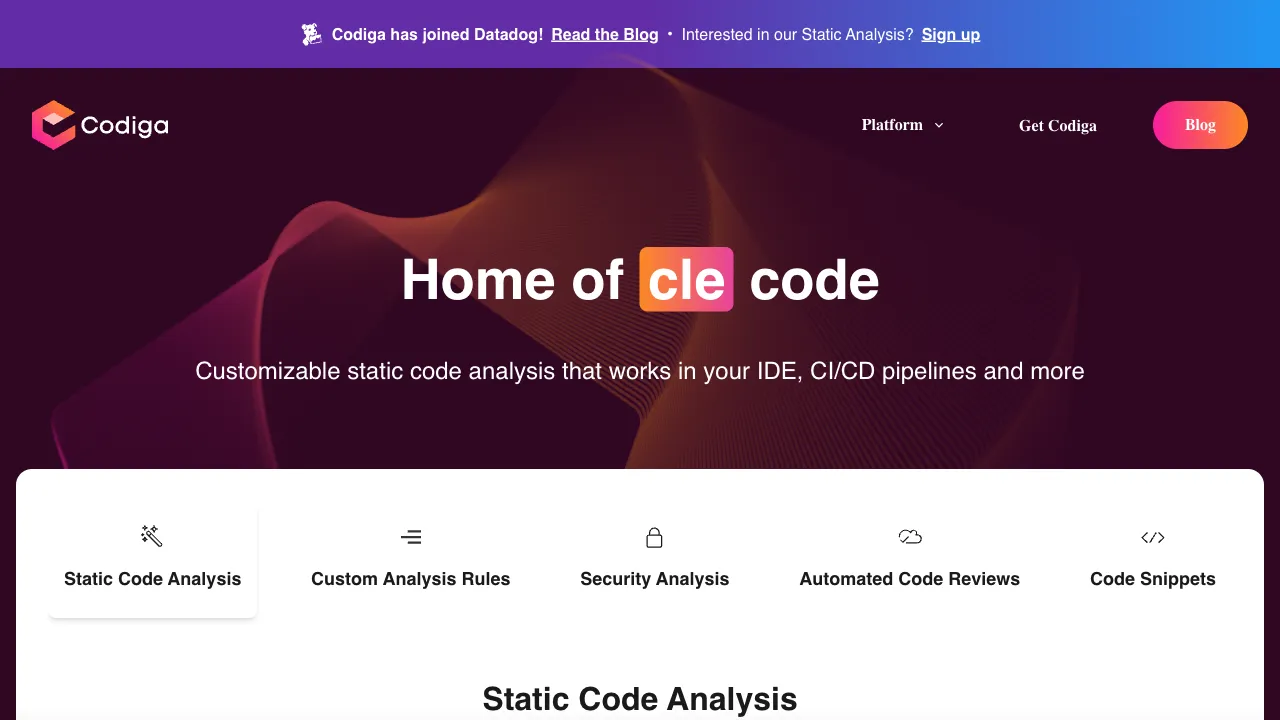
Acquired (checked 2026-09-06): Codiga's homepage carries a "Codiga has joined Datadog" notice, and the product has been folded into Datadog's platform. This page is kept as a historical record and no longer offers a standalone entry link; look for the equivalent capability inside Datadog.
What Codiga Was (and Is)
Codiga (codiga.io) was a code analysis platform with two core capabilities: code quality detection (bad smells, non-standard patterns, potential bugs) and security scanning (vulnerabilities like those in the OWASP Top 10). Its primary form was an IDE plugin (for VS Code and JetBrains products), supplemented by CI/CD integration (pipeline checks for GitHub/GitLab/Bitbucket) and a community-driven rule marketplace (Codiga Hub).
It supported mainstream languages such as Python, JavaScript/TypeScript, Java, Go, and Ruby. Its selling point was "lightweight and ready-to-use"—compared to heavy solutions requiring self-hosted servers, it lowered the barrier to static analysis to the level of individual developers.
What It Got Right
Real-time In-editor Feedback
Problematic lines are highlighted in real time as you code: overly long functions, deep nesting, unused variables, null pointer risks, performance anti-patterns—with explanations and fix suggestions. This "instant correction" teaching effect is particularly significant for junior developers: seeing "why it’s wrong" at the moment of writing is far more effective than seeing it in a review comment a week later.
Democratizing Security Checks
SQL injection, XSS, hardcoded secrets, weak encryption, path traversal—issues everyone knows are dangerous but often ignore when rushing to meet deadlines—are forced into view. Moving security checks from "the security team’s job" to "a default configuration in every editor" is the true social value of such tools.
Rules as Community (Codiga Hub)
Team coding standards transformed from "documents no one reads" into "executable, shareable check rules." The community marketplace allowed rules to be searched and reused—a concept of "rule assetization" later adopted by many similar products.
CI Gatekeeping
Automatic scanning before PR merges blocks non-compliant code from reaching the main branch—turning quality standards from mere initiatives into hard process constraints.
Current Status and Alternatives Guide
This section is likely the most practical part of this article for today’s readers: after Codiga was acquired by Datadog, its independent service has been gradually shut down, and new users can no longer consider it as an option. Here are its spiritual successors and current alternatives:
Datadog Code Security: The official destination of Codiga’s technology, now deeply integrated into the Datadog observability platform—teams already using Datadog effectively gained code analysis capabilities within their existing monitoring suite.
SonarQube / SonarCloud: Long-standing standards for code quality management with comprehensive rules and a mature ecosystem; self-hosted versions have operational costs, while the cloud version is free for open-source projects, making it the default choice for mid-to-large teams.
Semgrep: The static analysis tool most favored by the tech community in recent years—rules are written in a syntax resembling source code, making customization extremely intuitive. With an open-source core and commercial platform, it’s a favorite among security engineers and shares Codiga’s lightweight spirit.
DeepSource / CodeQL (GitHub): The former is an integrated code health platform; the latter is GitHub’s native semantic-level security analysis, free for open-source repositories and a standard for supply-chain upstream projects.
Review Capabilities of AI Coding Assistants: A new variable—code review features in tools like Copilot and Cursor are eroding parts of traditional static analysis using large models’ semantic understanding. The two technical approaches (rule engines vs. large models) are currently complementary: rule engines check for "definite issues" with zero false-positive cost, while large models cover a broader range of "logical layer issues."
Who These Tools Are For
Independent Developers: With no colleagues to review your code, static analysis is your second pair of eyes—the highest ROI quality investment.
Junior Engineers: Real-time prompts serve as best-practice tutorials embedded in the workflow, accelerating growth.
Small Teams: Wanting quality standards but unable to afford heavy platforms; lightweight tools + CI gatekeeping is the most pragmatic starting combination.
Compliance-Sensitive Projects: Handling user data or facing audit requirements, code-level security scanning is a necessary part of the defense line.
Lessons Learned
Static analysis output must be "configured as you go": enabling all default rules inevitably drowns real issues in false-positive noise. Trimming rule sets to fit actual project needs and decisively marking false positives as ignored allows the tool to maintain its credibility (avoiding the "boy who cried wolf" effect).
It can catch "writing incorrectly," but not "thinking incorrectly"—business logic errors and architectural problems exceed the capabilities of static analysis; human review remains irreplaceable. Tools free human energy from mechanical checks, allowing focus on parts that truly require intelligence.
Pricing (Historical and Current)
Codiga originally offered a free personal tier and paid team tiers; current pricing follows Datadog’s product lines. Many alternatives mentioned above have free tiers (SonarCloud is free for open-source, Semgrep’s open-source version is free, CodeQL is free for public repositories), making zero-cost onboarding feasible for individuals and small teams.
Codiga’s story is a microcosm of the developer tools industry: getting the direction right (shift left, lightweight, rule community), being acquired by a larger platform, and having its technological lineage absorbed into a giant’s product line. For today’s readers, what it leaves behind most usefully is that tenet itself—seeing issues the second they are written. Whatever tool you ultimately choose to implement this, it deserves a place in your engineering practice.