

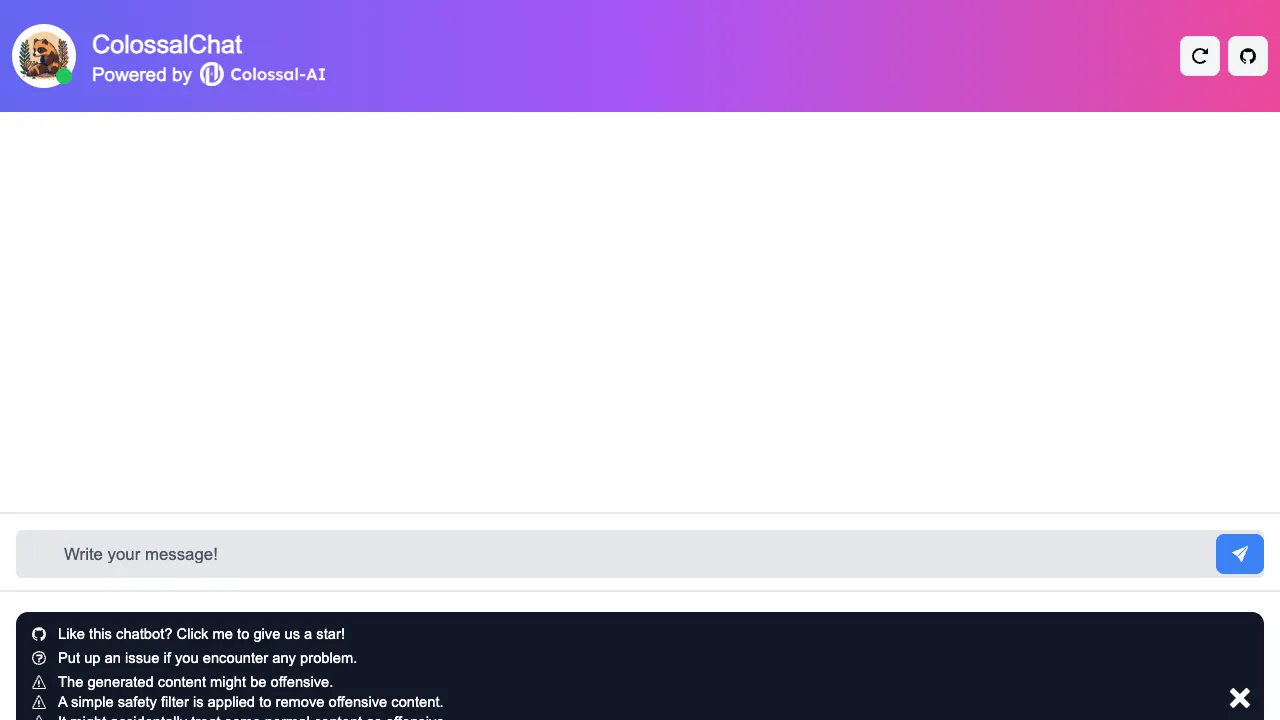
At the end of 2022, ChatGPT’s explosive global popularity left the AI research community in an awkward position: everyone knew that ChatGPT’s core capabilities stemmed from RLHF (Reinforcement Learning from Human Feedback), but the computational resources required for full RLHF training were far beyond the reach of ordinary university labs and small-to-medium-sized research institutions.
This wasn’t just a matter of “can’t afford it,” but also “can’t learn from it”—if no one implemented and open-sourced this process in an accessible way, AI technology would become a game reserved for a handful of supercomputer clusters.
ColossalChat is HPC-AI Tech’s answer to this problem (the team behind the ColossalAI project).
What Is ColossalChat?
ColossalChat is an open-source AI dialogue system built on the ColossalAI framework, with the core goal of fully reproducing the RLHF training process behind ChatGPT using relatively limited computational resources. In early 2023, the project rapidly garnered significant attention and was one of the earliest and most comprehensive attempts by the open-source AI community to replicate ChatGPT’s capabilities.
It is important to clarify upfront: ColossalChat is not a product designed to compete with ChatGPT in features, and its dialogue capabilities have a noticeable gap compared to ChatGPT. Its core value lies in “implementing a complete RLHF training pipeline” and “enabling a broader range of researchers to experiment with large model training techniques,” rather than being the “best AI assistant.”
Technical Background: What Is RLHF?
To understand the significance of ColossalChat, one must first understand what RLHF is.
After pre-training GPT-style language models, they only predict the next word and do not inherently know which responses are “good.” RLHF addresses this issue: by having human evaluators score different responses, a “reward model” is trained to replace human judgment; reinforcement learning (specifically the PPO algorithm) is then used to continuously optimize the dialogue model so that its responses achieve higher reward scores.
The result is that the model doesn’t just “answer,” but “provides answers that humans consider good”—more helpful, more harmless, and more truthful. This is the most critical technical difference between ChatGPT and purely pre-trained GPT models.
Core Technical Implementation
Complete Three-Stage Training Pipeline
ColossalChat implements the complete three-stage RLHF pipeline and open-sources all code:
Stage 1: Supervised Fine-Tuning (SFT) Fine-tune a base language model using human dialogue data so that the model learns “the format of conversation and basic helpful behaviors.” This step is relatively simple but lays the foundation for subsequent stages.
Stage 2: Reward Model Training Collect different responses to the same questions, have human annotators rank these responses by quality, and use this data to train a scoring model that can automatically evaluate response quality. This “scoring model” serves as a substitute for human feedback in the subsequent reinforcement learning stage.
Stage 3: Reinforcement Learning Optimization (PPO) Use the scores provided by the reward model as signals and repeatedly train the dialogue model using the Proximal Policy Optimization (PPO) algorithm, teaching the model to generate high-scoring responses. This is the most technically challenging and computationally intensive part of the RLHF pipeline.
ColossalChat’s contribution lies in implementing all three stages and making them open-source and reproducible—a rarity in early 2023.
Resource Optimization via the ColossalAI Framework
HPC-AI Tech’s ColossalAI framework is itself a system focused on large model training efficiency. By combining various parallel strategies (data parallelism, tensor parallelism, pipeline parallelism), it allows the same training tasks to be completed with fewer GPUs:
- For models of the same scale, ColossalAI can train them on machines with fewer cards
- Or, on the same hardware, train larger models
- Memory optimization techniques allow limited VRAM to handle larger models
These optimizations enable ColossalChat to complete RLHF training on relatively standard GPU servers, without requiring the massive computational clusters owned by OpenAI.
Open-Source Code and Reproducibility
All code is open-sourced on GitHub, including:
- Complete training scripts (code for each of the three stages)
- Data processing tools
- Inference code
- Model weights (relatively lightweight versions)
This fully open-source stance is ColossalChat’s most significant contribution to the AI research community—anyone can download the code and run the entire RLHF training process from scratch on their own server, seeing firsthand how it works.
Comparison with Contemporary Open-Source Projects
In the first half of 2023, the open-source AI community was highly active, with multiple teams competing to replicate ChatGPT’s core capabilities. ColossalChat was a key participant in this competition:
Comparison with Alpaca (Stanford): Alpaca is an LLaMA-derived model trained by Stanford using instruction tuning (without reinforcement learning). It only completed the first step of the three-stage process (SFT). While its implementation was relatively simple, its impact was widespread. ColossalChat is technically more complete, fully implementing all three stages of RLHF.
Comparison with Vicuna (UC Berkeley): Vicuna is also an instruction-tuned model based on LLaMA and does not include full RLHF. It performs well in dialogue fluency and has different strengths compared to ColossalChat.
Comparison with OpenAssistant (LAION): OpenAssistant is also pursuing open-source RLHF, taking a crowdsourced data annotation route that ultimately accumulated larger volumes of data. ColossalChat holds unique advantages in training efficiency optimization.
Comparison with LLaMA/LLaMA-2 (Meta): Meta’s open-sourced LLaMA series consists of base models. ColossalChat provides the methods and framework for performing RLHF training on top of base models; they operate at different levels.
Who Is It For?
AI Researchers and Graduate Students: To learn the practical implementation of RLHF, ColossalChat provides runnable reference code that is far more intuitive than reading papers. It is suitable for researchers seeking to deeply understand large model alignment techniques.
Engineers and Teams Wanting to Self-Train Dialogue Models: Those needing to build domain-specific dialogue AI but finding it difficult to implement RLHF from scratch can use ColossalChat’s open-source code as a starting point for modification and extension.
AI Systems Engineers: To learn distributed training technologies within the ColossalAI framework and understand how to efficiently train large models with limited resources—these technical insights are highly valuable in engineering contexts.
AI History Researchers: The open-source AI replication movement of early 2023 was a pivotal moment in AI development history, and ColossalChat is an important component of that history.
Limitations
Limited Dialogue Capability: As the output of a research project, ColossalChat’s dialogue quality has a noticeable gap compared to commercial products like ChatGPT or Claude. It is not suitable for daily use as an AI assistant.
High Technical Barrier: Truly leveraging ColossalChat (including local training and modifying code for experiments) requires a strong background in deep learning engineering. It offers almost no direct value to ordinary users.
Update Pace: As an open-source project maintained by a research institution, its update frequency is not on the same scale as commercial products. Given the rapid pace of AI development, the project may become relatively outdated after some time.
Pricing
Open source and free. The hosted demo works without payment; self-hosting or training through its pipeline costs whatever your own compute costs.
Two licence constraints to read first (both stated on the demo page):
- The chatbot is subject to the LLaMA licence
- The training data is subject to OpenAI's Terms
In other words, its value is demonstrating how far an open RLHF pipeline gets, not providing a model you can commercialise freely. The demo page also notes that generated content may be offensive and that a simple safety filter is applied, which may occasionally flag normal content.