

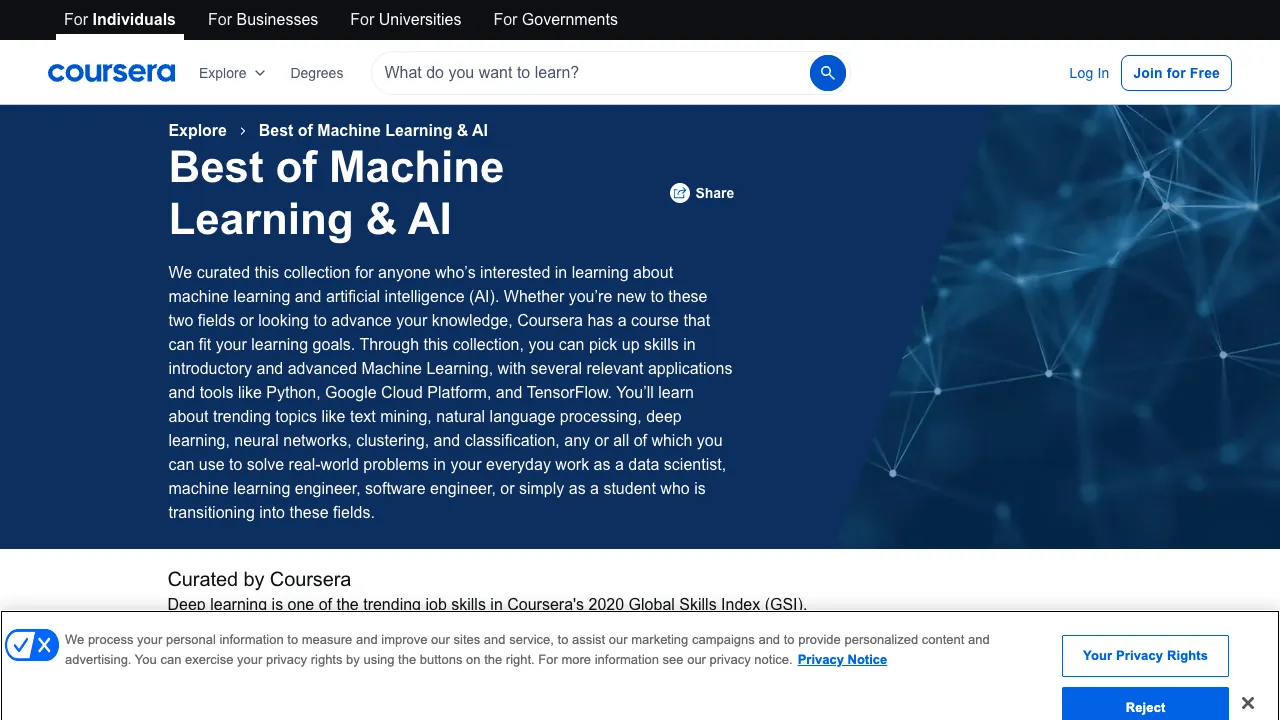
If you want to systematically learn AI and machine learning rather than piecing together knowledge from fragmented articles and YouTube videos, Coursera is one of the most credible online learning platforms available. The machine learning course taught by Stanford professor Andrew Ng on Coursera is considered one of the best introductory materials in the AI field, having helped millions of people worldwide enter this domain.
What Is Coursera?
Coursera is one of the world’s largest online learning platforms, partnering with over 200 universities (including Stanford, Michigan, Johns Hopkins, and Peking University) and companies (such as Google, IBM, Meta, and DeepLearning.AI) to offer courses ranging from beginner to professional levels. In the fields of AI and machine learning, Coursera offers hundreds of courses, covering everything from mathematical foundations to deep learning frontiers, and from programming practice to AI product management.
Coursera’s AI-related content can be categorized into several types:
- Courses: Individual classes that can be completed in a few weeks.
- Specializations: A series of multiple courses that comprehensively cover a specific direction.
- Professional Certificates: Practical skill certifications designed for career transitions.
- Degrees: Formal bachelor’s or master’s degree programs.
Representative AI Courses
Machine Learning Specialization (Andrew Ng)
Launched by Andrew Ng and DeepLearning.AI, this machine learning specialization consists of three courses covering supervised learning, unsupervised learning, recommendation systems, and an introduction to reinforcement learning. It is one of the most authoritative introductory series for machine learning today, with a completely updated version released in 2022 that uses Python (NumPy/scikit-learn).
Deep Learning Specialization (Andrew Ng)
This five-course deep learning specialization covers everything from the fundamentals of neural networks to convolutional neural networks, sequence models, and Transformers. It is the most systematic introductory course for deep learning, with over 500,000 people worldwide having completed it.
Machine Learning Engineering for Production (MLOps)
This course focuses on AI engineering practices from research to production deployment, emphasizing how to deploy models online and maintain them continuously. It is suitable for learners with some foundational knowledge who wish to enter industrial-level AI development.
IBM AI Engineering Professional Certificate
Offered by IBM, this professional certificate series for AI engineers covers machine learning, deep learning, neural networks, computer vision, and NLP. It includes numerous practical projects and is ideal for learners aiming for AI engineering roles.
AI for Everyone (Andrew Ng)
An introductory AI course designed for non-technical audiences, helping them understand what AI is, what it can do, and what it cannot do. It is suitable for managers, product managers, and other non-engineers who want to grasp the fundamentals of AI.
Natural Language Processing Specialization
A series of courses from Stanford’s NLP track, covering text classification, word embeddings, Transformers, and attention mechanisms. It is suitable for learners who wish to delve deeper into the field of NLP.
Generative AI Series
Recently launched courses related to generative AI, including ChatGPT usage, prompt engineering, and the principles of large language models, keeping pace with the latest technological trends.
Learning Methods
Audit (Free Access)
Most courses can be audited for free, allowing you to watch video lectures but without the ability to submit assignments or receive a certificate. For users whose primary goal is learning knowledge and who do not need certification, auditing is sufficient.
Paid Certificates
After subscribing, you can submit assignments (typically peer-graded) and earn course completion certificates. Individual courses usually cost around $40–50 per month; specializations require a subscription at $40–80 per month and grant a Specialization Certificate upon completion of all courses.
Coursera Plus
A Coursera Plus subscription (approximately $399 per year) provides unlimited access to 7,000+ courses, offering better value for users planning to take multiple classes.
Comparison with Other Learning Platforms
vs edX: Both are online university course platforms partnering with institutions like MIT and Harvard; however, Coursera offers richer AI/ML content, including exclusive series by Andrew Ng.
vs Udemy: Udemy is an instructor-led platform with the largest course catalog and lower prices, but quality varies significantly, and its review standards are less rigorous than Coursera’s. Coursera’s university backing and course quality are more reliable.
vs fast.ai: fast.ai offers free deep learning courses using a distinctive "top-down" teaching approach. While it lacks the systematic structure of Coursera, its developer-focused, practical learning style appeals to some learners.
vs YouTube (Free Resources): YouTube hosts numerous AI tutorial videos that are completely free but lack systematic structure, requiring users to filter for quality themselves without assignment or feedback mechanisms. Coursera’s structured learning paths suit those seeking systematic education.
Who Should Use Coursera to Learn AI
Beginners wanting to systematically learn machine learning fundamentals: Andrew Ng’s Machine Learning Specialization is the most recommended entry path; no more systematic or credible introductory resource exists.
Those transitioning to AI/Machine Learning Engineer roles: Professional Certificate series from IBM and others provide a relatively complete vocational skill path, which is more effective than self-studying fragmented knowledge.
Non-technical managers and decision-makers: Courses like AI for Everyone help understand the boundaries of AI capabilities, enabling more rational evaluation of AI applications in business decisions.
Learners needing certificate accreditation: For career transitions, boosting resumes, or meeting corporate training requirements, Coursera certificates hold a degree of recognition.
Limitations
Most high-quality courses are in English, with limited Chinese-language options, creating a barrier for learners less proficient in English.
The actual employment value of certificates varies significantly by industry and employer; technical roles prioritize practical skills over certificates.
Some courses are dated (2–3 years old); given the rapid pace of AI development, content may lag behind the latest advancements, particularly regarding new LLM technologies.
Pricing
Since August 2025, Coursera has replaced free auditing with a free Preview of the first module of most courses (videos, readings and graded items), and continuing requires payment. Only a small number of courses still offer full free access without a certificate. Paid options include individual courses or Specialization subscriptions, plus Coursera Plus (listed at $59/month or $399/year, with a 7-day free trial on the monthly plan). Prices may vary by region; refer to the official website.
For users aiming to systematically learn AI, Coursera is one of the most credible starting points—particularly Andrew Ng’s Machine Learning and Deep Learning series, which are classic introductory resources in the field. Investing time to complete them is a high-value investment in yourself.