

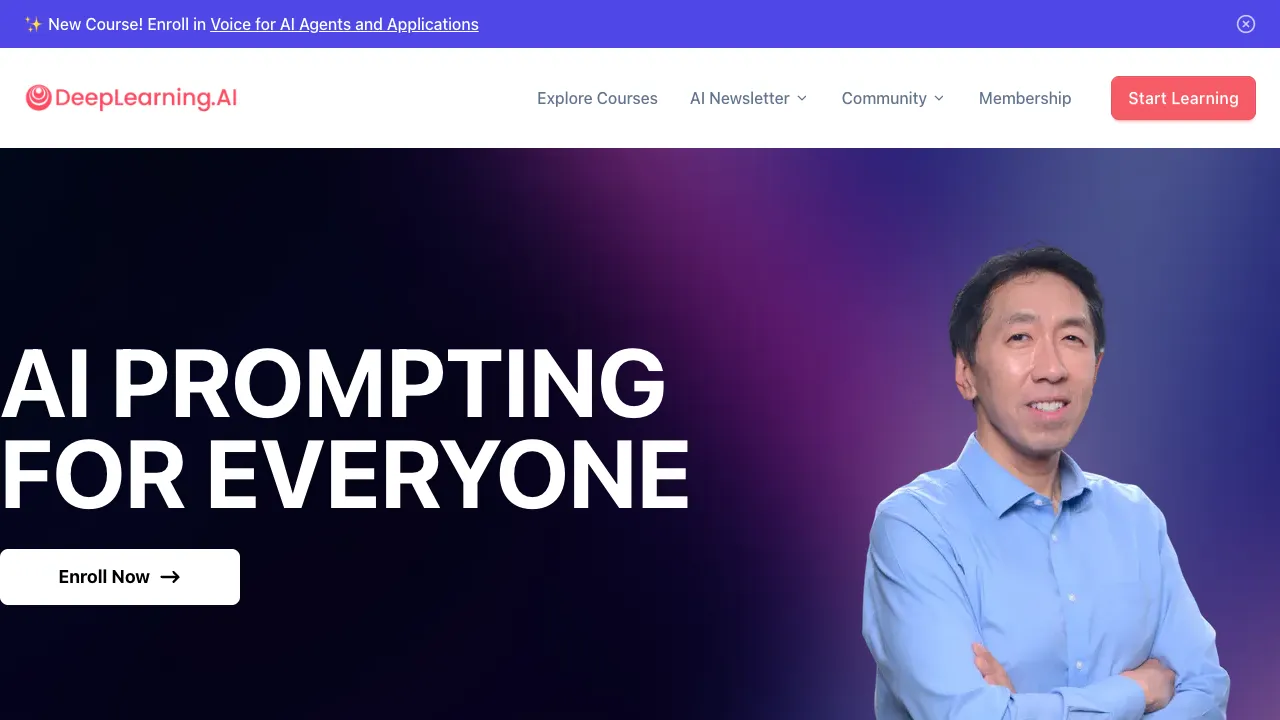
Andrew Ng is one of the most influential figures in AI education—his Machine Learning course at Stanford is among the most enrolled courses in Coursera’s history, helping millions of people worldwide get started with machine learning. DeepLearning.AI is the AI education company he founded in 2017, systematically bringing AI education from universities to the internet.
What Is DeepLearning.AI?
DeepLearning.AI (deeplearning.ai) is an AI professional education platform founded by Andrew Ng. It primarily offers courses through Coursera and also has its own short-course platform. Course content covers deep learning fundamentals, natural language processing, computer vision, MLOps, large language model applications, and more. It is known for its practice-oriented approach and high-quality instructional design.
Unlike general AI popular science content, DeepLearning.AI’s courses have clear technical depth—they actually teach you how to train neural networks, tune hyperparameters, and build ML engineering pipelines, rather than just explaining concepts.
Main Course System
Deep Learning Specialization
This is DeepLearning.AI’s foundational course, a specialization consisting of 5 courses covering:
- Foundations of Neural Networks: Principles and implementation of forward propagation, backpropagation, and gradient descent
- Improving Deep Neural Networks: Hyperparameter tuning, regularization, batch normalization, and optimizers
- Structuring Machine Learning Projects: How to properly organize ML projects, evaluate models, and improve performance
- Convolutional Neural Networks: Core technologies for computer vision
- Sequence Models: RNNs, LSTMs, attention mechanisms, and their applications in NLP
The distinctive feature of this course is that even without a strong mathematical background, Ng’s explanations allow you to understand these concepts. Additionally, all programming assignments are completed in Jupyter Notebooks within the browser, eliminating the need to configure your own environment.
Machine Learning Specialization
An introductory course updated in collaboration with Stanford, using Python and scikit-learn. It is suitable for those with no prior ML background and serves as a preparatory course before entering the Deep Learning Specialization.
Natural Language Processing (NLP) Specialization
A 4-course specialization that systematically covers the NLP technology stack, from word embeddings to Transformers.
MLOps Specialization
Focused on machine learning engineering—how to deploy ML models to production, monitor model performance, and build ML pipelines. This area has high industry demand but relatively few learning resources; DeepLearning.AI’s MLOps specialization is one of the few comprehensive courses available.
Short Courses
In recent years, DeepLearning.AI has launched numerous 1–3 hour short courses targeting specific technologies or tools—LangChain development, RAG technology, prompt engineering, fine-tuning large models, using various AI APIs, and more. These short courses update very quickly, often releasing corresponding courses within months of a new technology emerging, making them a rapid-entry resource for understanding the latest AI applications.
Comparison with Other AI Learning Platforms
vs. Other ML Courses on Coursera: DeepLearning.AI’s courses are originally hosted on Coursera, but other institutions also offer ML courses there with varying quality. Ng’s courses are renowned for clear explanations, accessible depth, and well-designed practical components, making them a recognized high-quality choice.
vs. fast.ai: fast.ai’s teaching philosophy is entirely different from DeepLearning.AI’s—fast.ai follows a “practice first, theory later” approach, starting directly with PyTorch to run models before understanding the underlying principles. DeepLearning.AI follows a “understand principles first, then practice” path. Both approaches have their audiences; those with strong self-learning abilities who prefer learning by doing may suit fast.ai better, while those needing a systematic theoretical understanding before hands-on work may prefer DeepLearning.AI.
vs. Udacity: Udacity’s AI-related courses offer Nanodegrees with mentor support at a significantly higher price point. DeepLearning.AI offers comparable quality at a lower cost, and its core courses often include an audit (free auditing) option.
vs. University Open Courses (MIT OpenCourseWare, Stanford CS231n, etc.): University open courses are free and offer greater content depth, suitable for those with strong self-learning motivation. However, their course structure is less organized than DeepLearning.AI’s, they lack specifically designed programming assignments, and tracking progress is more difficult.
vs. Self-Study on Bilibili: Bilibili hosts a vast amount of translated AI courses and free classes from domestic instructors, with varying quality. DeepLearning.AI provides clear high-quality assurance, backed by Andrew Ng himself.
Who Is DeepLearning.AI For?
Engineers wanting to systematically learn AI from the basics: Those with programming foundations (knowing Python) who want to truly understand how neural networks work, rather than just calling APIs, will find the Deep Learning Specialization one of the best starting points.
Product managers and technical decision-makers: Those who don’t need to build models themselves but need to understand AI’s capabilities and limitations to evaluate technical solutions and communicate with engineers will find DeepLearning.AI’s conceptual explanation courses highly suitable.
Engineers wanting to learn LLM application development: The short course system contains extensive practical content on LLM application development, covering hot technologies like LangChain, RAG, and Agents, making it a great resource for quickget started (getting started).
Beginners in AI research: Students preparing to conduct research in AI will find the Deep Learning Specialization essential for understanding the technical details in academic papers.
Pricing
DeepLearning.AI’s courses are provided on Coursera. Most courses offer a “free audit” option, allowing you to watch videos but not complete assignments or receive certificates. Obtaining a full certificate requires a subscription; a Coursera Plus subscription allows unlimited access to most courses.
Most short courses on the short-course platform (learn.deeplearning.ai) are free, making it one of the lowest-barrier ways to learn about the latest AI technology applications.
DeepLearning.AI is an important infrastructure for AI technology learning. Andrew Ng’s teaching standards and course update speed have maintained its continuous influence in the AI education sector, making it a platform that anyone seriously interested in learning AI technology should know.