

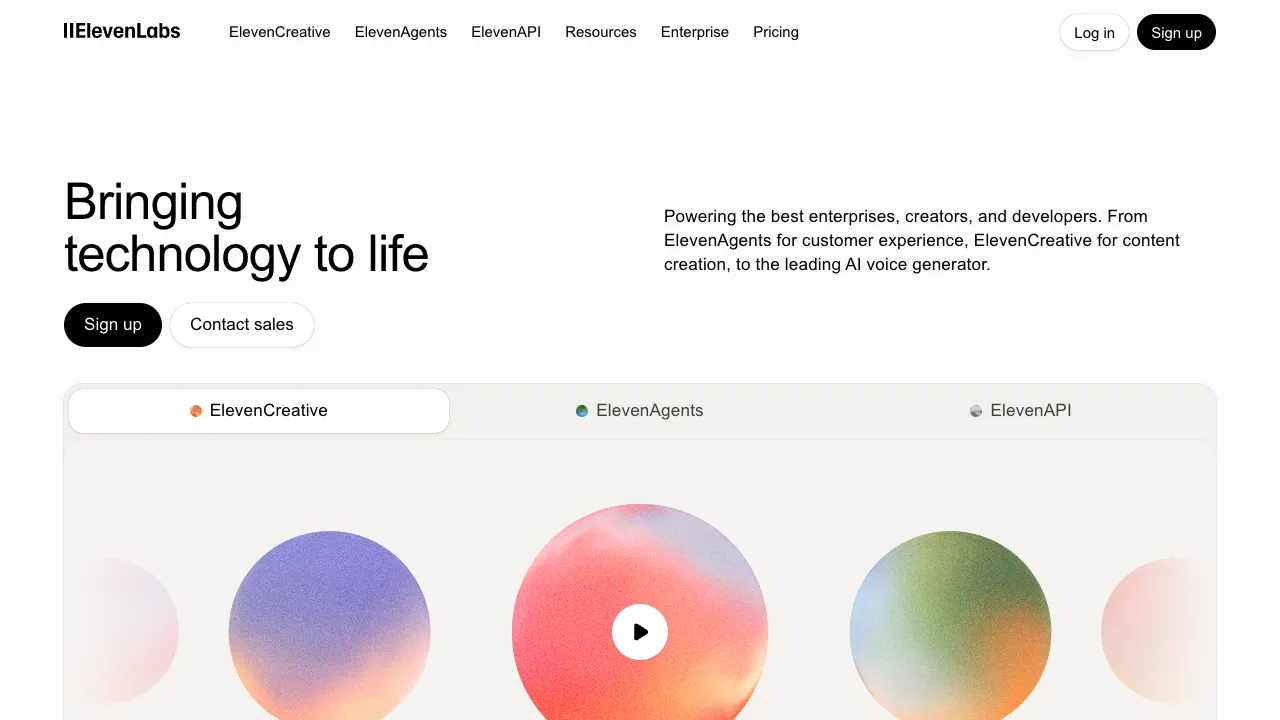
The field of AI speech synthesis is advancing rapidly, yet most products still sound distinctly "robotic"—flat, uniform, and devoid of emotional inflection, making it immediately obvious that they aren’t human. ElevenLabs is one of the few tools that can genuinely blur the line between real and artificial voices. Founded in 2022, it has become the most professionally recognized tool in the AI voice industry within just two years, widely used by podcasters, audiobook producers, game developers, film dubbing artists, and various other content creators.
What is ElevenLabs?
ElevenLabs is an AI voice generation platform with core capabilities including:
Text-to-Speech (TTS): Converts text into highly natural-sounding speech, offering a wide selection of pre-made voices or the ability to clone your own voice.
Voice Cloning: Upload a few minutes of real audio, and the AI learns the vocal characteristics to generate speech for any text using that cloned voice.
Multilingual Dubbing: Supports dozens of languages, allowing you to generate versions in different languages using the same voice, or translate and dub video content into other languages.
Conversational AI: Build AI agents capable of real-time voice interaction, suitable for customer service, education, voice assistants, and similar scenarios.
Core Capabilities Explained
Voice Quality: The Real Gap
What exactly makes ElevenLabs’ voice quality stand out? The key lies in its semantic-level understanding of language rather than phoneme-level processing. It doesn’t just convert text to corresponding sounds; it understands the emotion and intent behind the passage, adjusting tone, pauses, and stress accordingly.
Consider this example: The phrase "I don't know" spoken with a "resigned sigh" in one context will have a completely different intonation than when spoken with "curious inquiry" in another. ElevenLabs automatically adjusts to these contextual nuances instead of generating a monotonous, uniform reading tone.
This represents the most fundamental gap between it and most competitors.
Voice Cloning
This feature is one of ElevenLabs’ most impressive aspects, as well as its most controversial.
Instant Voice Cloning: Upload a few minutes of audio (the better the recording quality, the more accurate), and generate a clone in seconds. The cloned voice achieves very high fidelity when used for TTS generation.
Professional Voice Cloning: Upload more material (over 30 minutes) to generate higher-quality clones with greater detail and similarity to the original voice, suitable for professional scenarios requiring high-fidelity reproduction.
Voice cloning has a dual nature: for content creators, it means generating large volumes of content in their own voice without recording each time; however, it has also been used to create fake audio. ElevenLabs imposes certain restrictions on voice cloning (such as requiring confirmation that you have permission to clone the voice), but enforcement is limited in practice.
Multilingual Capabilities
ElevenLabs supports 29 languages, including English, Chinese, Japanese, Korean, Spanish, French, and others. Its multilingual quality varies—English is the best, while other languages show gaps depending on training data volume—but major European and Asian languages generally perform well.
A useful feature called "Speech Translation" allows you to upload a video or audio file, translate the speech into another language, and re-dub it while preserving the original speaker’s vocal characteristics as much as possible. This is highly valuable for creators producing multilingual content.
Emotional Control
By adjusting generation parameters, you can control the emotional tone of the generated speech—making it warmer, more formal, more excited, or adding "instability" to sound more natural rather than overly smooth. These adjustments are particularly useful when creating podcasts, audiobooks, and commercial voiceovers.
Who Uses ElevenLabs?
Audiobook and Podcast Producers: This is one of the largest user groups. Converting text into audiobooks or using AI to generate certain podcast segments significantly reduces recording and post-production costs. Some authors use it to create audiobook versions of their books.
Video Content Creators (YouTube/Short-form Video): Those who don’t want to appear on camera, have difficulty recording, or need multilingual versions find AI dubbing solves these problems. Many YouTube channels already use AI voice for narration.
Game Developers: Previously, dubbing NPCs required hiring voice actors and booking studio time, which was costly and cumbersome to modify. AI voice allows indie developers to give characters distinct voices, with dialogue changes requiring only a new audio generation.
Corporate Training and Product Tutorials: Creating training videos, product demos, and educational content using AI voice instead of human recording drastically reduces modification costs (just edit the text; no need to re-record).
Developers: ElevenLabs offers an API that many applications integrate for voice assistants, read-aloud features, and accessibility aids.
Comparison with Competitors
vs. Azure TTS / Google TTS: Microsoft and Google’s TTS services cover more languages and are cheaper, making them suitable for large-scale B2B integration. However, ElevenLabs clearly outperforms them in vocal naturalness and emotional expression, making it better suited for high-quality content creation.
vs. Murf, Descript: Murf and Descript are more comprehensive audio-video creation platforms that also include TTS features. ElevenLabs focuses exclusively on voice quality, pushing this core capability to the extreme, while its other editing features are relatively weaker.
Pricing
- Free Plan: 10,000 characters per month, access to most features, 3 custom voices
- Starter ($5/month): 30,000 characters/month, 10 custom voices
- Creator ($22/month): 100,000 characters/month, instant voice cloning, unlimited commercial use rights
- Pro ($99/month): 500,000 characters/month, professional voice cloning, higher priority processing
- Scale ($330/month): 2,000,000 characters/month, enterprise-grade features
For individual content creators, the Creator plan ($22/month) offers good value; 100,000 characters is roughly enough to generate an audiobook version of a 100,000-word book.
Usage Tips
Text formatting affects generation quality. Punctuation is crucial: commas create brief pauses, periods create full stops, and exclamation marks increase tonal intensity. If you want specific pause effects, add the correct punctuation in the text rather than expecting the AI to guess.
Test multiple voices before deciding. ElevenLabs has hundreds of preset voices; browsing through them to find one that matches your content’s tone is far better than picking randomly and regretting it later.
Keep segments under 2,500 characters. Very long text can sometimes degrade in quality; generating in segments and stitching them together yields more stable overall quality.
Use high-quality recordings for cloning. For voice cloning materials, use clear recordings made in quiet environments; excessive background noise will affect cloning quality.
Copyright and Ethics
ElevenLabs’ voice cloning feature exists in a complex gray area legally and ethically. Cloning your own voice is fine; using someone else’s voice requires explicit authorization; using it to create fake content (impersonating others, spreading misinformation) is explicitly against terms of service and potentially illegal.
When using the platform, ElevenLabs requires users to confirm they have the appropriate permissions for the cloned voice, but this relies primarily on user self-regulation. Extra caution is needed when using voices belonging to others.
ElevenLabs represents the current peak of AI voice technology—quality is good enough, features are complete enough, and for users with content creation needs, it is likely the most worthwhile voice tool to try today.