

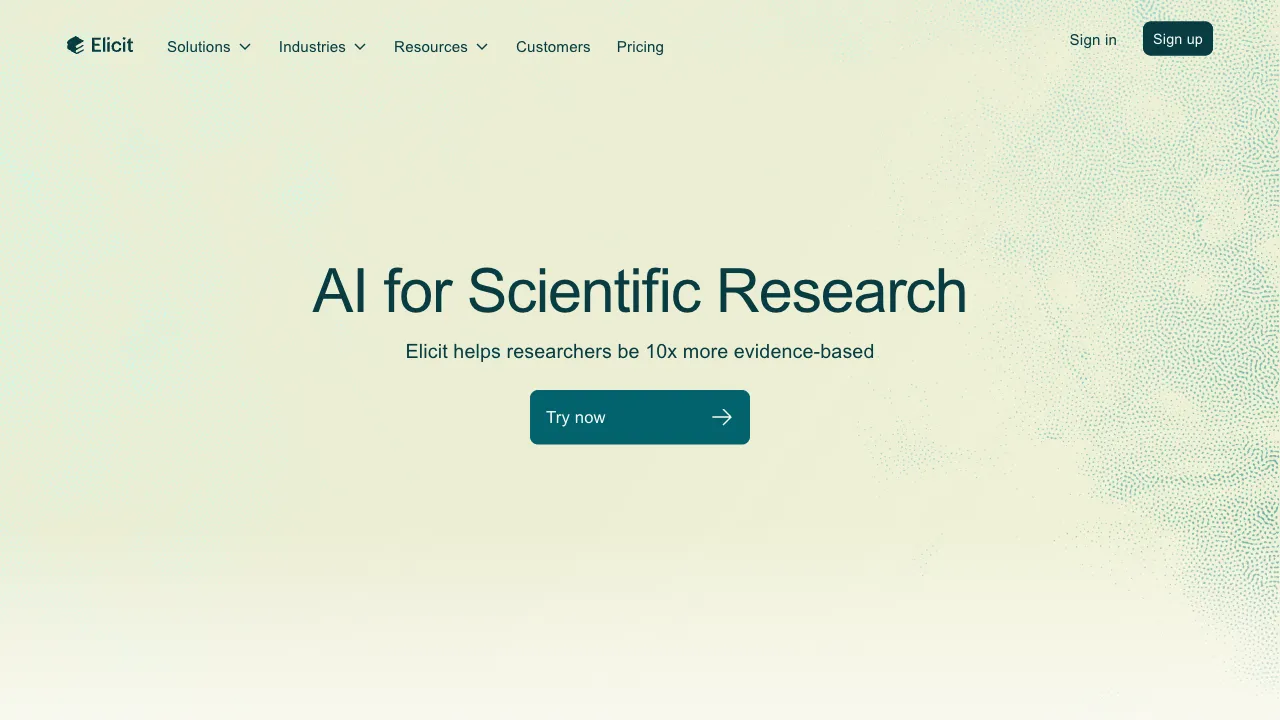
Anyone who has conducted academic research or literature reviews knows the process well: searching for dozens of relevant papers, reading their abstracts one by one, determining which ones align with your research, extracting key information, and synthesizing it all. This process is mechanical and time-consuming. Elicit is an AI research tool designed specifically to accelerate it.
What Is Elicit
Elicit is an AI-powered academic research assistant focused on literature retrieval and information extraction, catering to researchers, graduate students, analysts, and others who need systematic literature reviews. Its backend integrates the Semantic Scholar academic database and uses AI to extract, summarize, and compare content across papers.
It currently offers a free tier (with feature limitations) and paid plans, primarily accessible via its web interface.
Core Features
Academic Literature Search
Enter a research question in natural language (exact keywords are not required), and Elicit searches academic databases for relevant papers, returning results sorted by relevance.
It understands semantic relevance, not just keyword matching. For example, if you ask about "the impact of stress on memory," it will find papers describing this topic using various different terms, rather than only those containing those specific words.
Automatic Extraction of Key Paper Information
This is Elicit’s most core feature. For each paper, it automatically extracts key details and presents them in a table format:
- Publication year, authors, and journal
- Research question
- Methodology (experimental design, sample size, measurement methods)
- Main findings and conclusions
- Limitations
These details are arranged in a table, allowing you to quickly compare different aspects of multiple papers side-by-side. You can view key information directly from the table without opening each paper individually.
Custom Extraction Columns: You can customize the specific information you want extracted. For instance, if you are researching clinical trials for a drug, you can set columns to extract "sample size," "study population," "treatment dosage," and "side effects." Elicit will pull this corresponding information from each paper and populate the table.
Paper Summary Generation
For individual papers, Elicit generates concise summaries that distill the core research question, methodology, and findings, helping you quickly decide whether a paper is worth reading in depth.
Literature Review Support
When multiple papers are grouped together, Elicit can generate a comprehensive summary of the collection—highlighting similarities and differences between studies, key points of contention, and research gaps. This serves as an excellent starting draft for literature reviews.
Tracking Related Literature
For promising papers you find, Elicit identifies related works that cite them and those they cite in turn, helping you discover foundational classics and the latest developments in your field.
Difference from Google Scholar
Google Scholar is a literature search engine that provides a list of results for you to read yourself. Elicit is an AI assistant that helps you "read" the literature by directly extracting the information you need and organizing it into a usable format.
The two are complementary: Google Scholar finds the literature, while Elicit helps you digest it.
Difference from Semantic Scholar
Elicit uses the Semantic Scholar database, so there is overlap in the data layer. However:
- Semantic Scholar is a literature indexing platform that provides citation graphs and trend analysis.
- Elicit is an AI information extraction tool focused on pulling specific information you need directly from paper content.
Who Is It For
Graduate Students and PhD Candidates: Conducting literature reviews is foundational to research work. Elicit significantly boosts efficiency in this process—what used to take days of reading dozens of papers can now be completed in a few hours using Elicit’s table features to build an initial literature map.
Academic Researchers: Entering a new research field requires quickly establishing a literature foundation. Elicit helps you find the most relevant papers and understand their main findings in minimal time.
Systematic Review and Meta-Analysis Practitioners: These studies require systematic screening of large volumes of literature and information extraction. Elicit’s batch extraction features are ideally suited for this scenario.
Analysts in Healthcare and Policy: Professionals who need to make judgments based on evidence often need to quickly extract answers to questions like "What is the evidence base for this intervention?" or "Do the sample sizes and populations of these studies align with my context?"
Limitations
Limited Database Coverage: Elicit primarily covers English academic literature indexed in Semantic Scholar. Coverage of Chinese journals is very limited, making it unsuitable for research focused mainly on Chinese literature.
Extraction Accuracy Is Not 100%: AI-extracted information may occasionally contain errors or omissions, particularly regarding the understanding of complex methodologies. Important information should always be verified against the original text.
English-Only Interface: There is a learning curve for users not accustomed to English-language tools.
Restrictions on Paid Features: The free tier limits the number of papers you can process. Full functionality requires a paid subscription (starting at $12/month).
Practical Usage Recommendations
Search using research questions, not keywords. Instead of searching for "stress memory," try "Does cortisol affect long-term memory consolidation?" Framing your search as a research question allows Elicit’s semantic understanding to work more effectively.
Set extraction columns around your research question. Alongside standard extracted fields, you can define what to look for in a batch of papers. List the questions first, then set columns that help you compare the findings.
Use Elicit for initial screening, not as a replacement for reading. Use Elicit to quickly scan through a large volume of literature and identify the 10–20 most relevant papers for close reading, rather than relying entirely on AI extractions to skip reading the original texts.
Export tables to Excel for further processing. Elicit’s tables can be exported; you can then perform more complex filtering and analysis in Excel, which fits well into the literature management workflow of a systematic review.
Elicit is currently one of the most practical AI tools for academic literature processing, particularly for its ability to handle large batches of English-language papers—a capability that traditional literature management methods cannot match. If your research is based on English literature, it is worth trying out seriously.