

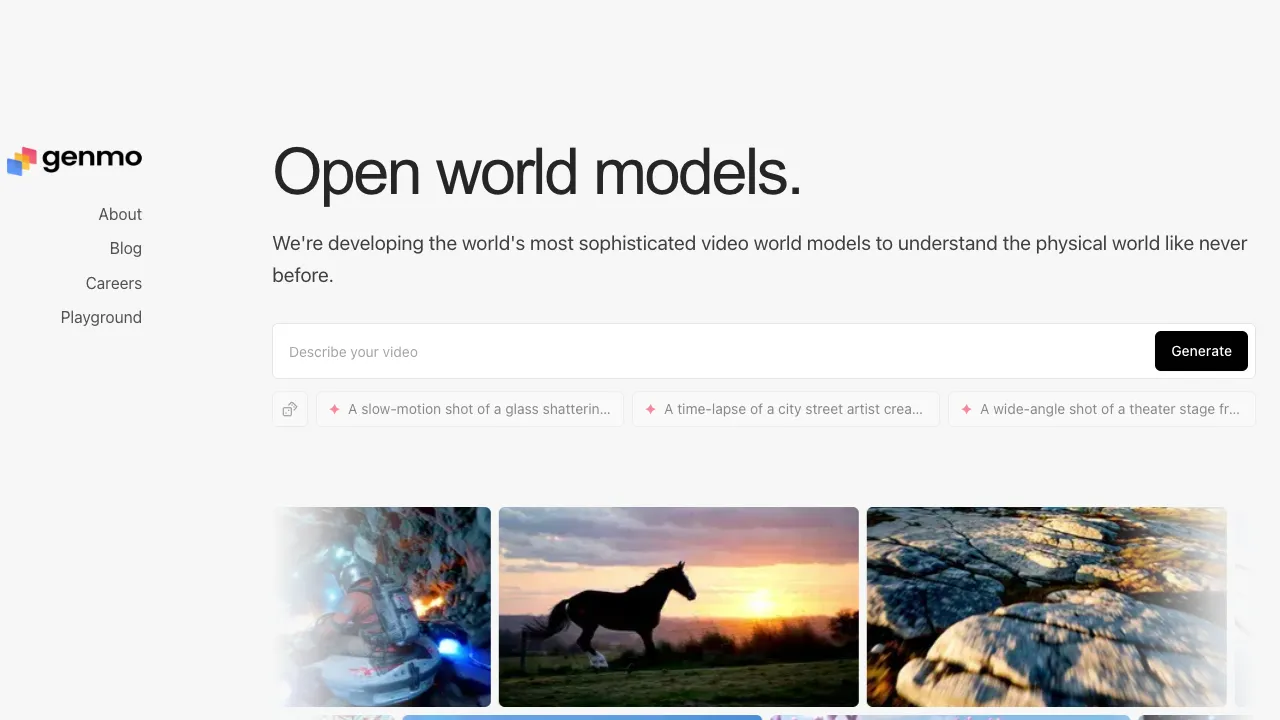
In October 2024, a pivotal shift occurred in the AI video generation landscape: while Runway, Pika, and Sora locked their models behind proprietary servers charging by the second, a company named Genmo open-sourced its entire video generation model, Mochi 1—releasing billions of parameters under an Apache 2.0 license for commercial use directly on Hugging Face. This move was to AI video what Stable Diffusion was to image generation: the first viable open-source foundation for video creation.
So when we talk about Genmo today, the real protagonist isn’t its web product, but Mochi’s open-source path—it has turned “deploying your own video generation model” from a fantasy into something achievable if you have a powerful enough GPU.
What is Genmo?
Genmo (genmo.ai) is a company focused on AI video generation, founded by a research team with Berkeley roots. It offers two product lines:
Mochi Model (Open Source): A self-developed video generation model. Mochi 1 was open-sourced using its ~10 billion parameter AsymmDiT architecture, focusing on motion fluidity and prompt adherence—the two classic failure points of AI video (glitchy character movements and unresponsive visuals) are precisely the targets of its training optimization.
Genmo Platform (Online): The official hosted web interface, allowing users to generate videos with Mochi without needing their own hardware. It features an early-accumulated “conversational creation” interaction—a progressive workflow of text-to-video, iterative text-based editing, and image-to-video.
Core Features
Text-to-Video
Input English prompts to generate several seconds of video clips. Mochi 1 has two relative strengths:
Motion Quality: Movements of characters and objects are coherent and natural. The uncanny valley elements of early AI video—such as limb disintegration and frame-to-frame jumping—are significantly suppressed. This was the primary metric used to benchmark it against commercial models upon its open-source release.
Prompt Adherence: The visual content adheres closely to textual descriptions. The controllability of “getting what you ask for” is more valuable for creators needing precise output than “randomly stunning” results.
Conversational Iterative Creation
A legacy of Genmo’s early product form and the source of its name implying “more creative”: if you’re unsatisfied with the initial generation, continue refining it using natural language—“change the sky to sunset,” “slowly zoom in,” “convert the whole scene to watercolor style”—progressively approaching the desired image. This aligns better with creative intuition than betting on a single perfect prompt.
Image-to-Video
Use a static image as a starting point to impart motion, paired with a two-stage workflow of image-first then video: finalize composition and style in the image stage, then animate it. This offers finer control granularity than direct text-to-video generation.
Open-Source Deployment (For Technical Users)
Mochi 1 weights are public. Users with sufficient VRAM can deploy locally, and the community has quickly followed up with quantized versions and ComfyUI integrations—meaning unlimited generation, privacy control, and fine-tuning customization. These three features are unavailable in any closed-source service and are the source of Mochi’s buzz in the developer community.
Comparison with Similar Tools
vs Runway/Pika: The leaders of the closed-source commercial camp, with mature product completion, higher video quality ceilings, and comprehensive toolchains (editing, lip-sync, VFX). Genmo’s platform is less polished, but Mochi’s open-source nature is a dimension they lack. Choose commercial products for out-of-the-box productivity; choose Mochi for autonomy and control.
vs Kling/Jimeng (Chinese Domestic): The quality of domestic video models has improved rapidly, with seamless access within China, making them the practical mainstay for Chinese users. Genmo’s significance remains its open-source nature—domestic platforms are also closed-source services.
vs Sora: OpenAI’s benchmark work, offering a quality ceiling but with high barriers to entry. Genmo is a pragmatic option: “usable now and deployable yourself.”
vs Open-Source Peers (HunyuanVideo, LTX-Video, Wan, etc.): Since Mochi opened the floodgates, open-source video models have become increasingly active. Later entrants like Tencent’s Hunyuan Video have already surpassed it in some metrics. The iteration speed of the open-source track is both brutal and exciting. Mochi’s historical status (being the first to open-source a high-quality video model) and its current competitiveness must be evaluated separately. For self-deployment selection, it is recommended to compare against the latest community benchmarks.
Who Should Care About Genmo?
Technical Developers and Researchers: Mochi’s open-source weights are high-quality raw material for researching video generation, performing custom fine-tuning, and building proprietary video pipelines—this is Genmo’s core audience.
Teams Requiring Private Video Generation: In scenarios where data cannot leave the premises or generation volumes make API fees painful, deploying an open-source model locally is the only solution. Mochi is a frequent candidate on such lists.
AI Video Early Adopters and Creators: The online platform offers free credits for experimentation, and its conversational iterative interface is friendly to exploratory creation.
Observers of the Open-Source AI Ecosystem: Whether the “SD moment” for video generation has arrived and whether open source can replicate the comeback seen in image generation—Genmo/Mochi is a key observational sample for this proposition.
Limitations
Video duration is short (seconds-level); long-form content requires stitching. Complex scenes (multi-subject interactions, fine hand details) remain a common challenge for all video models, including Mochi.
The quality gap with first-tier commercial models objectively exists. Under commercial delivery standards, Runway and Kling are still more reliable choices.
The VRAM threshold for local deployment is not low (the original version requires high-end GPUs, though quantized versions alleviate this somewhat). “Open source” does not mean “everyone can run it.” Additionally, accessing the online platform from within China requires specific network conditions.
Pricing
Two lines: open source and hosted.
Open source: Mochi 1's full weights and code are free to download from Hugging Face under Apache 2.0, covering 480p generation (a 720p Mochi 1 HD was announced as a follow-up). The cost is hardware — running it locally reportedly needs at least four Nvidia H100 GPUs, which puts it beyond individual machines.
Hosted (credit-metered):
- Free: up to 2 videos a day (about 30 a month), Genmo watermark, non-commercial use only, standard queue priority
- Lite, $10/month: 1,200 credits, which the vendor puts at roughly 12 Mochi videos
- Standard, $30/month: 5,000 credits with commercial usage, no watermark, highest queue priority and early access to selected models
The pricing page counts a Mochi video as 100 credits and a Replay video as 50. Third-party accounts of the Lite tier conflict (one describes 8 videos a day with no watermark and commercial rights), so check the official page before paying.