

Many people assume that "AI writing" is a new phenomenon emerging only after ChatGPT. In reality, long before the explosion of large language models (LLMs), a batch of domestic companies had already beendeep cultivationing (deeply cultivating) the path of "machine writing" for years. GIISO (Zhise) is one of the most senior among them: founded in Shenzhen in 2013, this company started with robot-written press releases and has served numerous media organizations. It ran nearly a decade ahead of the entire LLM era in the realm of "automated content production." This origin defines its product ethos: it does not chase the flashy tricks of conversational AI but instead doggedly focuses on the batched, scenario-based production of content—which is precisely the most authentic demand shape of the media and content operations industry.
What is GIISO?
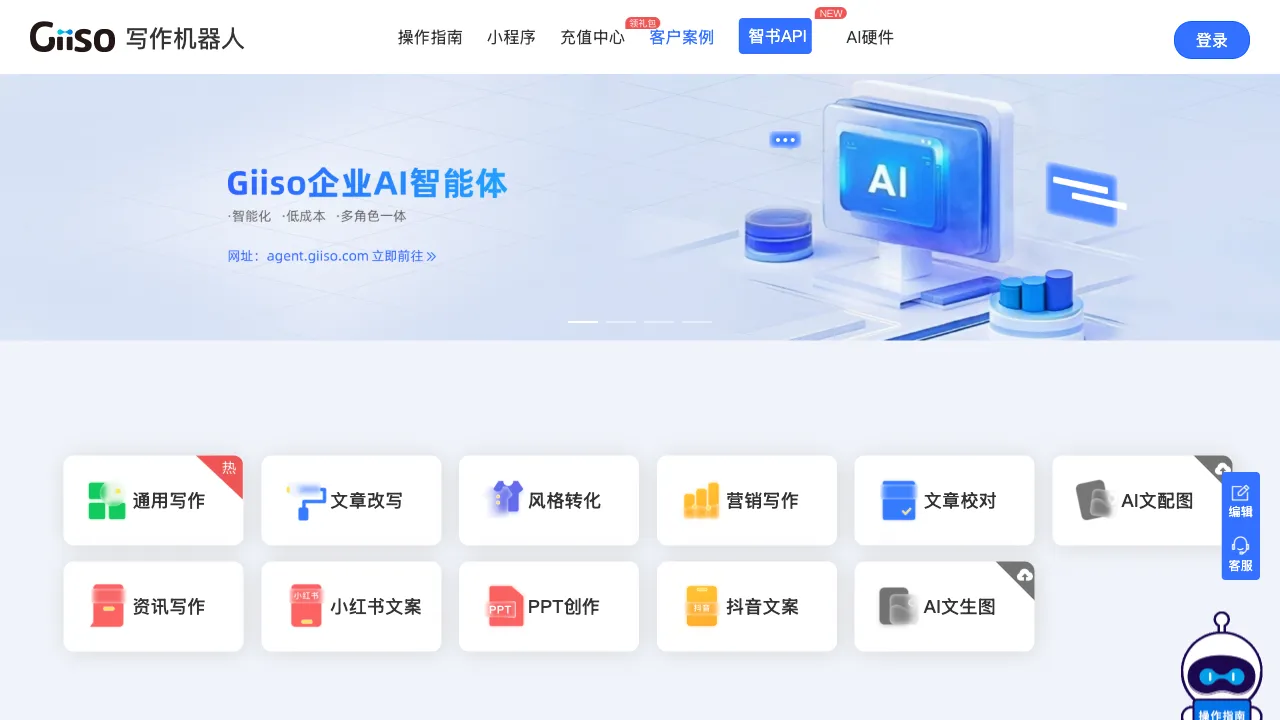
GIISO Writing Robot (giiso.com) is an AI writing platform designed for content production scenarios. Its core users are media practitioners, content operations teams, SEO webmasters, and corporate brand communicators—their common characteristic being that "writing is not creation; it is capacity." The platform’s functions cover article generation, news writing, marketing copy, SEO content, rewriting/paraphrasing, and summary extraction. It uses rich industry scenario templates as its product skeleton: select a scenario, input key points, and generate the final draft. Prompt engineering is pre-built into these templates, allowing users to utilize them with zero threshold.
In the LLM era, it has also completed an engine upgrade, integrating next-generation generation capabilities at its core. The combination of seasoned scenario accumulation with a new engine represents the standard transformation path for such "veterans of the pre-LLM era."
Core Features
Scenario-Based Article Generation
A pre-built generation pipeline based on content type:
News & Information: Its original forte—input event elements to produce articles in press release format. The rules of news writing, such as the inverted pyramid structure and objective tone, are embedded in the templates. For media accounts and corporate accounts that need daily updates on industry dynamics, this is a powerful tool for capacity building.
Industry Analysis & Popular Science: Expands topics into framework-based analytical or knowledge articles, quickly forming "filler-type" content with acceptable information density.
Marketing Soft Articles: Batch drafting for product promotions and brand stories.
Templates are further subdivided by industry (technology, finance, education, health, e-commerce, government affairs, etc.). The expressive conventions and focus points of each industry are pre-buried in the generation logic—this layer of "template-ized industry knowledge" is exactly where its efficiency gap lies compared to using raw LLMs.
Text Rewriting
A high-frequency, rigid demand for content operations: synonym rewriting to reduce repetition rates, Sinicizing translationese, versioning for multi-platform use, and reviving old articles. The depth of rewriting is adjustable: light rewriting preserves structure, while deep rewriting reorganizes paragraphs.
Standard disclaimer: Rewriting for expression diversification and content reprocessing is a legitimate use case; however, plagiarism infringement and academic misconduct are red lines. Platforms and detection technologies are tightening their grip, making the cost of taking chances increasingly high.
SEO Content Production
Keyword-oriented article generation: title keyword placement, body density, and structure align with search engine preferences. For content sites relying on search traffic, mass production of SEO articles is a fundamental survival requirement. The industry standard practice is an AI batch-drafting + human quality-check pipeline—GIISO’s template maturity in this scenario is one of its selling points.
Summaries & Short Video Scripts
Extracting key points from long articles and generating spoken-word scripts. These are supporting processes for content format conversion and handy tools for graphic/text teams expanding into short video production.
Comparison with Similar Tools
vs Metaso Writing Cat: Writing Cat excels in "rewriting"—its editor experience for error correction and polishing is refined. GIISO excels in "production"—the breadth of batch generation and industry templates. For refining single articles, choose Writing Cat; for mass-producing content, choose GIISO. Their positioning is complementary rather than competitive.
vs Biling AI: Both follow the template route. Biling’s templates lean more toward individual workplace needs (summaries, documents), while GIISO leans more toward media and operations institutions (news, SEO). Choose based on your identity.
vs Direct Use of Kimi/Wenxin Yiyan: General LLMs have a higher upper limit and more generous free quotas. Those who know how to write prompts can build their own workflows. GIISO sells the peace of mind that "prompts are written for you + industry conventions are built-in," along with batch processing and management capabilities tailored for institutions. Light individual users can use general LLMs directly; institutional capacity scenarios are GIISO’s home turf.
vs Aichuangzuo and other comprehensive platforms: Each platform has different layouts for integrated text and video. GIISO’s depth remains in the scenario-based production of text content. Selection depends on your primary demand shape.
Who is Suitable for GIISO?
Media & Information Content Teams: A first-draft pipeline under the pressure of daily update capacity. The maturity of its news templates is the capital of a ten-year veteran—the most targeted customer group.
SEO Webmasters & Content Matrix Operators: Scalable production of keyword articles. The standard production line configuration is AI drafting + human review.
Corporate Brand Communication & PR Roles: High-frequency needs for press releases, event drafts, and brand articles. Template-based generation cuts drafting time to a fraction.
Content Operations for Multi-Platform Distribution: Needs for rewriting one draft into multiple versions. Batch tools are far more dignified than manual copying.
Usage Boundaries
An honest industry truth that must be stated clearly: The quality ceiling of AI mass-produced content is "qualified filler," not "something people remember after reading." Content platforms are continuously intensifying their crackdown on low-quality AI content, and search engines are currently de-ranking pages with an "AI flavor"—the dividend period for pure AI pipelines is closing. There is only one sustainable posture: AI handles capacity, while humans inject real information, exclusive viewpoints, and quality control. Treating GIISO as a first-draft engine rather than a final-draft factory is the prerequisite for using it well.
The factual accuracy of generated content must, as always, be verified, especially in news scenarios—throughout the ten-year history of machine writing, factual errors have always been the profession’s greatest occupational risk.
Pricing
Offers free trial quotas; paid plans are tiered by version (individual/enterprise), unlocking more generation word counts, template permissions, and team features. Institutional clients have separate business solutions. Specifics are subject to the official website.
GIISO’s ten-year history itself is a mirror: machine writing has moved from news laboratories into the LLM era. The demand for "automated content production" has always been real; only the engine has changed. If "content output volume" is a KPI number in your work—such legacy tools that embed industry conventions into templates are worth adding to your production line evaluation list. Just remember: machines give you volume, but readers only recognize quality. Only those who grasp both ends can thrive in this round.