

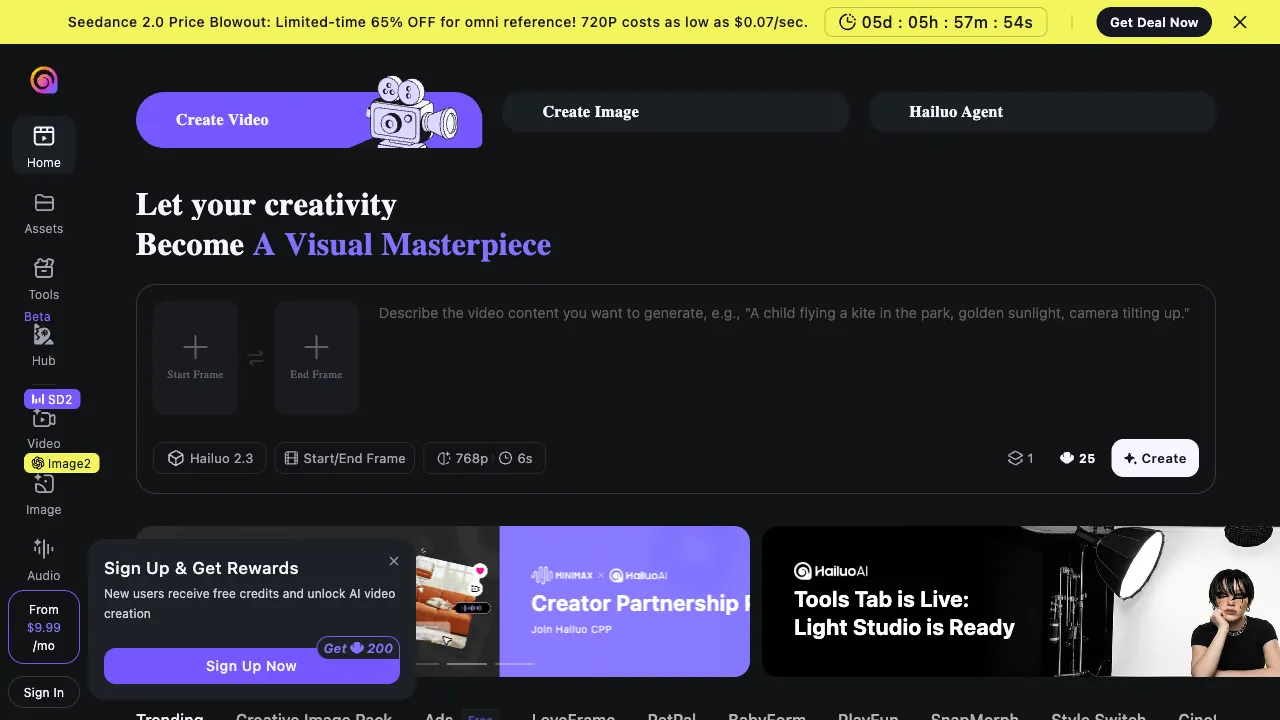
In the domestic AI video generation space, Kling (by Kuaishou) and Hailuo (by MiniMax) are the two most frequently mentioned names. Hailuo AI is developed by MiniMax, one of the earliest Chinese companies to enter the large AI model field, backed by investments from institutions such as Alibaba, and boasting a deep technical foundation in multimodal AI. After its international release (hailuoai.video), Hailuo AI rapidly accumulated a global user base due to its video quality, particularly excelling in the realism of human movement.
What is Hailuo AI?
Hailuo AI is an AI video generation product under MiniMax, offering:
- Text-to-Video
- Image-to-Video
- AI Creative Video features
Its core model is MiniMax’s video generation large model, placing it in the first tier of China’s AI video sector and giving it significant recognition internationally.
Video Quality Assessment
In evaluations of AI video generation tools, Hailuo AI is frequently noted for several characteristics:
Human Realism: Similar to Kling, Hailuo achieves high quality in facial expressions, skin texture, and basic movements for human subjects. Human-centric videos are one of its strengths.
Lighting Effects: The handling of scene lighting is natural. It is particularly adept at complex lighting conditions such as indoor-outdoor transitions, sunsets, and backlighting, offering more nuanced results than some competitors.
Video Coherence: In 6-second clips, scene continuity remains relatively stable, with subjects less prone to strange distortions midway through the clip.
Chinese Scene Understanding: Developed by a domestic team, it accurately understands Chinese prompts, yielding precise results without requiring English descriptions.
Limitations: Like all AI video tools, it still struggles with complex physical interactions, such as multi-person engagement or fine motor skills like picking up objects.
Usage Workflow
Text-to-Video
On the Hailuo AI platform, input a text description:
"A young girl standing by the sea watching the sunset, wind blowing her hair, slow motion, cinematic feel, warm orange tones"
Select resolution (720p or 1080p) and duration (5 seconds or 6 seconds), click Generate, and wait 1–3 minutes.
Image-to-Video
Upload an image and describe how you want it to "come alive." Suitable for:
- Creating dynamic showcases from product images
- Generating subtle animations from portrait photos
- Adding motion camera effects to landscape images
Image-to-Video tends to be more stable than Text-to-Video because the reference image acts as a constraint, reducing randomness.
Featured Feature: Story Video
Hailuo AI offers a "storyboard"-style feature that allows you to set descriptions for multiple scenes, generate separate video clips, and stitch them together into a longer narrative video. This is better suited for content requiring a storyline than single 5–6 second clips.
Domestic Version vs. International Version
- Domestic Version (Hailuo AI/MiniMax Video): Accessed through MiniMax’s various product entry points; seamless access within China and integrated into the broader MiniMax ecosystem.
- International Version (hailuoai.video): A standalone website for global users, offering free quotas and different paid plans.
Domestic users are recommended to use the domestic version directly for easier access and more complete Chinese language support.
Comparison with Competitors
vs. Kling AI (Kuaishou): Both are the primary competitors in China’s AI video space, with similar quality levels. Kling benefits from Kuaishou’s platform and a larger domestic user base; Hailuo has higher internationalization and broader recognition in overseas AI circles. Which is better depends on the specific scenario, so trying both is recommended before deciding.
vs. Runway: Runway offers a more complete toolchain (with extensive video editing features), while Hailuo focuses more intently on video generation itself. Its quality is competitive for human-centric scenes. Hailuo is also more cost-friendly for domestic users.
vs. Sora: Sora may achieve higher quality in certain scenarios but has restricted access. Hailuo offers barrier-free access for domestic users and better cost-effectiveness.
vs. Pika: Pika is simpler with distinctive special effects; Hailuo generally offers higher overall video quality, particularly in human-centric scenes.
Pricing
Hailuo bills across three systems: the web/app subscription, Credits, and API units on the open platform.
Consumer subscription: reworked alongside Hailuo 2 in 2026, starting at ¥68/month and reaching five figures a year at the top tier. The change drew visible pushback — some creators announced they were pausing or moving to other platforms, and the company followed with a video apology and direct outreach.
Open platform API: prepaid credit (unit) packs, with each generation deducting units. At the entry level a ¥7,000 pack carries about 3,680 units; using the most cost-efficient Hailuo-2.3-Fast (768p, 6 seconds, about 0.7 units per generation) that works out to roughly 5,257 clips, about ¥1.33 each.
Gotchas: units are counted monthly and expire with no rollover, and the entry pack caps concurrency at 20 requests per minute, so peak-hour throttling can force an upgrade even with units left. The vendor's own advice: use Hailuo-2.3-Fast for volume, then move to a monthly package once demand stabilises, which brings the unit price from about ¥1.9 down to ¥1.6.
On the model side, MiniMax says Hailuo 2.3 improves output while holding Hailuo 02's prices for both business and consumer users, and that 2.3 Fast generates faster at a lower price, cutting batch creation costs by up to 50%.
Promotions and tiers change often — check hailuoai.com.
Who Is It For?
Short Video Content Creators: Creators on Douyin, Kuaishou, and WeChat Channels who need to quickly generate creative assets, B-roll, or background videos will find Hailuo’s quality sufficient for direct publishing.
Marketing and Brand Video Production: For generating assets for product showcases and brand promotional videos, Hailuo’s lighting quality and human realism are adequate for commercial scenarios.
General Users Trying AI Video: With easy domestic access and free quotas, Hailuo is a low-barrier entry point for those wanting to experience AI video generation.
Creators Needing Human-Centric Scenes: If your content frequently involves people, Hailuo’s performance in this scenario is the core reason to choose it.
Usage Tips
Use Chinese prompts directly for good results. There is no need to translate descriptions into English; its understanding of Chinese is already highly accurate.
Add photography style descriptions. Terms like "cinematic," "shallow depth of field," "slow motion," or "aerial view" can significantly enhance the video’s texture.
Try Image-to-Video first. When a reference image is available, Image-to-Video offers higher stability and results closer to expectations.
Generate multiple times. AI video has high randomness; the same prompt yields different results each time. Running it several times and selecting the best outcome is standard practice.
Hailuo AI is an important competitor in China’s AI video generation field, matching Kling in quality and representing the upper limit of domestic AI video technology. For domestic users, both are worth keeping in their toolkit, with selection depending on the specific scenario.