

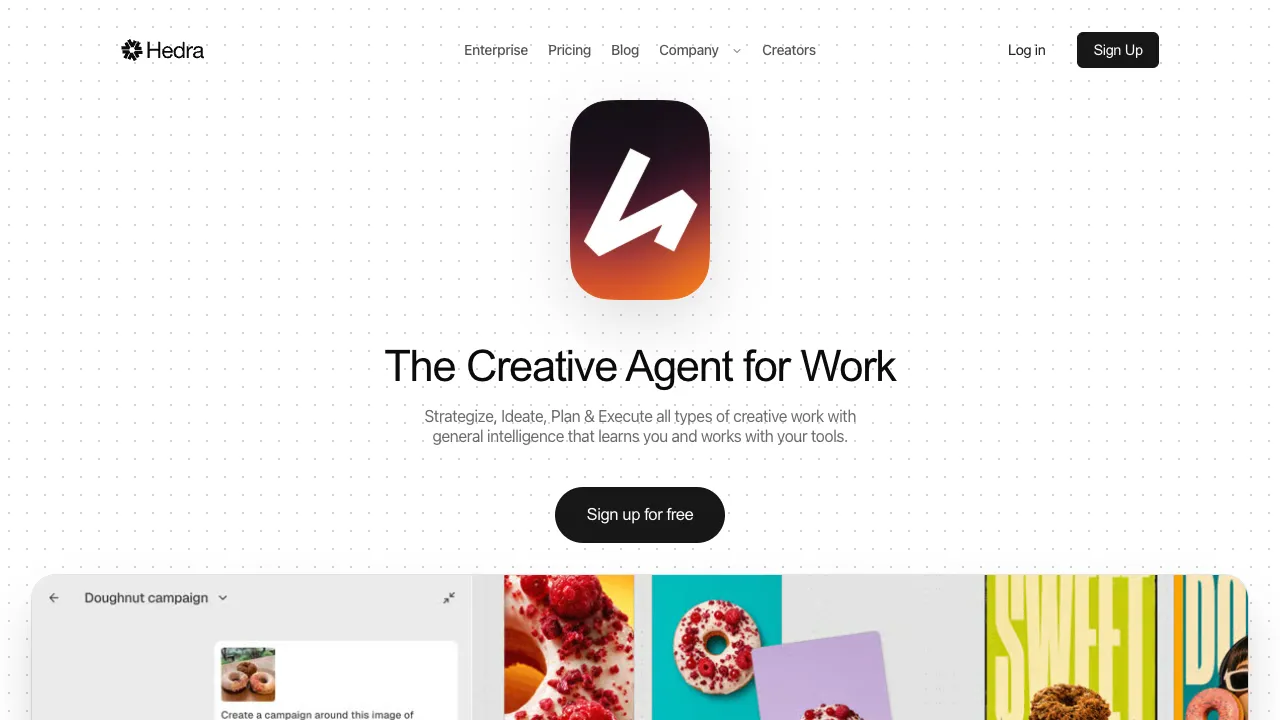
The talking portraits in Harry Potter were once pure magical fantasy; in the visual effects industry, making a static face speak has been an expensive craft billed by the second—requiring CGI teams, motion-capture equipment, and frame-by-frame lip-sync adjustments. Now, AI has crushed the cost curve to the floor: upload a photo of a face, provide some text, and within minutes, that face speaks naturally in a video.
Hedra is a representative product in this "talking portrait" space, gaining fame in the AI creation community in 2024 with its Character series models. The speaking figures it generates do more than just move their mouths; head posture, blinking, and micro-expressions of the eyebrows and eyes rise and fall with the emotional tone of the voice. Its vividness ranks among the top tier among similar tools, and its ability to generate long videos (several minutes at a time rather than just seconds) was its signature differentiator at the time.
What is Hedra?
Hedra (hedra.com) is the namesake product of an AI video startup, with core capabilities in audio-driven character video generation: input a character image (real photos, AI-generated portraits, illustrations, or cartoon characters are all acceptable) + audio (or text synthesized via built-in TTS), and output a video of that character speaking—lip-sync is precisely synchronized with the audio, and facial expressions and head movements naturally echo the rhythm and emotion of the voice.
Its proprietary Character series foundation models are the technical core of the product, with iterative directions always focused on longer durations, higher fidelity, and full-body character performance generation.
Core Features
Image + Audio = Talking Character Video
The main workflow involves four steps: upload a character image → provide audio (upload or text-to-speech) → generate → download.
Highlights of the generation quality include:
- Lip-sync precision: Phoneme-level mouth shape matching aligns well with Chinese, English, and other languages, effectively controlling any sense of dissonance.
- Performance beyond the mouth: Blinking, nodding, eyebrow raises, and subtle shifts in gaze—these "signs of life outside the mouth" are the dividing line between cheap lip-sync tools and Hedra. The emotion in the voice (excitement, low tone) is reflected in the amplitude of facial expressions.
- Long-duration generation: Supports generating continuous speaking videos lasting several minutes at a time. For creators making serious content rather than short meme clips, this is a fundamental difference in practicality.
Built-in Text-to-Speech
When you don’t have ready-made audio, input your script, select a voice tone, and synthesize directly. Multiple style options are available, keeping the entire process within the platform. You can also integrate audio from professional TTS services like ElevenLabs for higher voice quality.
Broad Image Style Compatibility
Realistic portraits yield the best results, but AI-generated characters (Midjourney faces), illustrations, and 3D cartoon characters can also be driven. This gives creators a complete pipeline to "fabricate a virtual streamer from scratch": generate an image with MJ → dub it with ElevenLabs → bring it to life with Hedra.
Multi-Aspect Ratio Output
Supports vertical (9:16), square, and horizontal formats, adapting to short-video platforms and traditional video scenarios.
Typical Use Cases
Virtual Streamers / Faceless Creators: Create an AI avatar for your account to replace a real person on camera—knowledge sharing, news commentary, or e-commerce explanations. This is the primary source of genuine demand for this type of tool.
Education and Corporate Content: Instructor image + course audio = lecture video; brand IP characters introduce products, making mascots speak for the first time.
AI Short Films and Narrative Creation: In the wave of AI video creation, character dialogue shots have always been a pain point (pure text-to-video struggles to control speaking scenes). Hedra serves as the "dialogue shot solution" for countless AI short film creators.
Podcast Video Conversion: Pair podcast audio with a host’s image to generate a video version, enabling dual-platform distribution from a single piece of content.
Entertainment Memes: The joy of making any character say any line needs no further explanation.
Comparison with Similar Tools
vs HeyGen: HeyGen is the commercial benchmark in the digital human space, with real-person cloning and video translation as its ace cards, mature for enterprise marketing scenarios. Hedra’s strength lies in the flexibility of "driving any image" and performance vividness, making it more popular among creators. Choose HeyGen for official corporate content; choose Hedra for creative and virtual character content.
vs D-ID: An early player in the photo-speaking space with a mature API ecosystem. However, its classic effect—"moving mouth, stiff face"—has an obvious puppet-like feel. This generation of Hedra’s models has a generational advantage in performance naturalness.
vs Jimeng/Kling Lip-Sync Features: Domestic video platforms are also catching up on audio-driven capabilities, offering friendly domestic access and integration with their generation ecosystems. In terms of specialized performance quality and duration capabilities, Hedra still holds an early-mover depth. Domestic users can test both sides for comparison.
vs Runway/Sora and Other General Video Generators: General text-to-video tools create "any scene," but precise speaking scenes (specific face + specific words + synced lips) are precisely their weak point. Hedra is a specialist doctor for this specific problem; the two are complementary in an AI film workflow.
vs Tencent Zhiying/Xunfei Zhizuo: Domestic institutional digital human platforms, strong in broadcast pipelines and Chinese dubbing. Hedra excels in character flexibility and performance feel; one leans toward "news station," the other toward "creative workshop."
Limitations
While performance naturalness is top-tier, close inspection still reveals AI artifacts: lip-sync may occasionally drift at very fast speeds or with complex syllables; stability decreases with large-angle profile footage; and there is a limit to the amplitude of emotional expression. "Passing for real" holds true in most scenarios but remains imperfect under strict scrutiny.
Generation relies on cloud computing power, with queues during peak times. Free quotas are limited; serious usage requires a subscription, and long videos consume credits quickly.
Ethical boundaries must be respected consciously: generating speaking videos using others’ real photos involves portrait rights, and impersonating someone’s speech carries clear legal risks in most regions. The safe zone is your own image, virtual characters, or authorized materials—this line applies to all similar tools, especially critical for a product like Hedra with such realistic effects.
Pricing
Free quotas allow you to experience basic generation; subscriptions offer more generation time, higher resolutions, and commercial rights by tier. Refer to the official website for specifics.
Hedra is worth every content creator spending ten minutes experiencing: take an AI-generated portrait, pair it with a script you wrote, and watch this never-before-existent face naturally speak your words—in that moment, you will intuitively understand that an old boundary of content production has quietly disappeared.