

There are two parallel universes in the AI world. One is the closed-source commercial universe—GPT, Claude, Gemini—boasting top-tier capabilities, but you can only interact with them through APIs and subscription fees. The other is the open-source universe—Llama, Mistral, Qwen, DeepSeek—with public weights accessible to everyone, catching up at a stunning pace. And the "capital" of this open-source universe is undoubtedly Hugging Face: known as the "GitHub of AI," this platform hosts over a million models, making it indispensable for the release, sharing, and downloading of almost all open-source AI.
But the capital has a problem: it was built for researchers, leaving ordinary users bewildered upon arrival—facing screens full of model cards, weight files, and inference code with no clear way to just "have a chat." HuggingChat is Hugging Face’s main entrance for the general public: a free chat interface backed by the strongest models in the open-source universe, offering zero-barrier access.
What is HuggingChat?
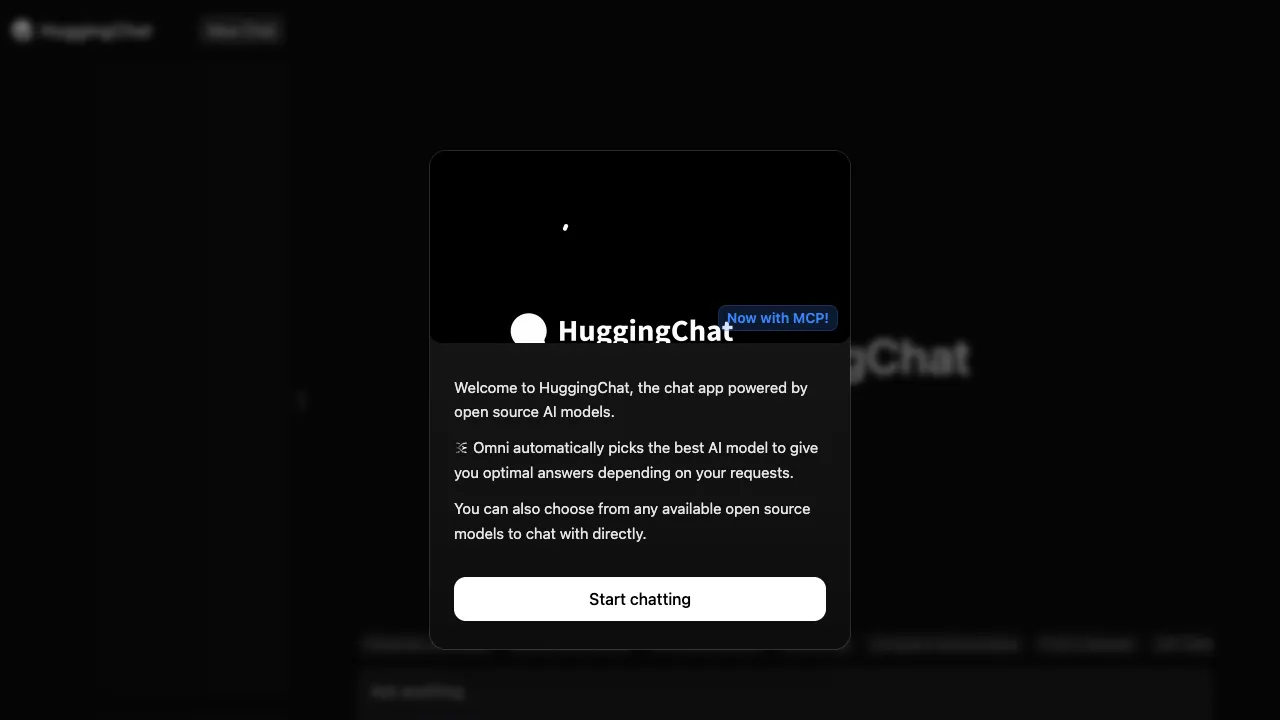
HuggingChat (huggingface.co/chat) is Hugging Face’s official free AI dialogue platform, allowing you to freely switch conversations between multiple top-tier open-source large language models—without deployment, API keys, or payment. It also serves as an exhibit of the open-source spirit: the platform’s code itself is open source (the chat-ui project), allowing anyone to fork it and build their own version.
The best analogy for understanding it? A test drive for open-source models. Commercial models have their own showrooms (ChatGPT, Claude.ai); this is the public showroom for open-source models.
Core Features
Free Switching Between Multiple Models
This is the flagship feature. The available model lineup rotates continuously with developments in the open-source community, butPersistent (permanent) options include:
- Meta Llama series: The flagship of the open-source universe and the benchmark for comprehensive capabilities.
- Mistral/Mixtral: French newcomers known for balancing efficiency and quality.
- Qwen (Tongyi Qianwen): Alibaba’s open-source offering, representing the top tier of open-source Chinese language capabilities.
- DeepSeek series: A phenomenal domestic open-source player with stunning reasoning and coding abilities.
- Plus various newly released star models—when a hit emerges in the open-source circle, it is typically listed here first.
Throwing the same question at three models to compare their answers is a unique joy and value here: the personality differences between models (who is verbose, who is rigorous, who is good at Chinese) are visibly apparent. This intuitive comparison is worth more than reading ten review articles.
Complete Dialogue Capabilities
Multi-turn dialogue, context memory, writing, coding, translation, reasoning—the standard capabilities of mainstream conversational AI are all present. The actual performance of top-tier open-source models is now sufficient for most daily use cases; the old impression that "open source = toy" needs updating.
Web Search
You can enable web search to allow the model to answer based on real-time information, compensating for the shortcoming of open-source models’ knowledge cutoff dates.
Custom Assistants and System Prompts
Supports setting System Prompts and creating custom assistants (a lightweight version similar to GPTs). For learners and developers of prompt engineering, this is a free multi-model testing ground—the performance differences of the same prompt across different models directly impact application selection.
Tool Calling and Multimodality
Capabilities such as tool use and image understanding are being added progressively with version updates, expanding the functional boundaries alongside the capabilities of open-source models.
Comparison with Alternatives
vs ChatGPT/Claude: The comprehensive capabilities of top-tier closed-source models (especially stability in complex reasoning and long-form writing) still lead, but the gap is narrowing. HuggingChat’s cards are total freedom from cost and model diversity. What you use as your daily main tool depends on personal preference, but this is the "ceiling of the free universe."
vs Poe: Poe aggregates both closed-source and open-source models with a polished experience, but accessing good models requires a subscription. HuggingChat is purely open-source and purely free, with a more focused positioning.
vs Local Deployment (Ollama, etc.): Running models locally offers the best privacy and complete offline capability, but it demands hardware (decent models require decent GPUs) and involves setup costs. HuggingChat is a zero-configuration cloud solution. For those who want to "try before they buy" (buying a GPU), trying models here first before deciding which to deploy locally is the standard path.
vs Official Demos of Individual Open-Source Models: The experience across individual model official spaces is fragmented. HuggingChat aggregates them into a single interface, unifying the experience.
vs Domestic Free Assistants (Kimi, Doubao, etc.): Domestic products offer smoother access, deeper Chinese optimization, and comprehensive features, making them more convenient for daily use by domestic users. HuggingChat’s value lies in the dimensions of "open source" and "multi-model," which domestic assistants do not provide.
Who is HuggingChat For?
AI Enthusiasts and Observers: If you want to personally feel the progress of the grand drama of "open-source catching up to closed-source," this is the front line—whenever a new open-source hit is released, coming here for a chat tells you its true quality.
Developers and Prompt Engineers: For selecting open-source models for applications and testing cross-model prompt performance, there is no more convenient free testing ground than this.
Users with Zero Budget: Students and light users who want unlimited AI dialogue without spending money will find the model quality here to be among the top tier of free options.
Pre-researchers for Local Deployment: Individuals and teams planning to build their own AI services should first conduct a horizontal evaluation of candidate models here before deciding which to download—saving time on repeated deployments.
Open-Source Community Participants: The chat-ui open-source code itself is high-quality base material for building your own dialogue interface.
Limitations
Accessing Hugging Face from within China faces network obstacles, with speed and stability affected by the network environment—this is the most realistic barrier for domestic users.
During peak times for popular models, you may face queues or throttling due to the resource realities of free services. The model list rotates frequently; a model you find convenient might be removed or replaced one day, making it less stable than commercial products.
Open-source models vary greatly in capability. Choosing the wrong model and concluding "open source doesn't work" is a common misjudgment—it is recommended to start by experiencing recognized strongholds like Llama, Qwen, and DeepSeek.
Pricing
Completely free, with no usage caps. Registering for a Hugging Face account allows you to save history and use full features.
Perhaps the greatest significance of HuggingChat is that it gives the slogan "AI democratization" anEntry Point (entry point) you can touch with your hands: the strongest open-source intelligence, free of charge, accessible to everyone, ready when you open the webpage. Next time someone says "good AI requires payment," send them this link.