

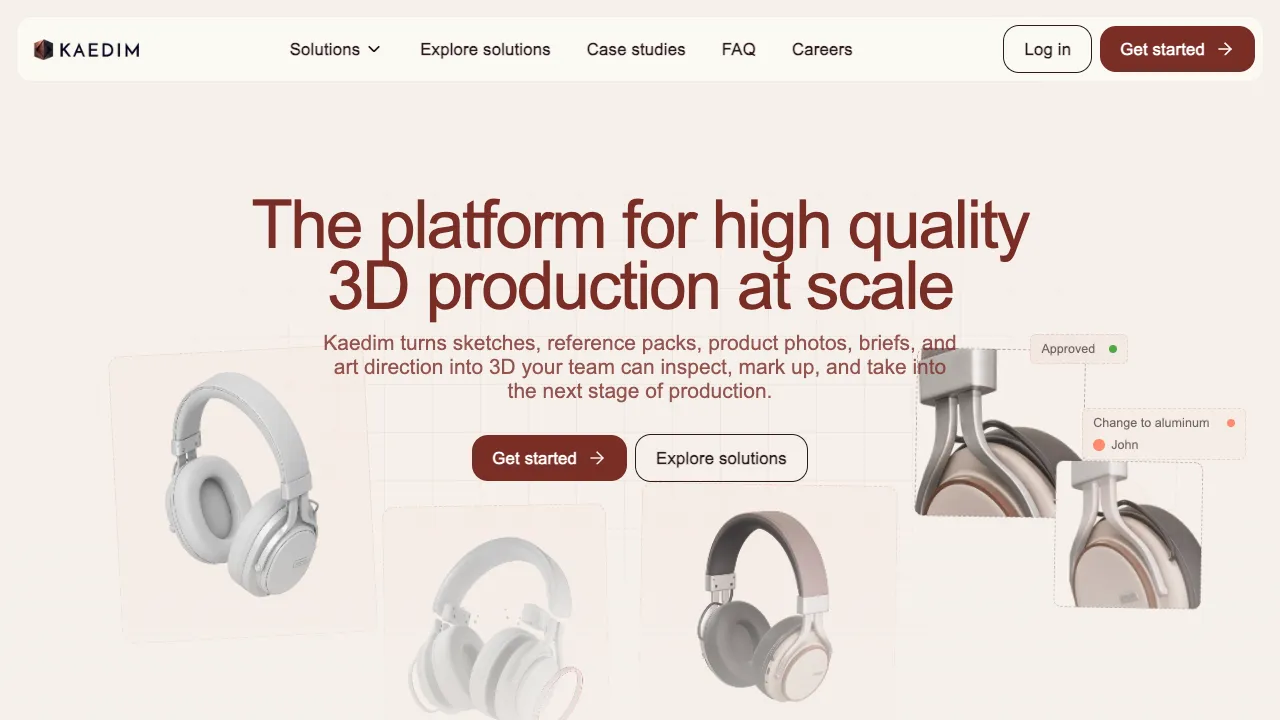
The positioning has moved upmarket. Kaedim now describes itself as a platform for high-quality 3D production at scale for studios and brands, rather than a self-serve one-click model generator — inputs are sketches, reference packs, product photos, briefs and art direction, and the output is 3D your team can inspect, mark up and take into the next stage of production. The pain it targets is that 3D always starts too late: the brief is locked and the campaign is moving while 3D waits on bandwidth, vendors or an already-buried artist.
For a long time, 3D modeling has been a process with high technical barriers and significant time costs—even experienced game artists need to go through sketching, UV unwrapping, normal baking, and texturing to complete the full pipeline before obtaining usable assets. KAEDIM attempts to compress this workflow significantly using AI: upload an image, and within minutes, you receive a textured 3D model ready for direct import into game engines.
What is KAEDIM?
KAEDIM is an AI-driven 3D model generation tool. Its core workflow involves the user uploading a concept art or reference image; KAEDIM’s AI analyzes the structural forms in the image to generate a corresponding low-poly 3D mesh, while simultaneously producing matching texture maps. The final output is a 3D asset ready for use in tools like Unity, Unreal Engine, and Blender.
KAEDIM targets game development teams, particularly those needing to rapidly iterate on concept assets or produce large volumes of environmental props. Its primary value proposition is “compressing the time required to turn concept art into game-ready 3D assets from hours down to minutes.”
Core Workflow
Image Input → 3D Model Output
The basic usage process is straightforward:
- Upload a reference image (concept art, sketches, photos, or AI-generated images are all acceptable).
- KAEDIM processes the image, and its AI generates the 3D mesh model.
- The system simultaneously generates texture maps (Albedo, Normal Map, etc.).
- Download the resulting 3D model file (supporting formats like FBX, OBJ, etc.).
The entire process typically completes within minutes, with speed being one of KAEDIM’s core selling points.
Low-Poly Output (Game-Ready)
Models generated by KAEDIM are primarily low-poly, which is an advantage in game development—game engines require controlled polygon counts to ensure performance. These low-poly assets can be used directly without manual decimation.
In contrast, some other 3D generation tools output models with very high polygon counts (resembling scan reconstruction). While visually detailed, they are not suitable for direct use in real-time rendered games and require post-processing before they can be utilized.
Human-in-the-Loop Refinement
KAEDIM offers human-assisted services in certain subscription tiers. If the AI-generated model has significant issues, KAEDIM’s team of 3D artists will intervene to correct them, ensuring the delivered model meets usability standards. This “AI + manual quality assurance” hybrid service model is more reliable for quality control than pure AI generation, but it also positions KAEDIM more as a service than a purely automated tool.
Batch Processing Capabilities
Through its API or batch upload features, KAEDIM can process multiple images simultaneously to generate 3D assets in bulk. For game projects requiring large quantities of similar props (various rocks, wooden crates, plants), batch processing significantly boosts content production efficiency.
Suitable Projects
Small-to-Medium Game Studios: Teams without large dedicated 3D art staff can use KAEDIM to rapidly produce assets for the concept validation phase, allowing designers and programmers to have materials to work with rather than waiting for modelers’ schedules.
Rapid Level Design Prototyping: Level designers need numerous props to fill spaces during the design phase. KAEDIM can quickly generate placeholder 3D assets tailored to the level’s style, which can later be replaced with polished versions.
Indie Game Development: For indie developers working alone or in small teams, art resources are often the biggest bottleneck. KAEDIM helps non-art-background developers quickly acquire usable 3D assets. While the quality may not match professional artists, it allows projects to keep moving forward.
Concept Validation and Demos: When you need to produce a game demo for investors or publishers in a short timeframe, KAEDIM can rapidly generate sufficient quantities of 3D assets to make the demo appear content-rich.
Comparison with Competitors
vs Meshy AI: Meshy also converts images/text to 3D and targets individual creators and game developers. Meshy offers a more user-friendly interface, supports text input, and iterates features rapidly; KAEDIM leans more toward enterprises and teams, offering a service layer with human assistance. While their functionalities overlap significantly, the actual quality difference must be compared on specific tasks.
vs Tripo3D: Tripo3D excels in speed, and its generated texture quality is competitive. KAEDIM’s differentiation lies in providing manual quality assurance services, which adds value for teams seeking reliable quality without having to judge output themselves.
vs 3DFY AI: 3DFY AI emphasizes enterprise-grade batch production and API integration, targeting larger-scale content production needs; KAEDIM functions more as a productivity tool for game development teams, with a more vertical focus.
vs Traditional Workflows (Blender/Maya + Substance): The complete manual modeling and texturing pipeline can take 4–16 hours for a single prop-level asset. KAEDIM’s “minutes vs. hours” comparison represents its most direct value proposition. Of course, manual production offers more precise quality control; for assets requiring extremely high fidelity, traditional workflows remain irreplaceable.
Pricing and Access
This is a paid platform aimed at studios and brands, entered through Get started and login, with no tiers or amounts published publicly — products positioned this way generally quote through sales, so pricing comes from the vendor directly.
What is verifiable on the product side is how it works: inputs are sketches, reference packs, product photos, briefs and art direction, and the output is 3D that a team can inspect, mark up and move into the next production stage, with the site's case pages showing a review workflow including approval markers.
Limitations and Honest Assessment
Limited Object Categories: KAEDIM generates high-quality models for regular geometric shapes (boxes, barrels, furniture, architectural components); quality declines for organic forms (characters, animals) or highly complex structures. It is best to test the asset types common in your project beforehand.
Outputs Are Not Always Ready-to-Use: Despite human assistance, some generated results still require fine-tuning in game engines or modeling software to achieve ideal effects. View it as a tool for “rapidly producing first drafts” rather than a “one-click magic wand”; managing expectations will be more accurate.
Limited Texture Precision: The detail richness of AI-generated textures is limited. For assets requiring extremely fine textures (e.g., main character equipment, key props), artists still need to hand-craft or significantly modify the AI-generated textures.
Dependence on Input Image Quality: Clear, well-angled, and representative reference images yield better 3D models. If the input concept art has sketchy lines or poor angles, the AI’s interpretation may deviate from expectations, requiring multiple adjustments.
KAEDIM represents a product philosophy of “AI-ifying professional processes”—not completely replacing 3D artists, but accelerating standardized, time-consuming parts with AI, allowing teams to focus their energy on areas truly requiring creativity and professional judgment. For game teams with 3D asset needs but limited art resources, it is worth seriously evaluating whether it can integrate into your existing workflow.