
After ChatGPT emerged, a large number of developers wanted to integrate LLM capabilities into their own products: enabling AI to search their databases, call external APIs, retain context across multi-turn conversations, and complete complex tasks according to fixed workflows. However, implementing these requirements by directly calling LLM APIs involves handling many tedious infrastructure issues. LangChain is the framework born to solve this problem.
What is LangChain?
LangChain is an open-source framework for building large language model (LLM) applications, created by Harrison Chase at the end of 2022. It rapidly became one of the most popular LLM development frameworks during the ChatGPT boom, with its GitHub Star count growing at a record-breaking pace at the time.
Its core value lies in abstraction and encapsulation: it wraps common operations when interacting with LLMs (prompt template management, conversation history, tool calling, document retrieval, Agent workflows) into reusable components. Developers do not need to implement these underlying logics from scratch; they can quickly build LLM applications by assembling LangChain’s components like building blocks.
Core Components
Chains
A "Chain" is a foundational concept in LangChain—linking a series of operations into a workflow. The simplest Chain is a single LLM call: template → fill variables → send to LLM → return result. More complex Chains can include multi-step LLM calls, tool calling, conditional logic, and more.
For example, a resume analysis Chain: receive resume text → extract key information (education background, work experience) → score based on job requirements → generate a report. The entire process can be linked together via a Chain and called as a whole.
Retrieval Augmented Generation (RAG)
RAG is one of LangChain’s most important application scenarios: enabling LLMs to "retrieve from their own document library" to answer questions, solving the issues of LLM training data cutoff dates and "lack of knowledge about private data."
LangChain provides a complete RAG toolchain: document loaders (reading PDFs, Word docs, web pages, etc.), text splitters, vector database integrations (Chroma, Pinecone, Weaviate, etc.), and RetrievalChain to integrate retrieval with LLM responses.
Agents
Agents are a more advanced pattern in LangChain: giving an LLM a set of "tools" (search engines, calculators, code execution, API calls, etc.) and letting the LLM decide which tool to use when to complete a task.
This transforms the LLM from "only able to answer questions" to "able to execute tasks"—given a goal, it plans steps, calls tools, continues executing based on results, until the goal is achieved.
Memory
Manages conversation history, allowing the LLM to "remember" what was discussed previously, ensuring contextual coherence in multi-turn conversations. LangChain offers various memory strategies: saving full history, retaining only the most recent N turns, compressing history using LLM summaries, etc.
Prompt Templates
Tools for managing prompts, supporting variable filling, structured prompts, and Few-shot example management, making prompt engineering more systematic.
Supported Languages
LangChain primarily has two versions:
- Python version (langchain): The most comprehensive in features and richest in ecosystem; the preferred choice for data science and AI application domains.
- JavaScript/TypeScript version (langchain.js): Features synchronized with the Python version, suitable for frontend and Node.js projects.
Comparison with Other Frameworks
vs LlamaIndex: LlamaIndex focuses more on RAG and knowledge base Q&A scenarios, with deeper optimizations in document indexing and retrieval; LangChain covers a broader range, including Agents and various tool calls. While there is some overlap, their focuses differ, and many projects use both.
vs Direct API Calls: Calling OpenAI or other LLM APIs directly is more straightforward, without the abstraction layer of a framework; LangChain’s value lies in reducing repetitive code when handling common complex scenarios (RAG, Agents, multi-step workflows). For simple single LLM calls, calling the API directly is more concise.
vs AutoGen (Microsoft): AutoGen focuses on multi-Agent collaboration scenarios, where multiple AI roles communicate to complete tasks; LangChain has a broader scope and also includes Agent functionality but is less specialized in multi-Agent collaboration than AutoGen.
vs Haystack: Haystack is also an LLM application framework with accumulated expertise in RAG and NLP pipelines; however, its overall visibility and community size are smaller than LangChain’s.
Who Should Use LangChain?
Engineers wanting to add AI capabilities to their products: With Python or JS backgrounds, needing to quickly implement LLM application features, LangChain’s rich components can significantly reduce development time.
Building enterprise knowledge base Q&A systems: RAG is currently the most mainstream form of internal enterprise AI applications; LangChain’s RAG toolchain is one of the most mature reference implementations.
Experimenting and exploring LLM application possibilities: For rapid prototyping and validating ideas, LangChain’s abstraction layer lets you focus on business logic rather than underlying details.
Projects needing to support multiple LLMs: Using OpenAI today and wanting to switch to Anthropic or local models tomorrow—LangChain’s unified interface makes switching costs very low.
Limitations
Points of criticism from some developers regarding LangChain include: excessive abstraction leading to debugging difficulties, documentation updates failing to keep pace with code iterations, and the framework’s own complexity sometimes being greater than the problems it solves.
For simple LLM applications, calling the API directly may be more concise; LangChain’s value becomes more apparent in projects of medium to high complexity.
Pricing
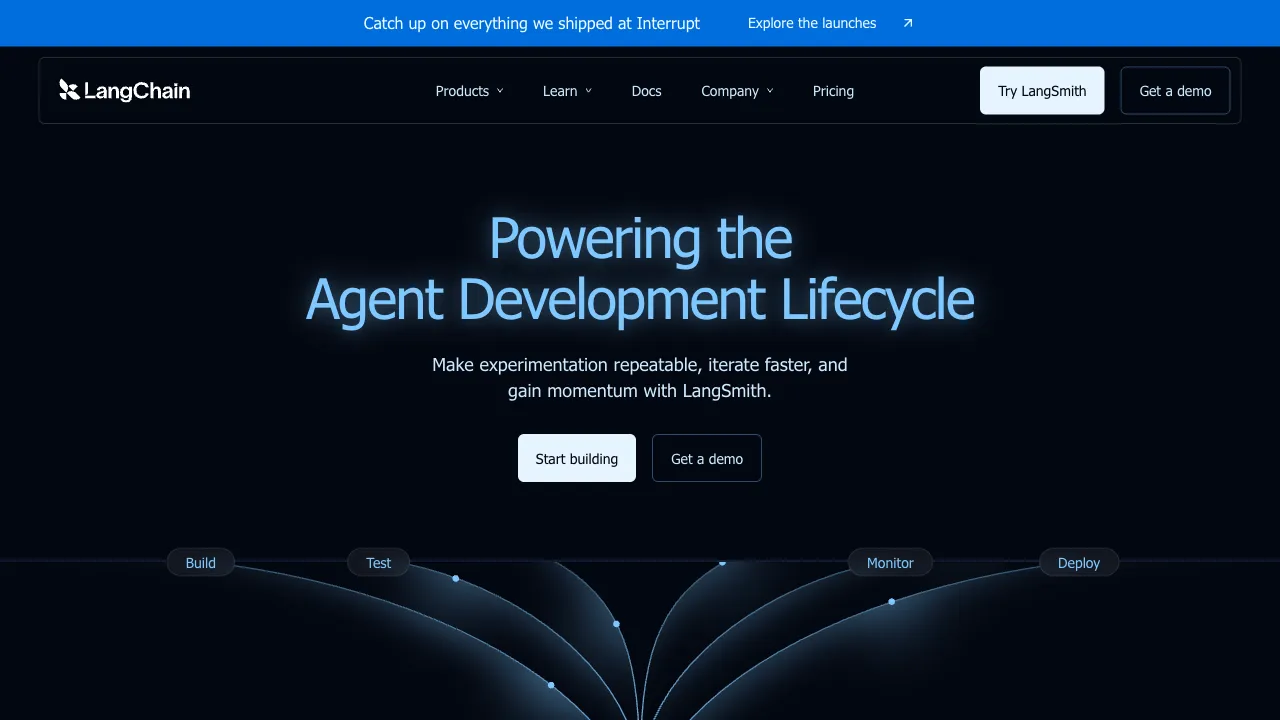
The LangChain framework itself is open-source and free (MIT license). The company also offers commercial products such as LangSmith, an LLM application monitoring and debugging platform, and LangGraph for complex agent workflows. Costs associated with calling LLMs depend on the provider you choose; LangChain itself does not charge fees.
LangChain is one of the most important tools in the LLM application development ecosystem. Understanding its design philosophy and usage patterns is a crucial step toward entering the field of LLM application development.